José María de Teresa and César Magén have led a study that has succeeded in fabricating and investigating three-dimensional cobalt magnetic nanotubes measuring just a few nanometres in size, a breakthrough that opens up new possibilities for exploring magnetism in 3D structures and developing future technologies based on nanomagnetism.
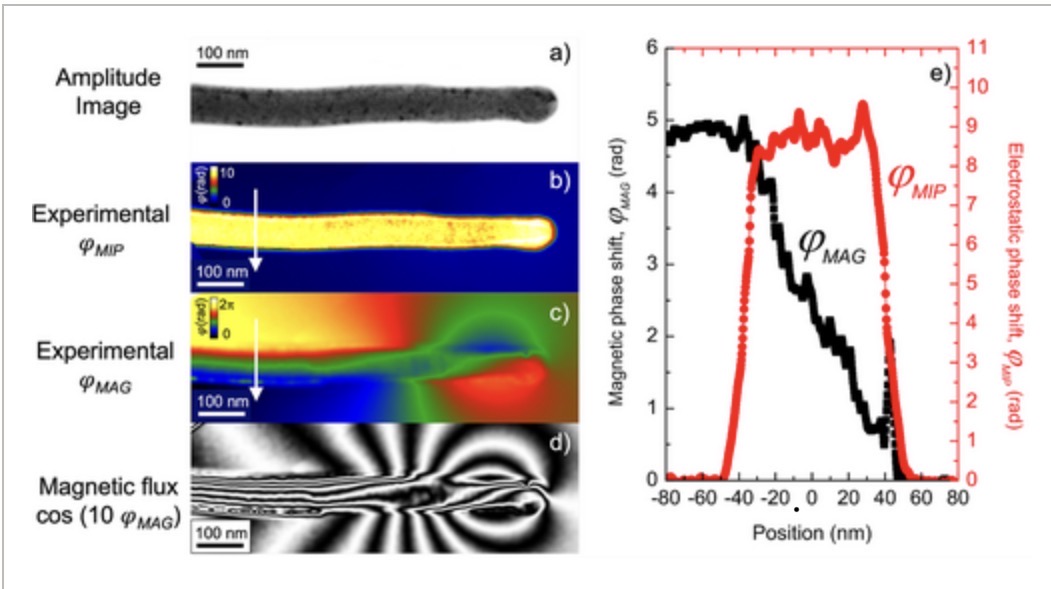
For the first time, the team has managed to fabricate these nanotubes at the nanoscale using a single technique, focused electron beam induced deposition (FEBID). Furthermore, by means of advanced electron microscopy techniques, the researchers were able to directly observe within the nanotubes a magnetic domain wall with a vortex structure, which was subsequently confirmed through simulations.
These structures are of particular interest because their three-dimensional, curved geometry can give rise to novel magnetic behaviours with potential applications in future spintronic devices and information storage and processing technologies.
The study has been published in the journal Small.
Vortex domain wall imaging in a 3D magnetic nanotube grown by focused electron beam induced deposition
DOI: https://doi.org/10.1002/smll.75693
Nano-Micro Small
First published: 16 September 2026
Javier Pablo-Navarro, Luis Alfredo Rodríguez, Christophe Gatel, Ingrid Marie Andersen, Étienne Snoeck, José Maria De Teresa, César Magén
Abstract: Theoretical predictions present the magnetic nanotube (MNT) as an ideal physical implementation for 3D spintronic devices due to the unique magnetization dynamics, with stable and fast domain wall (DW) motion beyond the Walker limit, given by its coreless curved topology. However, due to this heterogeneous architecture and the need to combine different synthetic methods, experimental realizations of nanometer-size MNTs are scarce and technically complex. Here, we report for the first time the fabrication of nanometer-scale 3D Co MNTs, synthesized by a single growth technique, namely focused electron beam induced deposition (FEBID), and thermally annealed in vacuum. Quantitative magnetic imaging of the remanent state and DW structure of a 10-nm-thick cylindrical Co nanotube grown on a 70-nm-wide vertical Pt–C nanowire template, carried out by off-axis electron holography in an aberration-corrected Lorentz (field-free) transmission electron microscope, reveals the nucleation and pinning of a head-to-head tilted vortex DW, whose structure has been confirmed by detailed micromagnetic simulations. The direct experimental evidence of such spin configuration stabilized in MNTs opens new venues for the investigation of curvature-driven spin textures and new technologies based on 3D nanomagnets.