The CSIC Research Professor at the INMA (CSIC–University of Zaragoza) received the Juan de la Cierva National Research Award in Vitoria-Gasteiz last Tuesday 27th Oct. 2026, which recognises his career in knowledge transfer and his contribution to the development of technologies with biomedical applications.
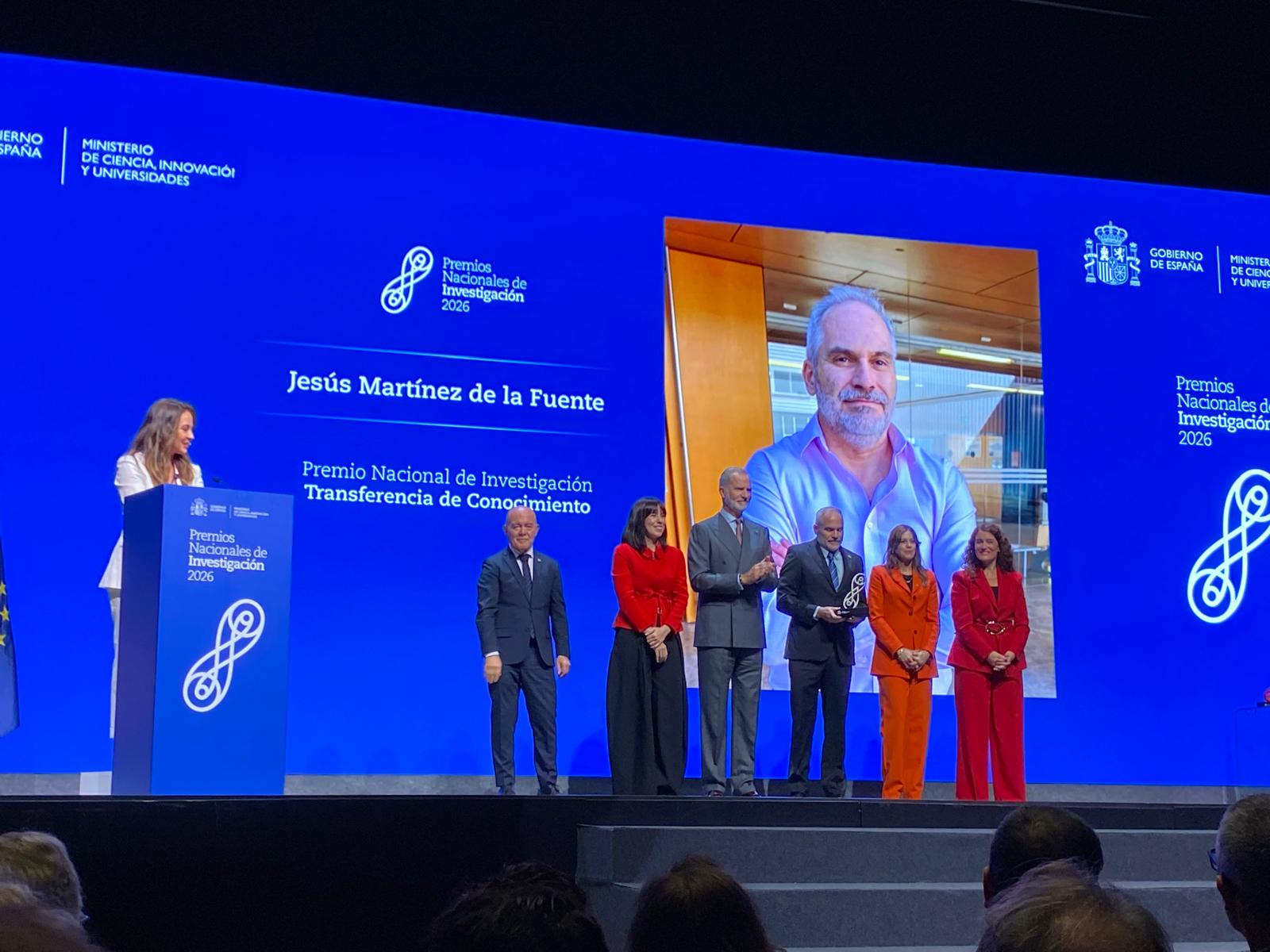
Zaragoza/Vitoria-Gasteiz, 27 October. Jesús Martínez de la Fuente, Research Professor at the Spanish National Research Council (CSIC) at the Aragon Nanoscience and Materials Institute (INMA, CSIC–University of Zaragoza), received the Juan de la Cierva National Research Award this Tuesday. The ceremony took place in Vitoria-Gasteiz, where King Felipe VI presided over the presentation of the most prestigious awards granted annually by the Ministry of Science, Innovation and Universities. Also attending the event were the CSIC Institutional Delegate in Aragón, María Jesús Lázaro, together with Teresa Sierra and Alodia Orerarepresenting the INMA management team.
The award recognises Martínez de la Fuente’s outstanding career in the field of nanobiotechnology. Specifically, it acknowledges his achievements in the area of Knowledge Transfer, having successfully met the challenging objective of transforming scientific research outcomes into technologies with potential applications in the biomedical and business sectors.
“It is a great honour to have received this award because it recognises all the work and effort invested over the years, but also a philosophy of research development that we have always championed. We must strive to ensure that what is developed in our laboratories reaches the market, either through the creation of our own companies or through collaboration with technology-based enterprises,” says Martínez de la Fuente.
Nanotechnology with healthcare applications
Jesús Martínez de la Fuente’s career has been closely linked to the development of nanomaterials for biomedical applications. His research focuses on the design of nanoparticles capable of interacting selectively with biological systems, with the aim of developing new tools for the diagnosis and treatment of diseases such as cancer.
At the INMA (CSIC–University of Zaragoza), he leads the Biofunctionalisation of Nanoparticles and Surfaces (BIONANOSURF) research group, which promotes the development of technologies related to biomolecule detection, the design of highly sensitive biosensors, and new strategies for targeted drug delivery to specific cells.
Among the most significant outcomes of this research is the development of ultra-sensitive biosensors based on metallic nanoparticles, and new therapies based on the use of magnetic nanoparticles and enzymes.
This example illustrates one of the defining features of his career: the search for pathways that allow scientific knowledge to move beyond publications and experimental results, advancing towards adoption by companies and, ultimately, applications that benefit society.
A career linked to research and technology transfer in Aragon
Jesús Martínez de la Fuente was born in Barakaldo (Bizkaia) in 1975, although he moved to Andalusia at an early age. He holds a degree in Chemistry from the University of Córdoba and a PhD from the University of Seville. Following a period of research at the University of Glasgow, he developed his scientific career in Zaragoza. In 2007, he moved to Aragón through the ARAID Foundation, and in 2014 he obtained a permanent research scientist position at the CSIC.
His previous distinctions include the Aragón Investiga Award in the Young Researchers category, granted by the Government of Aragón in 2010, as well as his appointment to the Young Academy of Spain.
The Juan de la Cierva National Research Award specifically recognises this ability to connect knowledge generation with innovation and productive industry.
For the Aragon Nanoscience and Materials Institute, a joint centre of the CSIC and the University of Zaragoza, accredited as a Severo Ochoa Centre of Excellence, this recognition highlights the importance of promoting high-quality, scientifically rigorous research that not only expands the frontiers of knowledge but is also capable of generating new opportunities for innovation and technology transfer.
28-10-2026