Instituto de Nanociencia y Materiales de Aragón
  • EspañolEspañol
Intranet
  • THE INSTITUTE
    • General information
      • Welcome
      • History of the Institute
      • Organizational chart
      • Departments
        • Department 1: Functional organic materials
        • Department 2: Materials for energy and environment
        • Department 3: Physics of materials and nanosystems
        • Department 4: Bio-nano-medicine
        • Department 5: Multifunctional magnetic materials
      • Scientific Committee
      • Annual Reports
      • Welcome Handbook
      • Associations
    • Directory
    • Location and contact
  • RESEARCH
    • Research Areas
      • Area 1: Materials for energy
        and environment (MEM)
      • Area 2: Materials for biomedicine (BIO)
      • Area 3: Materials for information
        technology (MTI)
      • Area 4: New phenomena at the
        nanoscale (NFN)
      • Area 5: Synthesis, processing and scaling
        of advanced functional materials (SPE)
      • Area 6: Singular experimental
        technologies (TES)
    • Research Groups
    • Scientific publications
    • International projects
    • INMA scientific infrastructure
    • Microdevices Engineering Technical Unit (UTIM)
      • Structure UTIM
      • Catalog UTIM
      • Capabilities UTIM
      • Applications UTIM
    • INMA large scientific facilities
    • Scientific-Technical Services available at the institute
  • TRAINING
    • Master NANOMAT
    • Degree studies
    • Master studies
    • PhD studies
    • Internships
    • Scholarships and grants
    • Course of introduction to laboratory safety -SegurINMA
    • Research career path in Spain
  • JOB OFFERS
  • DISSEMINATION
    • Activities
      • General public
      • Schools and institutes
      • Special events
        • Researchers’ Night
        • Woman and science
        • Semana de la Ciencia
          Valle de Benasque
      • Cátedra SAMCA de Nanotecnología (EN)
      • LMA
    • Projects
    • Advising and training
    • Awards and distinctions
    • Multimedia
  • TRANSFER
    • Technological offer
      • Patents
      • Capabilities for industry
    • Transferred technology
    • Spin-offs
  • EQUALITY
    • Protocols and prevention against harassment
Instituto de Nanociencia y Materiales de Aragón
No Result
View All Result

Home » Switching cells on with magnets: a drug-free way to speed up tissue repair

Switching cells on with magnets: a drug-free way to speed up tissue repair

by INMAweb
22/10/2026
in Highlight
0
Activar células con imanes: una vía sin fármacos para acelerar la reparación de tejidos

We are glad to share a new research, published in Advanced Functional Materials! 🚀

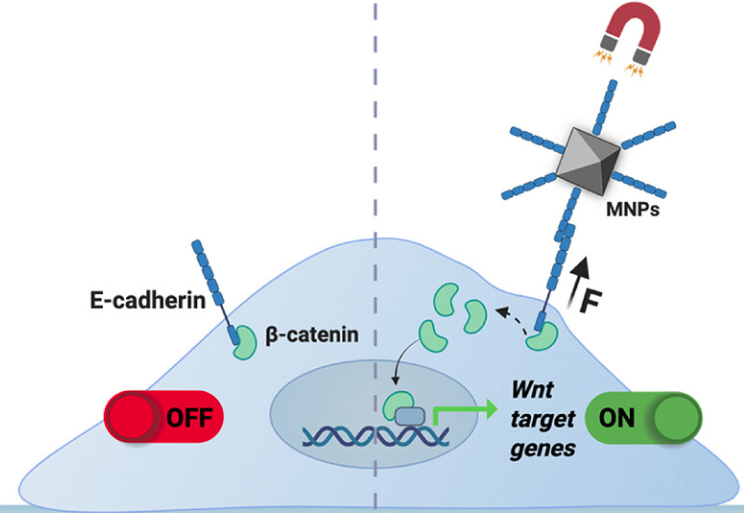
How can we remotely trigger cell signaling and accelerate cell proliferation without using drugs? In our study, “Remote activation of Wnt signaling and cell proliferation by E-cadherin magnetomechanical stimulation”, we introduce a novel magnetogenetic strategy to remotely tune the Wnt/ β-catenin pathway using magnetic nanoparticles and low-intensity magnetic fields.

💡 The challenge: The Wnt/ β-catenin pathway is a crucial master regulator of cell proliferation and tissue repair. However, conventional chemical approaches lack spatiotemporal control and often trigger off-target effects.

🧲 Our solution
We functionalized magnetic nanoparticles (MNPs) with the full extracellular domain of E-cadherin to selectively bind cellular E-cadherin molecules on epithelial cells. Exposing the labeled cells to a weak, dynamic magnetic field (~33 mT) generates localized forces directly on E-cadherin! This gentle mechanical force induces β-catenin release from the membrane complex, activating Wnt target genes, translating into enhanced cell proliferation and significantly accelerated epithelial gap closure without adverse cytotoxic effects.

🌟 Why it matters: Unlike previous designs, this platform provides a purely mechanical and targeted input, offering a non-invasive and highly adaptable strategy for probing mechanobiology and guiding targeted regenerative therapies.

Congratulations to all the team, but especially to Christian Castro Hinojosa, how has worked really hard to publish this work, a major milestone of our ERC Starting Grant project SIROCCO!


Remote activation of Wnt signaling and cell proliferation by e-cadherin magnetomechanical stimulation

DOI: 10.1002/adfm.78964D

Advanced Functional Materials, 2026; 0:e78964; 15th Oct. 2026

Christian Castro-Hinojosa, Pablo Martínez-Vicente, Lucía G. Recaredo, Susel Del Sol-Fernández, Pilar Gomollón-Zueco, Yilian Fernández-Afonso, Raluca M. Fratila, María Moros

Abstract:
The ability to remotely and precisely manipulate intracellular signaling pathways is crucial for fundamental research and therapeutics. The Wnt/β-catenin cascade regulates cell proliferation, differentiation, and tissue regeneration, but current pharmacological activation methods lack spatiotemporal control and induce off-target effects. Here, we introduce a pioneering magnetogenetic toolkit to modulate the Wnt/β-catenin pathway through magnetomechanical stimulation of E-cadherin, a key cell adhesion molecule intimately linked to β-catenin dynamics. Magnetic nanoparticles functionalized with the extracellular domain of E-cadherin (MNPs@E/EC15) selectively bind cellular E-cadherins. Applying a low-intensity, low-gradient magnetic field via a custom stimulator generates localized mechanical forces that trigger E-cadherin mechanotransduction. This stimulation induces β-catenin membrane release, nuclear translocation, and Wnt target gene activation, confirmed by transcriptomic profiling and a luciferase reporter assay. These molecular changes translate into enhanced cell proliferation and accelerated gap closure. This work establishes an innovative, non-invasive tool for probing E-cadherin mechanobiology and remotely modulating Wnt/β-catenin signaling. Unlike other mechanotransduction tools, this approach enables simultaneous, high-spatiotemporal modulation of multiple cells using low-intensity magnetic fields adaptable for in vivo designs. Our findings open promising avenues for studying mechanotransduction and developing targeted regenerative therapies based on mechanical stimulation.

Previous Post

The INMA is participating in international research on catalyst design using advanced electron microscopy techniques

Últimas noticias destacadas

  • Lucía Gutiérrez, selected as an IEEE Magnetics Society Distinguished Lecturer for 2027-2028.
  • Jesús Martínez de la Fuente receives the Juan de la Cierva National Research Award for his outstanding career in knowledge transfer in the field of nanobiotechnology
  • María José Martínez, CSIC scientist at INMA, receives the National Research Award

Últimas publicaciones científicas destacadas

  • Switching cells on with magnets: a drug-free way to speed up tissue repair
  • The INMA is participating in international research on catalyst design using advanced electron microscopy techniques
  • A 3D magnetic nanotube enables the observation of new magnetic structures at the nanoscale

Últimas novedades

  • A Marie Curie fellow advances research into new intelligent materials capable of self-organisation at the nanoscale
  • INMA Data Management Unit, recognised by the CSIC Management Awards
  • A portable device will enable soil analysis to optimise nutrient applications

Últimas noticias de divulgación

  • Nanocrític@s among the outreach projects highlighted by FECYT
  • INMA participates in the 4th Conference on Advanced Materials in Spain (AMatS 2025)
  • NanoAsalto and Conrado Rillo, awarded by IPFest 2025

Bienvenida

  • Dr Anton Stasyuk
  • Dr Olga Stasyuk
  • Dr Mónica Marro

    Campus San Francisco, Facultad de Ciencias
    C/ Pedro Cerbuna, 12 – 50009 Zaragoza (España)

    Tel.:(+34) 876 55 33 22
    webmasterinma@unizar.es

    INSTITUTO DE NANOCIENCIA Y MATERIALES DE ARAGÓN, Copyright © 2022 INMA, CSIC-UZ | Aviso Legal | Política de cookies  | webmasterinma@unizar.es

    No Result
    View All Result
    • THE INSTITUTE
      • General information
        • Welcome
        • History of the Institute
        • Organizational chart
        • Departments
        • Scientific Committee
        • Annual Reports
        • Welcome Handbook
        • Associations
      • Directory
      • Location and contact
    • RESEARCH
      • Research Areas
        • Area 1: Materials for energy
          and environment (MEM)
        • Area 2: Materials for biomedicine (BIO)
        • Area 3: Materials for information
          technology (MTI)
        • Area 4: New phenomena at the
          nanoscale (NFN)
        • Area 5: Synthesis, processing and scaling
          of advanced functional materials (SPE)
        • Area 6: Singular experimental
          technologies (TES)
      • Research Groups
      • Scientific publications
      • International projects
      • INMA scientific infrastructure
      • Microdevices Engineering Technical Unit (UTIM)
        • Structure UTIM
        • Catalog UTIM
        • Capabilities UTIM
        • Applications UTIM
      • INMA large scientific facilities
      • Scientific-Technical Services available at the institute
    • TRAINING
      • Master NANOMAT
      • Degree studies
      • Master studies
      • PhD studies
      • Internships
      • Scholarships and grants
      • Course of introduction to laboratory safety -SegurINMA
      • Research career path in Spain
    • JOB OFFERS
    • DISSEMINATION
      • Activities
        • General public
        • Schools and institutes
        • Special events
        • Cátedra SAMCA de Nanotecnología (EN)
        • LMA
      • Projects
      • Advising and training
      • Awards and distinctions
      • Multimedia
    • TRANSFER
      • Technological offer
        • Patents
        • Capabilities for industry
      • Transferred technology
      • Spin-offs
    • EQUALITY
      • Protocols and prevention against harassment

    © 2026 JNews - Premium WordPress news & magazine theme by Jegtheme.

    Este sitio web utiliza cookies para que usted tenga la mejor experiencia de usuario. Si continúa navegando está dando su consentimiento para la aceptación de las mencionadas cookies y la aceptación de nuestra política de cookies

    ACEPTAR
    Aviso de cookies