Instituto de Nanociencia y Materiales de Aragón
  • EspañolEspañol
Intranet
  • THE INSTITUTE
    • General information
      • Welcome
      • History of the Institute
      • Organizational chart
      • Departments
        • Department 1: Functional organic materials
        • Department 2: Materials for energy and environment
        • Department 3: Physics of materials and nanosystems
        • Department 4: Bio-nano-medicine
        • Department 5: Multifunctional magnetic materials
      • Scientific Committee
      • Annual Reports
      • Welcome Handbook
      • Associations
    • Directory
    • Location and contact
  • RESEARCH
    • Research Areas
      • Area 1: Materials for energy
        and environment (MEM)
      • Area 2: Materials for biomedicine (BIO)
      • Area 3: Materials for information
        technology (MTI)
      • Area 4: New phenomena at the
        nanoscale (NFN)
      • Area 5: Synthesis, processing and scaling
        of advanced functional materials (SPE)
      • Area 6: Singular experimental
        technologies (TES)
    • Research Groups
    • Scientific publications
    • International projects
    • INMA scientific infrastructure
    • Microdevices Engineering Technical Unit (UTIM)
      • Structure UTIM
      • Catalog UTIM
      • Capabilities UTIM
      • Applications UTIM
    • INMA large scientific facilities
    • Scientific-Technical Services available at the institute
  • TRAINING
    • Master NANOMAT
    • Degree studies
    • Master studies
    • PhD studies
    • Internships
    • Scholarships and grants
    • Course of introduction to laboratory safety -SegurINMA
    • Research career path in Spain
  • JOB OFFERS
  • DISSEMINATION
    • Activities
      • General public
      • Schools and institutes
      • Special events
        • Researchers’ Night
        • Woman and science
        • Semana de la Ciencia
          Valle de Benasque
      • Cátedra SAMCA de Nanotecnología (EN)
      • LMA
    • Projects
    • Advising and training
    • Awards and distinctions
    • Multimedia
  • TRANSFER
    • Technological offer
      • Patents
      • Capabilities for industry
    • Transferred technology
    • Spin-offs
  • EQUALITY
    • Protocols and prevention against harassment
Instituto de Nanociencia y Materiales de Aragón
No Result
View All Result

Home » Neuromorphic impedance signatures and oxygen-related interfacial dynamics in Pt/YBCO memristive junctions

Neuromorphic impedance signatures and oxygen-related interfacial dynamics in Pt/YBCO memristive junctions

by INMAweb
28/10/2026
in Highlight
0
Neuromorphic impedance signatures and oxygen-related interfacial dynamics in Pt/YBCO memristive junctions

Screenshot

DOI: 10.1021/acsaelm.6c01363

ACS Appl. Electron. Mater. 2026, 8, 9006−9019, cover, 25th Sep. 2026

Esteban A. Rodríguez, Hannu Huhtinen, Petriina Paturi, Myriam H. Aguirre, and Carlos Acha


Abstract

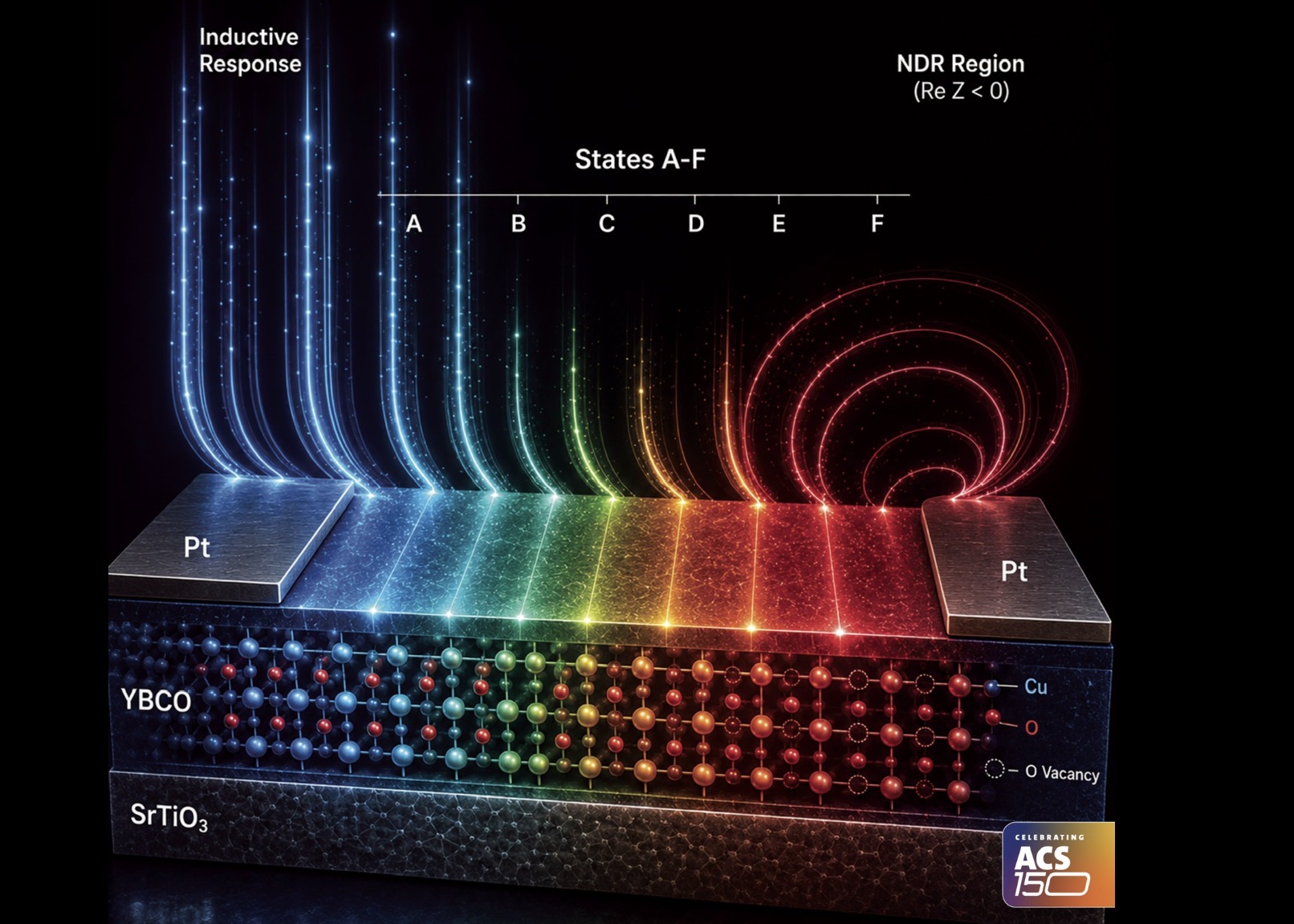
Memristive junctions based on high-temperature superconducting cuprates are promising building blocks for oxide-based neuromorphic electronics; however, the small-signal dynamics underlying their state-dependent behavior remain largely unexplored. Here, we use zero-bias impedance spectroscopy (IS) to probe memristive Pt/YBa2Cu3O7–δ (YBCO) junctions programmed into a series of nonvolatile resistive states along and beyond the resistive hysteresis switching loop (RHSL). Over the full temperature range (80–300 K) and for every state, the response is well captured by equivalent-circuit models built from two interfacial blocks, consistent with the two-interface picture of bipolar resistive switching. The low-resistance state requires an interfacial element with a negative-resistance branch, in which a negative differential resistance (NDR) is limited by a slow internal variable acting as a chemical inductance; intermediate states are described by two parallel-RC relaxations whose parameters evolve consistently with a progressive depletion of the interfacial oxygen content. Upon further programming toward high resistance, the most resistive states develop a qualitatively distinct signature, with the Bode phase dropping below –90° as the negative-resistance branch becomes dominant. We interpret this crossover as compatible with two regimes of the coupled ionic–electronic dynamics: a slow response set by the scarcity of oxygen vacancies and a faster one enabled by their abundance. Cross-sectional scanning transmission electron microscopy of an electrically overstressed junction reveals a crystalline-to-amorphous degradation pathway that bounds the structural changes compatible with the milder switching explored here. These results are consistent with field-driven oxygen redistribution at the Pt/YBCO interface acting as the control parameter of both the accessible resistance states and the emergence of impedance responses with a negative-conductance band, and they identify the small-signal spectroscopic fingerprint of a FitzHugh–Nagumo (FHN)-like circuit topology in a complex-oxide memristive junction.


Cover

Previous Post

Jesús Martínez de la Fuente receives the National Research Award for bringing from the laboratory to the market

Últimas noticias destacadas

  • Jesús Martínez de la Fuente receives the National Research Award for bringing from the laboratory to the market
  • Lucía Gutiérrez, selected as an IEEE Magnetics Society Distinguished Lecturer for 2027-2028.
  • Jesús Martínez de la Fuente receives the Juan de la Cierva National Research Award for his outstanding career in knowledge transfer in the field of nanobiotechnology

Últimas publicaciones científicas destacadas

  • Neuromorphic impedance signatures and oxygen-related interfacial dynamics in Pt/YBCO memristive junctions
  • Switching cells on with magnets: a drug-free way to speed up tissue repair
  • The INMA is participating in international research on catalyst design using advanced electron microscopy techniques

Últimas novedades

  • A Marie Curie fellow advances research into new intelligent materials capable of self-organisation at the nanoscale
  • INMA Data Management Unit, recognised by the CSIC Management Awards
  • A portable device will enable soil analysis to optimise nutrient applications

Últimas noticias de divulgación

  • Nanocrític@s among the outreach projects highlighted by FECYT
  • INMA participates in the 4th Conference on Advanced Materials in Spain (AMatS 2025)
  • NanoAsalto and Conrado Rillo, awarded by IPFest 2025

Bienvenida

  • Dr Anton Stasyuk
  • Dr Olga Stasyuk
  • Dr Mónica Marro

    Campus San Francisco, Facultad de Ciencias
    C/ Pedro Cerbuna, 12 – 50009 Zaragoza (España)

    Tel.:(+34) 876 55 33 22
    webmasterinma@unizar.es

    INSTITUTO DE NANOCIENCIA Y MATERIALES DE ARAGÓN, Copyright © 2022 INMA, CSIC-UZ | Aviso Legal | Política de cookies  | webmasterinma@unizar.es

    No Result
    View All Result
    • THE INSTITUTE
      • General information
        • Welcome
        • History of the Institute
        • Organizational chart
        • Departments
        • Scientific Committee
        • Annual Reports
        • Welcome Handbook
        • Associations
      • Directory
      • Location and contact
    • RESEARCH
      • Research Areas
        • Area 1: Materials for energy
          and environment (MEM)
        • Area 2: Materials for biomedicine (BIO)
        • Area 3: Materials for information
          technology (MTI)
        • Area 4: New phenomena at the
          nanoscale (NFN)
        • Area 5: Synthesis, processing and scaling
          of advanced functional materials (SPE)
        • Area 6: Singular experimental
          technologies (TES)
      • Research Groups
      • Scientific publications
      • International projects
      • INMA scientific infrastructure
      • Microdevices Engineering Technical Unit (UTIM)
        • Structure UTIM
        • Catalog UTIM
        • Capabilities UTIM
        • Applications UTIM
      • INMA large scientific facilities
      • Scientific-Technical Services available at the institute
    • TRAINING
      • Master NANOMAT
      • Degree studies
      • Master studies
      • PhD studies
      • Internships
      • Scholarships and grants
      • Course of introduction to laboratory safety -SegurINMA
      • Research career path in Spain
    • JOB OFFERS
    • DISSEMINATION
      • Activities
        • General public
        • Schools and institutes
        • Special events
        • Cátedra SAMCA de Nanotecnología (EN)
        • LMA
      • Projects
      • Advising and training
      • Awards and distinctions
      • Multimedia
    • TRANSFER
      • Technological offer
        • Patents
        • Capabilities for industry
      • Transferred technology
      • Spin-offs
    • EQUALITY
      • Protocols and prevention against harassment

    © 2026 JNews - Premium WordPress news & magazine theme by Jegtheme.

    Este sitio web utiliza cookies para que usted tenga la mejor experiencia de usuario. Si continúa navegando está dando su consentimiento para la aceptación de las mencionadas cookies y la aceptación de nuestra política de cookies

    ACEPTAR
    Aviso de cookies