

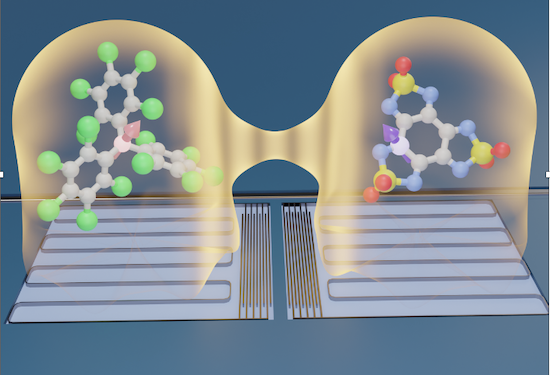
The study, whose results have been published in the journal PRX Quantum, involved collaboration with researchers from the Centre for Astrobiology in Madrid (CSIC-INTA), the Institute of Materials Science of Barcelona (CSIC), and the Jagiellonian University in Kraków, Poland
The findings establish a technological foundation for the development of new hybrid quantum processors
Magnetic molecules wired up by a superconducting circuit
Magnetic molecules are attractive building blocks for quantum computation and quantum simulation as they’re microscopic, like atoms, yet also tuneable, like circuits albeit by different means provided by Chemistry. There is however no established technology able to ‘wire up’ molecular spin qubits into a scalable, thus potentially useful, architecture. This work introduces a novel hybrid platform that helps overcoming this major bottleneck. A superconducting circuit mediates and detects coherent interactions between distant molecular spin ‘polaritons’, hybrid states that combine spin and photonic components. Besides, these communication channels enable engineering remote correlations between spins and microwave photons and exploiting them to read out one polariton state via changes in a distant one. Its modular character and inherent flexibility enable interconnecting diverse spin systems, with distinct functionalities, thus it provides a promising basis for developing scalable, molecular based, quantum processors.
Polariton-polariton coherent coupling in a molecular spin-superconductor chip
Carolina del Río, Marcos Rubín-Osanz, David Rodriguez, Sebastián Roca-Jerat, María Carmen Pallarés, J. Alejandro de Sousa, Paweł Pakulski, José Luis García Palacios, Daniel Granados, Dawid Pinkowicz, Núria Crivillers, Anabel Lostao, David Zueco, Alicia Gomez and Fernando Luis
PRX Quantum – Accepted 2 October, 2026
DOI: https://doi.org/10.1103/xvjl-h44h
Abstract:
The ability to establish coherent communication channels is key for scaling up quantum devices. Here, we engineer interactions between distant polaritons, hybrid spin-photon excitations formed at different lumped-element superconducting resonators within a chip. The chip consists of several resonator pairs, slightly detuned in frequency to make them addressable, capacitively coupled within each pair and inductively coupled to a common readout line. They interact locally with samples of PTMr and Tripak−organic free radicals, deposited onto their inductors, which provide model 𝑆=1/2, 𝑔≃2 spin ensembles. Frequency-dependent microwave transmission experiments, performed at very low temperatures, measure polariton frequencies as a function of magnetic field in different scenarios. When only one resonator within a pair hosts a molecular sample, the results evidence that spins couple remotely to the empty LER as well as to the local cavity mode. If both resonators interact with a spin ensemble, the magnetic field tunes the polariton frequencies relative to each other, on account of the different spin-photon interactions at each LER. When polaritons are brought into mutual resonance, the microwave transmission spectroscopically resolves an avoided level crossing that evidences a polariton-polariton interaction mediated by the circuit. Then, pump-probe experiments reveal that the excitation of a polariton within a connected pair is indeed felt, thus it can be read out, by the other one. Model calculations, compatible with the experimental parameters and results, suggest that the system excitation eigenstates show photon-photon and spin-spin correlations and entanglement near the polariton-polariton anticrossing.


