

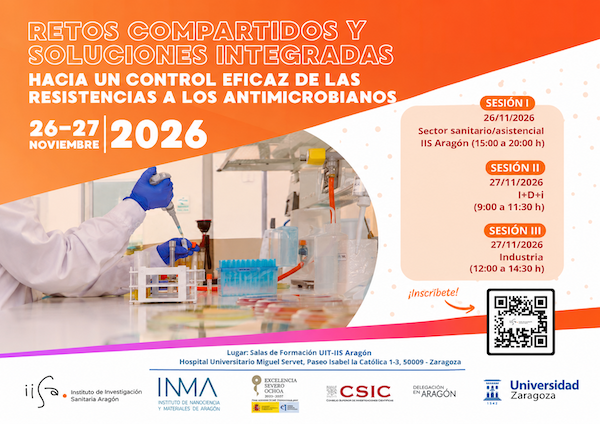
IIS Aragón and the INMA (CSIC-University of Zaragoza) are organising a conference on 26 and 27 November at Miguel Servet University Hospital to address one of the world’s greatest public health challenges through a cross-disciplinary approach
Zaragoza, 19 November 2026. Antimicrobial resistance (AMR) is the ability of microorganisms to withstand the action of medicines designed to combat them. This phenomenon threatens to turn infections that can currently be treated relatively easily into increasingly difficult health problems. The inappropriate use of these medicines and the spread of resistant microorganisms among people, animals and the environment present a global challenge that requires a coordinated and multidisciplinary response.
How can we anticipate this threat, and what contributions can be made by laboratories, healthcare institutions and industry? These are some of the questions that will be explored during the conference “Shared challenges and integrated solutions: towards effective control of antimicrobial resistance”, organised by the Aragón Health Research Institute (IIS Aragón) and the Aragon Nanoscience and Materials Institute (INMA), a joint centre of the Spanish National Research Council (CSIC) and the University of Zaragoza.
The event will take place on 26 and 27 November at Miguel Servet University Hospital in Zaragoza, and the programme has been designed around the current challenges in this field. Throughout the two days, healthcare professionals, researchers from several research institutes and representatives from industry will share their latest advances with one objective: to explore innovative solutions that can help improve the prevention and control of antimicrobial resistance.
Antimicrobial resistance occurs when microorganisms such as bacteria, viruses, fungi and parasites no longer respond to the medicines used to combat them. In the case of bacteria, this resistance can render antibiotics ineffective and make certain infections much more difficult to treat.
However, the problem is not confined to the healthcare sector. Resistant microorganisms and antimicrobial resistance genes can be transferred between people, animals and ecosystems, meaning that addressing this issue requires coordinated action across different sectors. The United Nations has warned that by 2050 antimicrobial resistance (AMR) could cause 10 million or more deaths annually worldwide, making it one of the leading causes of mortality, with figures comparable to those of cancer.
This is the basis of the One Health approach, which recognises the close interconnection between human health, animal health and the environment and forms the central theme of the conference.
From public health to nanomedicine: two perspectives on the same challenge
The conference will feature two plenary lectures offering complementary perspectives on the issue.
The first will be delivered by Ane Laburu, an environmental health scientist involved in coordinating the European initiative EU-JAMRAI at the Spanish Agency of Medicines and Medical Devices (AEMPS). Her presentation will explore how to integrate the environmental dimension into antimicrobial resistance control policies and strategies in Spain and across Europe.
The second keynote lecture will be given by Ana González, from the CSIC AMR Connection, who will examine the potential of nanomedicine to tackle antimicrobial resistance and open new avenues for research.
Hospitals present their challenges: diagnosis, treatment and prevention
The first day, Thursday 26 November, will be devoted to the healthcare and clinical sector. Participants include Aitziber Lanza, Director General of Public Health of the Government of Aragón, who will present the region’s One Health strategy for tackling antimicrobial resistance.
Specialists from Miguel Servet University Hospital and Lozano Blesa Clinical University Hospital will discuss some of the challenges faced by healthcare professionals in their daily practice. Juan Manuel García-Lechuz, from the Clinical Microbiology Department at Miguel Servet, will outline clinical needs and opportunities for improvement, while Julia Origüen, an Infectious Diseases specialist at the Clinical Hospital, will address the consequences of overdiagnosing urinary tract infections in older people and its relationship with multidrug resistance.
The programme will also examine the potential of photodynamic therapy to combat dermatological infections, presented by dermatologist Manuel Almenara; the role of microbiologists in antimicrobial stewardship programmes, presented by Cristina Seral; and the importance of genetic analysis of Mycobacterium tuberculosis in monitoring antimicrobial resistance, presented by researcher Sofía Samper.
New materials and therapies: solutions being explored by research
On Friday 27 November, research and innovation will take centre stage in a session coordinated by the Aragon Nanoscience and Materials Institute (INMA), where various scientific strategies for preventing and combating infections will be presented. Researchers from the institute will demonstrate how materials science, chemistry and nanomedicine can contribute to the development of new tools against resistant microorganisms.
Luis Oriol (University of Zaragoza), from the CLIP group, will present innovative strategies for bacterial detection and the development of antibacterial therapies. Rafael Martín (University of Zaragoza), from the AMBER group, will discuss the potential of antimicrobial hybrid materials for surface treatment. Meanwhile, Guillermo Landa, from the AMiB group, will explain the development of smart materials and preclinical models for investigating new therapeutic approaches.
The session will also highlight the scientific facilities and capabilities that make progress in this field possible. Claudia Guerrero (CSIC), Head of Microbiology at the INMA BIO Support Laboratory, a facility established through the Severo Ochoa Excellence Programme, will present the scientific and technical services available to support antimicrobial resistance research. Likewise, Carmen Lafoz, from the Microbiological Analysis Service of the University of Zaragoza, will discuss the role of BSL-2 and BSL-3 biosafety facilities, while Cristina Yus, from IIS Aragón, will explain the institute’s capabilities for the preclinical evaluation of new strategies against infections.
Industry plays a key role
The final session, dedicated to industry, will focus on how scientific knowledge can be transformed into solutions that reach society. Among the speakers is Carlos Martín, Professor of Microbiology at the University of Zaragoza and associated with Biofabri, who will discuss the development of MTBVAC, an innovative tuberculosis vaccine, and the challenge of taking this breakthrough from the laboratory to industrial development, as well as the importance of vaccines in preventing the emergence of antimicrobial resistance.
The event will also feature companies including Operon, BioClonal, Laboratorios Argenol, ZEULAB, INGEOBRAS and Grupo Jorge, which will share experiences related to diagnostics, the development of antimicrobial products, food safety, water management and the prevention of antimicrobial resistance.
Practical information
Conference: Shared challenges and integrated solutions: towards effective control of antimicrobial resistance.
Dates: 26 and 27 November 2026.
Thursday 26 November: 3:00 pm to 8:00 pm. Healthcare and clinical sector.
Friday 27 November: 9:00 am to 11:30 am. Research, development and innovation.
Friday 27 November: 12:00 pm to 2:30 pm. Industrial sector.
Venue: Training rooms of the UIS-IIS Aragón, Miguel Servet University Hospital, Paseo Isabel la Católica 1-3, Zaragoza.
Organised by: Aragon Nanoscience and Materials Institute (INMA, CSIC-University of Zaragoza) and Aragón Health Research Institute (IIS Aragón).
Programme and announcing poster
19-11-2026


