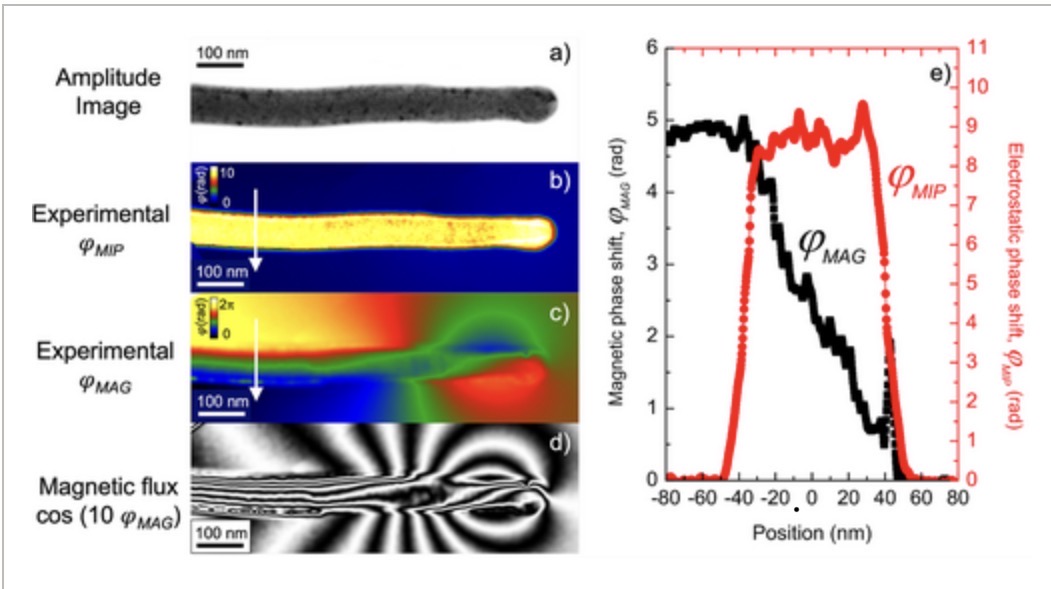
José María de Teresa y César Magén han liderado un trabajo que ha logrado fabricar y estudiar nanotubos magnéticos tridimensionales de cobalto de apenas unos nanómetros, un avance que abre nuevas posibilidades para investigar el magnetismo en estructuras 3D y desarrollar futuras tecnologías basadas en nanomagnetismo. El equipo ha conseguido, por primera vez, fabricar estos nanotubos a escala nanométrica mediante una única técnica, la deposición inducida por haz de electrones focalizado (FEBID). Además, utilizando técnicas avanzadas de microscopía electrónica, ha podido observar directamente en su interior una pared de dominio magnético con estructura de vórtice, confirmada posteriormente mediante simulaciones. Estas estructuras son especialmente interesantes porque su geometría tridimensional y curvada puede dar lugar a nuevos comportamientos magnéticos con potencial para futuras aplicaciones en dispositivos espintrónicos y tecnologías de almacenamiento y procesamiento de información. El trabajo se ha publicado en la revista Small.
Vortex domain wall imaging in a 3D magnetic nanotube grown by focused electron beam induced deposition
DOI: https://doi.org/10.1002/smll.75693
Nano-Micro Small
First published: 16 September 2026
Javier Pablo-Navarro, Luis Alfredo Rodríguez, Christophe Gatel, Ingrid Marie Andersen, Étienne Snoeck, José Maria De Teresa, César Magén
Abstract: Theoretical predictions present the magnetic nanotube (MNT) as an ideal physical implementation for 3D spintronic devices due to the unique magnetization dynamics, with stable and fast domain wall (DW) motion beyond the Walker limit, given by its coreless curved topology. However, due to this heterogeneous architecture and the need to combine different synthetic methods, experimental realizations of nanometer-size MNTs are scarce and technically complex. Here, we report for the first time the fabrication of nanometer-scale 3D Co MNTs, synthesized by a single growth technique, namely focused electron beam induced deposition (FEBID), and thermally annealed in vacuum. Quantitative magnetic imaging of the remanent state and DW structure of a 10-nm-thick cylindrical Co nanotube grown on a 70-nm-wide vertical Pt–C nanowire template, carried out by off-axis electron holography in an aberration-corrected Lorentz (field-free) transmission electron microscope, reveals the nucleation and pinning of a head-to-head tilted vortex DW, whose structure has been confirmed by detailed micromagnetic simulations. The direct experimental evidence of such spin configuration stabilized in MNTs opens new venues for the investigation of curvature-driven spin textures and new technologies based on 3D nanomagnets.