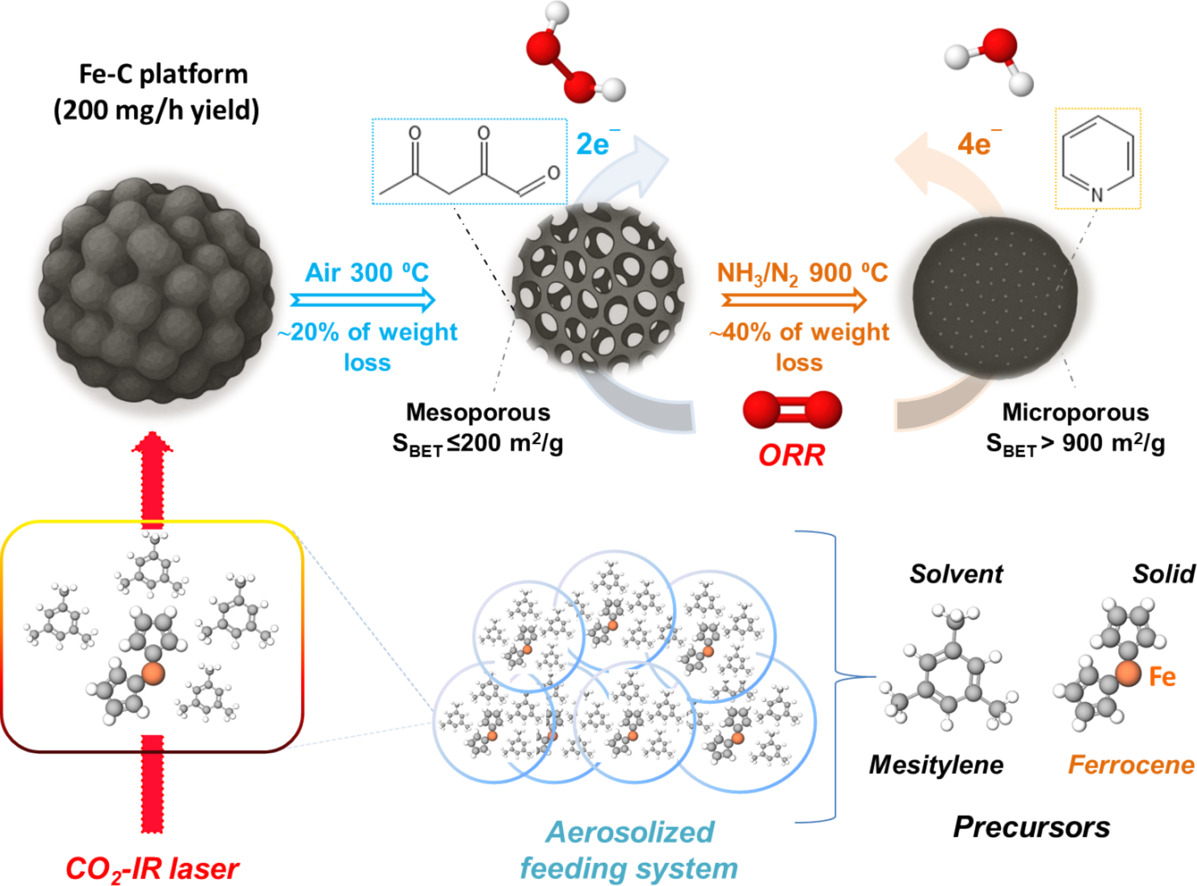
A team of researchers from INMA (CSIC-UNIZAR), together with the Institute of Carbon Science and Technology (ICB-CSIC), has developed iron-carbon (Fe-C) nanostructures using laser technology that are capable of promoting two different pathways of the same reaction: oxygen reduction.
Why is this important? Because, depending on how the material is treated, it can be tailored towards two very different applications:
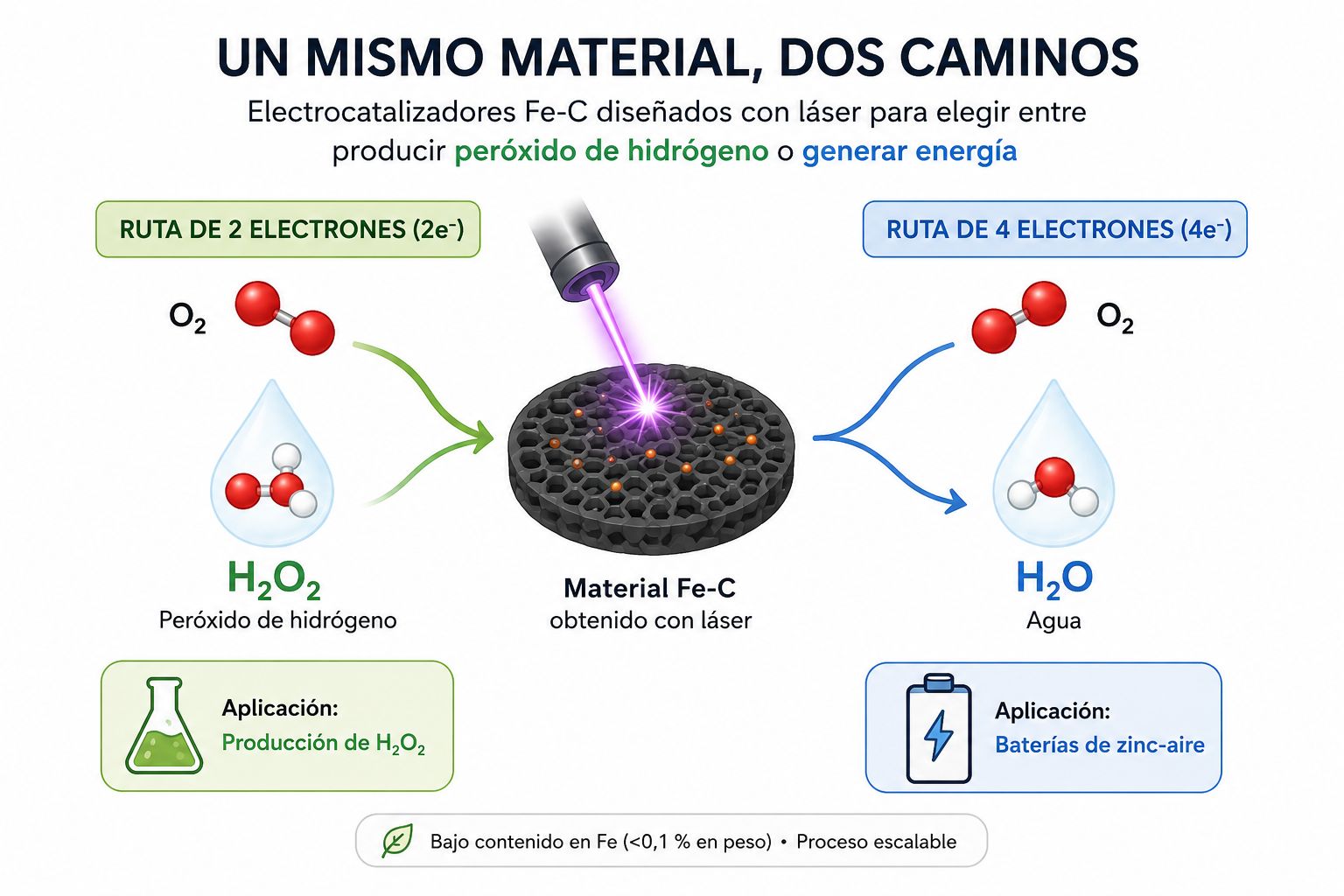
🧪 The 2-electron (2e⁻) pathway favours the production of hydrogen peroxide (H₂O₂). The optimised catalyst achieved a Faradaic efficiency of 94% after 24 hours of electrolysis.
🔋 The 4-electron (4e⁻) pathway favours the formation of water and enables the material to be used as a catalyst in zinc-air batteries, where it demonstrated power output and stability comparable to those of a benchmark platinum-based catalyst.
The research therefore shows that it is possible to fine-tune a single material to direct a chemical reaction towards the desired outcome, while using extremely small amounts of iron, less than 0.1 wt%, and a process with strong potential for scale-up.
The work has been published in the Chemical Engineering Journal (CEJ) and is authored by Ekaterina Pakrieva, Javier Hernández-Ferrer, Ana Rueda-Flores, Francisco Balas, Enrique García-Bordeje, Alejandro Ansón-Casaos, Oleg Usoltsev, Ana M. Benito, Wolfgang K. Maser and José L. Hueso.
👉 Research that brings together nanomaterials, chemistry and energy to advance more efficient electrochemical processes and technologies.
Tuning 2e− and 4e− oxygen reduction pathways in laser-driven Fe-C electrocatalysts for H2O2 production and Zn–air batteries
DOI: 10.1016/j.cej.2026.180589
Ekaterina Pakrieva, Javier Hernández-Ferrer, Ana Rueda-Flores, Francisco Balas, Enrique García-Bordeje, Alejandro Ansón-Casaos, Oleg Usoltsev, Ana M. Benito, Wolfgang K. Maser and José L. Hueso
Chemical Engineering Journal 546 (2026) 180589, 12th Aug. 2026
Abstract:
Electrocatalytic oxygen reduction plays a central role in electrochemical energy technologies and in the production of hydrogen peroxide. Achieving selective control over the two-electron (2e−) and four-electron (4e−) oxygen reduction reaction (ORR) pathways within a single catalyst platform remains challenging. Here, we report a laser-driven synthesis of Fesingle bondC nanostructures that enables tunable ORR selectivity through controlled post-treatment. Air annealing at 300 °C yields high H2O2 selectivity (~75% at 0.65 V vs RHE), attributed to oxygen-rich groups and well-developed mesoporosity. Notably, with an optimized 2-electron catalyst, 80 ppm of H2O2 with 94% faradaic efficiency was achieved after 24 h of electrolysis. In contrast, an ammonia based (NH3/N2) treatment at 900 °C promotes the formation of a microporous structure and the incorporation of nitrogen species, resulting in selective water production (~86% at 0.65 V vs RHE). The 4-electron catalyst delivers power and stability comparable to Pt/GC in a primary zinc–air battery. These findings demonstrate a practical approach for tuning ORR selectivity within a Fe-containing carbon-based platform, using scalable processing and trace Fe contents (<0.1 wt%) with Fe present as atomically dispersed sites, limiting leaching and Fenton-type reactions.