Instituto de Nanociencia y Materiales de Aragón
  • EspañolEspañol
Intranet
  • THE INSTITUTE
    • General information
      • Welcome
      • History of the Institute
      • Organizational chart
      • Departments
        • Department 1: Functional organic materials
        • Department 2: Materials for energy and environment
        • Department 3: Physics of materials and nanosystems
        • Department 4: Bio-nano-medicine
        • Department 5: Multifunctional magnetic materials
      • Scientific Committee
      • Annual Reports
      • Welcome Handbook
      • Associations
    • Directory
    • Location and contact
  • RESEARCH
    • Research Areas
      • Area 1: Materials for energy
        and environment (MEM)
      • Area 2: Materials for biomedicine (BIO)
      • Area 3: Materials for information
        technology (MTI)
      • Area 4: New phenomena at the
        nanoscale (NFN)
      • Area 5: Synthesis, processing and scaling
        of advanced functional materials (SPE)
      • Area 6: Singular experimental
        technologies (TES)
    • Research Groups
    • Scientific publications
    • International projects
    • INMA scientific infrastructure
    • Microdevices Engineering Technical Unit (UTIM)
      • Structure UTIM
      • Catalog UTIM
      • Capabilities UTIM
      • Applications UTIM
    • INMA large scientific facilities
    • Scientific-Technical Services available at the institute
  • TRAINING
    • Master NANOMAT
    • Degree studies
    • Master studies
    • PhD studies
    • Internships
    • Scholarships and grants
    • Course of introduction to laboratory safety -SegurINMA
    • Research career path in Spain
  • JOB OFFERS
  • DISSEMINATION
    • Activities
      • General public
      • Schools and institutes
      • Special events
        • Researchers’ Night
        • Woman and science
        • Semana de la Ciencia
          Valle de Benasque
      • Cátedra SAMCA de Nanotecnología (EN)
      • LMA
    • Projects
    • Advising and training
    • Awards and distinctions
    • Multimedia
  • TRANSFER
    • Technological offer
      • Patents
      • Capabilities for industry
    • Transferred technology
    • Spin-offs
  • EQUALITY
    • Protocols and prevention against harassment
Instituto de Nanociencia y Materiales de Aragón
  • THE INSTITUTE
    • General information
      • Welcome
      • History of the Institute
      • Organizational chart
      • Departments
        • Department 1: Functional organic materials
        • Department 2: Materials for energy and environment
        • Department 3: Physics of materials and nanosystems
        • Department 4: Bio-nano-medicine
        • Department 5: Multifunctional magnetic materials
      • Scientific Committee
      • Annual Reports
      • Welcome Handbook
      • Associations
    • Directory
    • Location and contact
  • RESEARCH
    • Research Areas
      • Area 1: Materials for energy
        and environment (MEM)
      • Area 2: Materials for biomedicine (BIO)
      • Area 3: Materials for information
        technology (MTI)
      • Area 4: New phenomena at the
        nanoscale (NFN)
      • Area 5: Synthesis, processing and scaling
        of advanced functional materials (SPE)
      • Area 6: Singular experimental
        technologies (TES)
    • Research Groups
    • Scientific publications
    • International projects
    • INMA scientific infrastructure
    • Microdevices Engineering Technical Unit (UTIM)
      • Structure UTIM
      • Catalog UTIM
      • Capabilities UTIM
      • Applications UTIM
    • INMA large scientific facilities
    • Scientific-Technical Services available at the institute
  • TRAINING
    • Master NANOMAT
    • Degree studies
    • Master studies
    • PhD studies
    • Internships
    • Scholarships and grants
    • Course of introduction to laboratory safety -SegurINMA
    • Research career path in Spain
  • JOB OFFERS
  • DISSEMINATION
    • Activities
      • General public
      • Schools and institutes
      • Special events
        • Researchers’ Night
        • Woman and science
        • Semana de la Ciencia
          Valle de Benasque
      • Cátedra SAMCA de Nanotecnología (EN)
      • LMA
    • Projects
    • Advising and training
    • Awards and distinctions
    • Multimedia
  • TRANSFER
    • Technological offer
      • Patents
      • Capabilities for industry
    • Transferred technology
    • Spin-offs
  • EQUALITY
    • Protocols and prevention against harassment
Instituto de Nanociencia y Materiales de Aragón
No Result
View All Result

Home » A neural network enables the design of how light propagates at the nanometre scale

A neural network enables the design of how light propagates at the nanometre scale

by INMAweb
31/08/2026
in News
0
A neural network enables the design of how light propagates at the nanometre scale

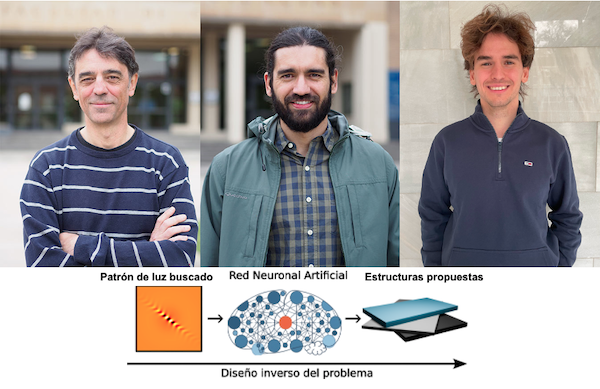
Researchers from the Quantum Nano-Optics Group at the University of Oviedo and CINN-CSIC, in collaboration with the Aragon Nanoscience and Materials Institute (INMA), CSIC-UNIZAR, and DIPC, have developed an artificial intelligence tool that starts from a desired nanolight propagation pattern and proposes structures capable of producing it, consisting of thin layers of different materials with specific thicknesses, twist angles and operating frequencies. The study, published in Nature Materials, will help advance the development of nanophotonic components, sensors and thermal management systems.


Zaragoza, 31 August 2026. Surface polaritons are hybrid light-matter waves confined close to a surface. They propagate along it with wavelengths much shorter than those of light in free space, making them a form of nanolight. In α-MoO₃, an inorganic material composed of molybdenum and oxygen, this nanolight arises from the coupling of conventional light with atomic vibrations and is known as a phonon polariton.

Controlling its direction of propagation could facilitate the development of nanophotonic components, sensors and thermal management systems. Researchers from the University of Oviedo and the Centre for Research in Nanomaterials and Nanotechnology (CINN), in collaboration with the Aragon Nanoscience and Materials Institute (INMA, a joint institute of the Spanish National Research Council, CSIC, and the University of Zaragoza) and the Donostia International Physics Center (DIPC), present in Nature Materials a tool that enables the on-demand design of nanolight propagation.

The strategy takes advantage of the possibility of exfoliating materials that generate nanolight, such as α-MoO₃, into very thin sheets and stacking them with a controlled relative orientation, much like a deck of cards placed one on top of another and rotated with respect to each other. In these structures, the direction of nanolight propagation depends on the number and type of layers, their thicknesses and twist angles, and the frequency of the incident light.

This stacking-based approach underpins the emerging field of twistronics-inspired optics, or twist optics, an area of 2D material optics that studies how optical properties change when one material layer is rotated relative to another. However, the number of possible combinations grows rapidly as additional layers are added, making it difficult to predict the resulting propagation through physical intuition alone.

Artificial intelligence makes it possible to tackle this design space with its many variables. One of the most striking aspects of this capability is that it reverses the usual procedure: rather than starting from a structure and then calculating how light will propagate through it, the network begins with the desired propagation and proposes several candidate configurations.

To achieve this, the team created a multi-branch neural network that enabled the design of trilayers from an initial bilayer, as well as novel propagation patterns in previously unexplored spectral regions and across different materials. To experimentally verify one of the network’s predictions, the researchers used near-field optical microscopy, a technique that the team has helped establish over the past decade.

“Previously, we had to explore many possibilities both theoretically and experimentally. Now we start from the desired propagation and obtain several candidate structures in a short time,” explains Lucía F. Álvarez-Tomillo, a doctoral researcher at the University of Oviedo and first author of the study.

Through calculations and simulations, the network proposed α-MoO₃ structures exhibiting bi-canalisation and tri-canalisation of nanolight, meaning they can direct it in two and three directions respectively, behaviour that had not been observed previously. It also predicted canalisation in bilayers composed of different materials, with operating frequencies ranging from the visible spectrum to the terahertz regime.

“Automation enables us to generate multiple solutions and explore highly innovative structures in record time,” says José Álvarez-Cuervo, a doctoral researcher at the University of Oviedo and co-author of the paper.

Strategic commitment to Artificial Intelligence in nanoscience and materials

At INMA, the work was led by Luis Martín Moreno, CSIC Research Professor; Sergio Gutiérrez Rodrigo, Associate Professor at the University of Zaragoza; and Pablo Antonio Calvo Barlés, a CSIC doctoral researcher.

“It is important to stress that the neural network does not replace the physical model developed previously. Rather, it learns from solutions calculated using that model. It then identifies several proposals, which are subsequently validated through simulations and, in selected cases, through experiments,” explains Luis Martín-Moreno.

The work was carried out within INMA’s ATMOS Group (Theory, Modelling and Simulation), to which the participating researchers belong.

This research also forms part of the national project “Simulation, Modelling and Artificial Intelligence for Materials Science”, funded under the 2023 Knowledge Generation Projects call, which specifically focuses on the application of new simulation, modelling and artificial intelligence tools to the study of materials.

This line of research is also part of INMA’s strategic commitment to promoting the use of Artificial Intelligence in advancing nanoscience and materials science, one of the areas the Institute is strengthening as part of its Severo Ochoa Excellence Programme.

Reference

Deep learning design of nanoscale polariton propagations in twisted van der Waals multilayers

DOI: https://doi.org/10.1038/s41563-026-02723-2

Álvarez-Tomillo, L. F., Álvarez-Cuervo, J., Calvo-Barlés, P., Rodrigo, S. G., Terán-García, E., Taragaza Martín-Luengo, A., Voronin, K. V., Nikitin, A. Y., Martín-Moreno, L. & Alonso-González, P.

Nature Materials (2026), 28 August 2026.

Abstract: Nano-optics aims to understand and control the propagation of light at the nanoscale through the excitation of surface polaritons, hybrid light-matter quasiparticles. Recently, twisted van der Waals materials have enabled unprecedented phonon-polariton propagation phenomena, such as canalisation. However, nano-optics still faces an important limitation: achieving polariton propagation on demand. Here, we combine deep neural networks with twisted polaritonic multilayers to enable on-demand design of phonon-polariton propagation. We demonstrate canalisation, bi-canalisation and tri-canalisation in twisted α-MoO₃ homostructures across previously unexplored frequencies (600 to 800 cm⁻¹). We illustrate the practical potential of our method by achieving a desired polariton propagation in an existing α-MoO₃ bilayer through the addition of an extra α-MoO₃ layer. Finally, we extend our neural networks to a variety of other materials, enabling the prediction of canalisation from the visible to the terahertz regime. Our deep-learning-based approach offers considerable potential for advancing nanophotonic applications in areas such as sensing and thermal management.


Photos: Luis Martín Moreno, Sergio Gutiérrez and Pablo Antonio Calvo Barlés.


31-08-2026
Previous Post

Computational design of a photoactive [4]catenane with cyclo[48]carbon as an electron-accepting hub

Últimas noticias destacadas

  • Jesús Martínez de la Fuente receives the Juan de la Cierva National Research Award for his outstanding career in knowledge transfer in the field of nanobiotechnology
  • María José Martínez, CSIC scientist at INMA, receives the National Research Award
  • Ultrasmall platinum nanoparticles for radiation-enhanced cancer therapy

Últimas publicaciones científicas destacadas

  • Computational design of a photoactive [4]catenane with cyclo[48]carbon as an electron-accepting hub
  • Programming of complex magnetic profiles enforced by 4D printed magnetic LCE actuators
  • Tuning 2e− and 4e− oxygen reduction pathways in laser-driven Fe-C electrocatalysts for H2O2 production and Zn–air batteries

Últimas novedades

  • A neural network enables the design of how light propagates at the nanometre scale
  • Aragon marks forty years as a leading force in the materials science that is transforming the world
  • Boost your future in nanotechnology! Applications are now open for Cátedra SAMCA de Nanotecnología scholarships for the NanoMat Master’s programme (2026–2027 academic year)

Últimas noticias de divulgación

  • INMA participates in the 4th Conference on Advanced Materials in Spain (AMatS 2025)
  • NanoAsalto and Conrado Rillo, awarded by IPFest 2025
  • Quantum film series at the Zaragoza Film Library

Bienvenida

  • Dr Anton Stasyuk
  • Dr Olga Stasyuk
  • Dr Mónica Marro

    Campus San Francisco, Facultad de Ciencias
    C/ Pedro Cerbuna, 12 – 50009 Zaragoza (España)

    Tel.:(+34) 876 55 33 22
    webmasterinma@unizar.es

    INSTITUTO DE NANOCIENCIA Y MATERIALES DE ARAGÓN, Copyright © 2022 INMA, CSIC-UZ | Aviso Legal | Política de cookies  | webmasterinma@unizar.es

    No Result
    View All Result
    • THE INSTITUTE
      • General information
        • Welcome
        • History of the Institute
        • Organizational chart
        • Departments
        • Scientific Committee
        • Annual Reports
        • Welcome Handbook
        • Associations
      • Directory
      • Location and contact
    • RESEARCH
      • Research Areas
        • Area 1: Materials for energy
          and environment (MEM)
        • Area 2: Materials for biomedicine (BIO)
        • Area 3: Materials for information
          technology (MTI)
        • Area 4: New phenomena at the
          nanoscale (NFN)
        • Area 5: Synthesis, processing and scaling
          of advanced functional materials (SPE)
        • Area 6: Singular experimental
          technologies (TES)
      • Research Groups
      • Scientific publications
      • International projects
      • INMA scientific infrastructure
      • Microdevices Engineering Technical Unit (UTIM)
        • Structure UTIM
        • Catalog UTIM
        • Capabilities UTIM
        • Applications UTIM
      • INMA large scientific facilities
      • Scientific-Technical Services available at the institute
    • TRAINING
      • Master NANOMAT
      • Degree studies
      • Master studies
      • PhD studies
      • Internships
      • Scholarships and grants
      • Course of introduction to laboratory safety -SegurINMA
      • Research career path in Spain
    • JOB OFFERS
    • DISSEMINATION
      • Activities
        • General public
        • Schools and institutes
        • Special events
        • Cátedra SAMCA de Nanotecnología (EN)
        • LMA
      • Projects
      • Advising and training
      • Awards and distinctions
      • Multimedia
    • TRANSFER
      • Technological offer
        • Patents
        • Capabilities for industry
      • Transferred technology
      • Spin-offs
    • EQUALITY
      • Protocols and prevention against harassment

    © 2026 JNews - Premium WordPress news & magazine theme by Jegtheme.

    Este sitio web utiliza cookies para que usted tenga la mejor experiencia de usuario. Si continúa navegando está dando su consentimiento para la aceptación de las mencionadas cookies y la aceptación de nuestra política de cookies

    ACEPTAR
    Aviso de cookies