The physicist from Huesca is the first researcher from Aragon to receive this distinction, in recognition of her scientific independence and her original contributions to the field of magnetism, particularly nanometre-scale superconductivity
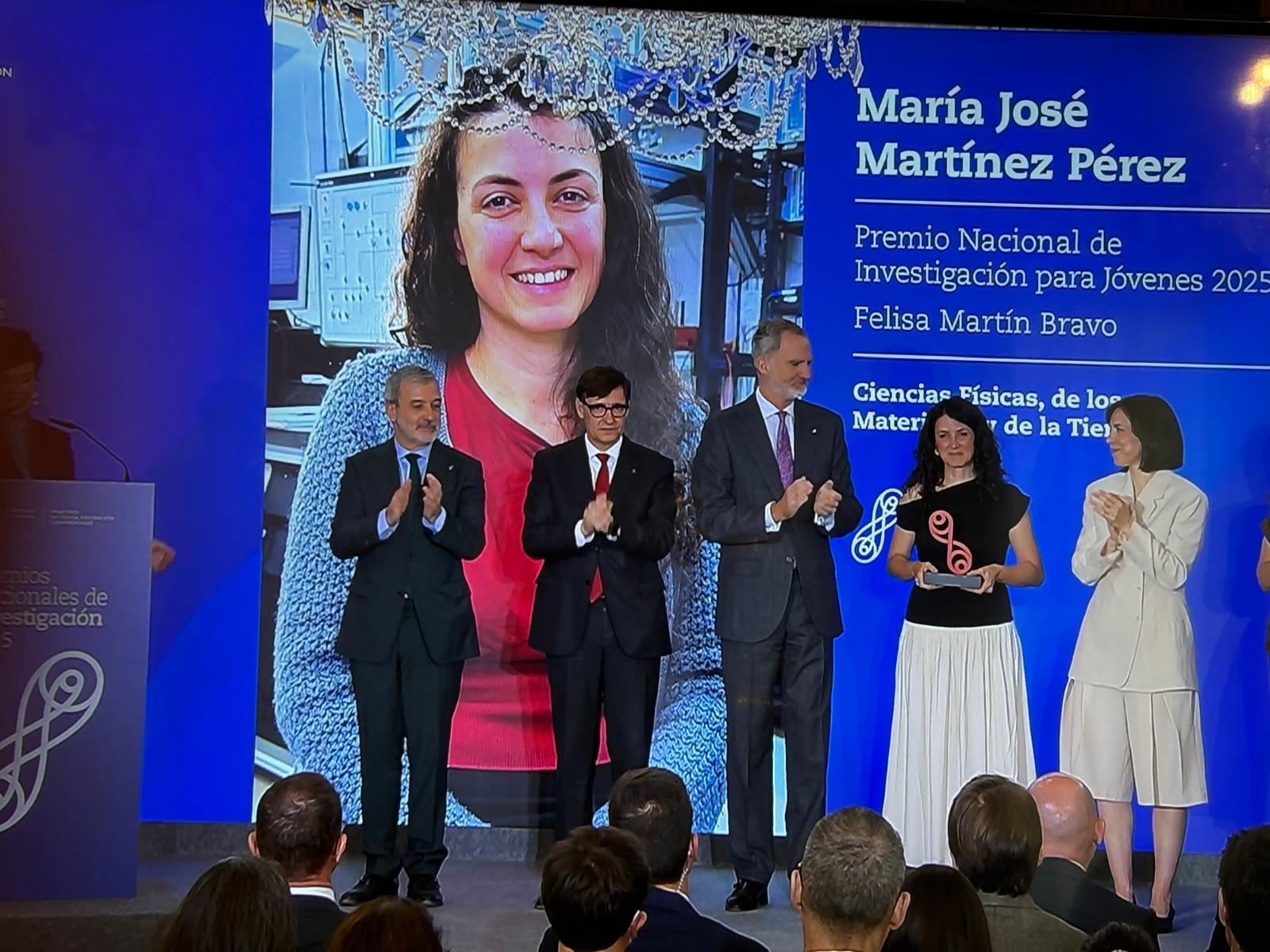
Zaragoza, 4 May 2026. María José Martínez Pérez has today received the 2025 National Research Award for Young Researchers, granted by the Ministry of Science, Innovation and Universities, in recognition of her solid research career in advanced scientific instrumentation and her decisive contribution to research infrastructures and technology transfer. Her career is marked by scientific independence and original contributions in the field of magnetism, especially in nanometre-scale superconductivity. The physicist from Huesca is a senior scientist at the Spanish National Research Council (CSIC) at the Aragon Nanoscience and Materials Institute (INMA, CSIC–University of Zaragoza), and thus becomes the first researcher from Aragon to be awarded this prestigious distinction.
The ceremony was presided over today by His Majesty the King at the Pedralbes Royal Palace in Barcelona. The Minister of Science, Innovation and Universities, Diana Morant, also addressed the event, accompanied by the President of the Government of Catalonia, Salvador Illa, and the Mayor of Barcelona, Jaume Collboni. The President of the CSIC, Eloísa del Pino, among other authorities, was also in attendance.
Pepa Martínez (Huesca, 1983) holds a PhD in Physics from the University of Zaragoza. After defending her doctoral thesis in 2011, she spent three years at the NEST laboratory (National Enterprise for nanoScience and nanoTechnology) of the Scuola Normale Superiore of Pisa and the Italian National Research Council. She subsequently moved to the University of Tübingen in Germany with a Humboldt Research Fellowship, before returning to Spain in 2017 with a permanent position at the Aragonese Agency for Research and Development Foundation (ARAID), based at the Aragon Nanoscience and Materials Institute (INMA), where she continues to work.
She has received several distinctions, including the “Aragón Investiga” award granted by the Government of Aragon, the “Young Researcher in Experimental Physics” award from the Royal Spanish Society of Physics (RSEF), and the Research Award in the Physics Section from the Royal Academy of Sciences of Zaragoza in 2021.
Her research is particularly attractive in light of the major challenges facing today’s society, as her work focuses on magnetism, superconductivity and, above all, computing and quantum physics. Indeed, this line of research is aimed at developing the quantum computers of the future, which will not only perform tasks at greater speed but will also solve problems beyond the reach of conventional computers, enabling advances in the design of fertilisers, medicines, vaccines, superconducting materials and batteries.
This is one of INMA’s priority research lines as a Severo Ochoa Centre of Excellence.
The CSIC researchers recognised with the National Research Awards, which distinguish researchers in Spain for their outstanding scientific careers and international relevance in their respective fields, were: Ignacio de la Torre Sainz, Ana María Traveset Vilaginés and Marisol Martín González.
Meanwhile, the recipients of the institution’s National Research Awards for Young Researchers, which recognise the merit of Spanish researchers under the age of 40 with significant early-career achievements, were María José Martínez Pérez and Jesús Campos Manzano. Pepa received the “Felisa Martín Bravo” award in the area of physical, materials and earth sciences.
Severo Ochoa Centre of Excellence
The Aragon Nanoscience and Materials Institute (INMA) was the first centre in the Autonomous Community of Aragon to obtain the Severo Ochoa accreditation of excellence, awarded by the State Research Agency. This recognition brings funding of €4.5 million and five predoctoral contracts for the period 2024–2028.
INMA is a joint institute of the CSIC and the University of Zaragoza. With around 300 members, it currently runs more than 40 European projects and produces an average of 300 publications per year, securing around €7 million annually from competitive public funding programmes. In addition, it works in collaboration with industry, generating approximately €1 million per year through contracts and royalties.
05-05-2026