INMA (CSIC–University of Zaragoza) contributes to the discovery of a lighter yet stronger material that could be key for strategic sectors such as electric vehicles, aeronautics, drones and more efficient power grids
The work, which has just been published in the prestigious journal Science, has been made possible thanks to the techniques developed at the Advanced Microscopy Laboratory (LMA–University of Zaragoza) and in collaboration with researchers from the IMDEA Materials Institute.
Zaragoza, 27 April 2026. A team of researchers from the Aragon Nanoscience and Materials Institute (INMA), a joint institute of the Spanish National Research Council (CSIC) and the University of Zaragoza, has taken part in a scientific breakthrough of major international relevance that brings closer the replacement of copper in electrical systems by materials that are much lighter and more efficient.
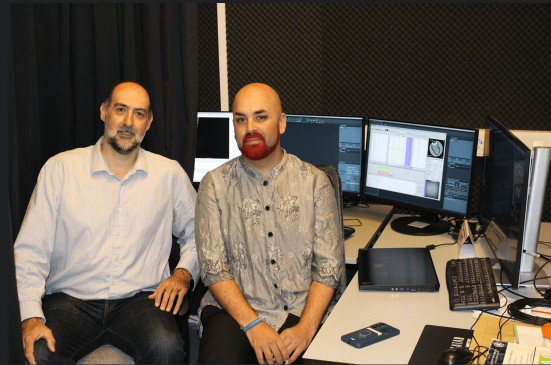
The work, led by the IMDEA Materials Institute and published in Science, demonstrates for the first time that carbon nanotube (CNT) fibres can achieve levels of electrical conductivity comparable to those of traditional materials such as copper or aluminium, but with a weight up to six times lower. On behalf of INMA, the paper is co-authored by two researchers from the University of Zaragoza: Dr Raúl Arenal (ARAID researcher) and Dr Mario Peláez Fernández, both members of the Nanoscopy on Low-Dimensional Materials (NLDM) group at INMA, led by Raúl Arenal himself. Their contribution to the study focused on advanced characterisation techniques carried out at the Advanced Microscopy Laboratory (LMA) of the University of Zaragoza, one of the nodes of the Singular Scientific and Technical Infrastructure (ICTS) ELECMI.
he participation of these INMA scientists from Aragon was key to analysing the structure and properties of the materials at the sub-nanometre scale, making it possible to validate the results obtained and to gain a deeper understanding of the composition and behaviour of these new conductive fibres.
These electron microscopy and spectroscopy studies were performed using the recently upgraded TITAN3 transmission electron microscope at the LMA. This instrument has the optimal specifications and features required to conduct a detailed structural and chemical study of such complex materials.
The research was carried out in collaboration with IMDEA Materials, in a joint effort that underlines the capacity of Spanish science to lead advances in advanced materials with industrial impact. From IMDEA Materials, the research was conducted by predoctoral researcher Ana Inés de Isidro Gómez, Dr Juan José Vilatela, Dr Anastasiia Mikhalchan and Prof. Javier Llorca, together with former IMDEA Materials researcher Dr Valentín Vassilev Galindo.
What the breakthrough consists of
The study (available at https://www.science.org/doi/10.1126/science.aeb0673) demonstrates a scalable manufacturing process for carbon nanotube fibres with an electrical conductivity of up to 24.5 MS/m (megasiemens per metre), approaching that of copper but with a major advantage: their light weight. This breakthrough opens the door to their use in strategic sectors such as electric vehicles, aeronautics, drones and more efficient power grids. In all these fields, reducing the weight of wiring is essential to improving energy efficiency.
The achievement is based on the introduction of a new dopant agent (tetrachloroaluminate, AlCl₄⁻) into the carbon nanotube fibres. This process makes it possible to multiply their electrical conductivity without altering their structure or their mechanical properties.
Thanks to this technique, the researchers have managed to increase the electrical conductivity of the pristine material (the CNTs themselves) by more than 17 times, even reaching values relatively close to those of copper.
In addition to their conductivity, these fibres exhibit a unique combination of strength and low weight. According to the study’s results, they could be up to five times stronger than conventional cables, while weighing half as much.
Severo Ochoa Centre of Excellence
The Aragon Nanoscience and Materials Institute (INMA) has been the first institute in the region to obtain Severo Ochoa Centre of Excellence accreditation, awarded by the State Research Agency. This recognition entails funding of €4.5 million and the provision of five predoctoral contracts for the period 2024–2028.
INMA is a joint institute of CSIC and the University of Zaragoza. With around 300 members, it currently has more than 40 European projects under way and an annual average of 300 publications and €7 million obtained through competitive public funding programmes. In addition, it works in collaboration with industry, generating around €1 million per year through contracts and royalties.
Singular Scientific and Technical Infrastructure (ICTS)
The Advanced Microscopy Laboratory (LMA), owned by the University of Zaragoza and linked to INMA, was inaugurated in 2010 with an initial investment of over €18 million. This milestone positioned the University of Zaragoza as a world reference in research in electron microscopy, materials analysis and nanofabrication. Since 2014, the LMA has formed part of the Integrated Infrastructure for Electron Microscopy of Materials (ELECMI), a Singular Scientific and Technical Infrastructure (ICTS) of the Spanish State, which it currently leads.
Photos of Raúl Arenal and Mario Peláez: 1 & 2
Scientific publication:
“Intercalated carbon nanotube fibers with high specific electrical conductivity”
I. de Isidro-Gómez, V. Vassilev-Galindo, A. Mikhalchan, M. Peláez-Fernández, J. LLorca, R. Arenal, and J. J. Vilatela
Science, 23 Apr 2026, Vol 392, Issue 6796, pp. 395-400
DOI: https://www.science.org/doi/10.1126/science.aeb0673
27-04-2026