Instituto de Nanociencia y Materiales de Aragón
  • EspañolEspañol
Intranet
  • THE INSTITUTE
    • General information
      • Welcome
      • History of the Institute
      • Organizational chart
      • Departments
        • Department 1: Functional organic materials
        • Department 2: Materials for energy and environment
        • Department 3: Physics of materials and nanosystems
        • Department 4: Bio-nano-medicine
        • Department 5: Multifunctional magnetic materials
      • Scientific Committee
      • Annual Reports
      • Welcome Handbook
      • Associations
    • Directory
    • Location and contact
  • RESEARCH
    • Research Areas
      • Area 1: Materials for energy
        and environment (MEM)
      • Area 2: Materials for biomedicine (BIO)
      • Area 3: Materials for information
        technology (MTI)
      • Area 4: New phenomena at the
        nanoscale (NFN)
      • Area 5: Synthesis, processing and scaling
        of advanced functional materials (SPE)
      • Area 6: Singular experimental
        technologies (TES)
    • Research Groups
    • Scientific publications
    • International projects
    • INMA scientific infrastructure
    • Microdevices Engineering Technical Unit (UTIM)
      • Structure UTIM
      • Catalog UTIM
      • Capabilities UTIM
      • Applications UTIM
    • INMA large scientific facilities
    • CEQMA Scientific-Technical Services
  • TRAINING
    • Master NANOMAT
    • Degree studies
    • Master studies
    • PhD studies
    • Internships
    • Scholarships and grants
    • Course of introduction to laboratory safety -SegurINMA
    • Research career path in Spain
  • JOB OFFERS
  • DISSEMINATION
    • Activities
      • General public
      • Schools and institutes
      • Special events
        • Researchers’ Night
        • Woman and science
        • Semana de la Ciencia
          Valle de Benasque
      • Cátedra SAMCA de Nanotecnología (EN)
      • LMA
    • Projects
    • Advising and training
    • Awards and distinctions
    • Multimedia
  • TRANSFER
    • Technological offer
      • Patents
      • Capabilities for industry
    • Transferred technology
    • Spin-offs
  • EQUALITY
    • Protocols and prevention against harassment
Instituto de Nanociencia y Materiales de Aragón
  • THE INSTITUTE
    • General information
      • Welcome
      • History of the Institute
      • Organizational chart
      • Departments
        • Department 1: Functional organic materials
        • Department 2: Materials for energy and environment
        • Department 3: Physics of materials and nanosystems
        • Department 4: Bio-nano-medicine
        • Department 5: Multifunctional magnetic materials
      • Scientific Committee
      • Annual Reports
      • Welcome Handbook
      • Associations
    • Directory
    • Location and contact
  • RESEARCH
    • Research Areas
      • Area 1: Materials for energy
        and environment (MEM)
      • Area 2: Materials for biomedicine (BIO)
      • Area 3: Materials for information
        technology (MTI)
      • Area 4: New phenomena at the
        nanoscale (NFN)
      • Area 5: Synthesis, processing and scaling
        of advanced functional materials (SPE)
      • Area 6: Singular experimental
        technologies (TES)
    • Research Groups
    • Scientific publications
    • International projects
    • INMA scientific infrastructure
    • Microdevices Engineering Technical Unit (UTIM)
      • Structure UTIM
      • Catalog UTIM
      • Capabilities UTIM
      • Applications UTIM
    • INMA large scientific facilities
    • CEQMA Scientific-Technical Services
  • TRAINING
    • Master NANOMAT
    • Degree studies
    • Master studies
    • PhD studies
    • Internships
    • Scholarships and grants
    • Course of introduction to laboratory safety -SegurINMA
    • Research career path in Spain
  • JOB OFFERS
  • DISSEMINATION
    • Activities
      • General public
      • Schools and institutes
      • Special events
        • Researchers’ Night
        • Woman and science
        • Semana de la Ciencia
          Valle de Benasque
      • Cátedra SAMCA de Nanotecnología (EN)
      • LMA
    • Projects
    • Advising and training
    • Awards and distinctions
    • Multimedia
  • TRANSFER
    • Technological offer
      • Patents
      • Capabilities for industry
    • Transferred technology
    • Spin-offs
  • EQUALITY
    • Protocols and prevention against harassment
Instituto de Nanociencia y Materiales de Aragón
No Result
View All Result

Home » Programming of complex magnetic profiles enforced by 4D printed magnetic LCE actuators

Programming of complex magnetic profiles enforced by 4D printed magnetic LCE actuators

by INMAweb
24/08/2026
in Highlight
0
Programming of complex magnetic profiles enforced by 4D printed magnetic LCE actuators

🤔 What if a 4D-printed material could create its own template for magnetic programming?

That is the idea 💡 behind our new work, “Programming of complex magnetic profiles enforced by 4D printed magnetic LCE actuators”, now published in Advanced Materials from Wiley – Advanced Portfolio.

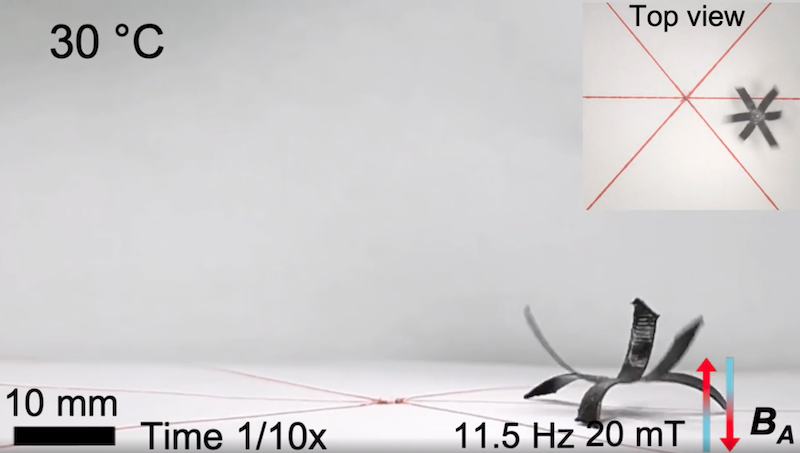
In this work, we use the programmed thermomechanical deformation of 4D-printed magnetic liquid crystal elastomers (MLCEs) to encode complex, 3D magnetic profiles.

Instead of using complex magnetic field patterns, moulds or external mechanical templates, the 4D-printed actuator itself defines the shape in which it is magnetically programmed. Upon cooling, this translates into a spatially varying magnetic profile that allows complex shapes to be recovered at room temperature using for this low magnetic fields 🧲.

The approach enables bidirectional and multistate actuation and is used to create multimaterial soft robots capable of frequency-tunable linear locomotion and chirality-controlled clockwise or anticlockwise rotation. And we put the concept into motion as seen in the movie… 🕷️

Congratulations Erick Espíndola on another great paper! 👏 Great work and a very nice step forward in our research on 4D-printed functional materials and soft robotics. More to come!

This work is the result of a great collaboration between our Advanced Manufacturing Laboratory at INMA (CSIC-UNIZAR) (CSIC–Universidad de Zaragoza) and the group of Prof. Peer Fischer at the Max Planck Institute for Medical Research and Heidelberg University.

The research is part of the STORM-BOTS ITN project 🤖, which has received funding from the European Union’s Horizon 2020 (European Research Executive Agency (REA)) research and innovation programme under Grant Agreement No. 956150.

Video


Programming of complex magnetic profiles enforced by 4D printed magnetic LCE actuators

DOI: 10.1002/adma.202600029

Advanced Materials, 2026; 0:e00029; 20th Aug. 2026

Erick R. Espíndola-Pérez, Rahul Goyal, Lovish Gulati, María López-Valdeolivas, Peer Fischer, Carlos Sánchez-Somolinos

Abstract:
Magnetic soft actuators enable untethered, contact-free actuation yet they are fundamentally limited by the difficulty of programming complex, three-dimensional (3D), spatially non-uniform magnetic profiles. Here, we introduce a four-dimensional (4D) printing-enabled magnetic programming strategy that overcomes this challenge by magnetizing magnetically active liquid crystal elastomers (MLCEs) in thermally actuated target states. Digitally prescribed director architectures define deterministic 3D deformations at elevated temperature, which serve as intrinsic programming templates during magnetization under a spatially uniform magnetic field. Upon cooling, relaxation of the thermomechanical deformation transforms the initially uniform magnetization into a complex, spatially varying magnetic profile that encodes the target shape as a magnetically favoured configuration. This approach enables the recovery of thermally defined shapes at room temperature under low magnetic fields and allows bidirectional and multistate actuation via simple reversal of field direction. By integrating spatial magnetic programming with controlled geometric asymmetry, we demonstrate frequency-tunable linear locomotion and chirality-encoded clockwise or anticlockwise rotational motion in multimaterial soft robotic architectures. This strategy decouples magnetic profile complexity from magnetization hardware, providing a scalable, template-free route to fully 3D magnetic programming for soft robotics and untethered actuators operating under low-field conditions.


Previous Post

Tuning 2e− and 4e− oxygen reduction pathways in laser-driven Fe-C electrocatalysts for H2O2 production and Zn–air batteries

Últimas noticias destacadas

  • Jesús Martínez de la Fuente receives the Juan de la Cierva National Research Award for his outstanding career in knowledge transfer in the field of nanobiotechnology
  • María José Martínez, CSIC scientist at INMA, receives the National Research Award
  • Ultrasmall platinum nanoparticles for radiation-enhanced cancer therapy

Últimas publicaciones científicas destacadas

  • Programming of complex magnetic profiles enforced by 4D printed magnetic LCE actuators
  • Tuning 2e− and 4e− oxygen reduction pathways in laser-driven Fe-C electrocatalysts for H2O2 production and Zn–air batteries
  • High-efficiency magnetic nanomaterials that do not sacrifice biological safety

Últimas novedades

  • Aragon marks forty years as a leading force in the materials science that is transforming the world
  • Boost your future in nanotechnology! Applications are now open for Cátedra SAMCA de Nanotecnología scholarships for the NanoMat Master’s programme (2026–2027 academic year)
  • A mussel‑inspired biomedical adhesive takes a key step towards clinical application

Últimas noticias de divulgación

  • INMA participates in the 4th Conference on Advanced Materials in Spain (AMatS 2025)
  • NanoAsalto and Conrado Rillo, awarded by IPFest 2025
  • Quantum film series at the Zaragoza Film Library

Bienvenida

  • Dr Anton Stasyuk
  • Dr Olga Stasyuk
  • Dr Mónica Marro

    Campus San Francisco, Facultad de Ciencias
    C/ Pedro Cerbuna, 12 – 50009 Zaragoza (España)

    Tel.:(+34) 876 55 33 22
    webmasterinma@unizar.es

    INSTITUTO DE NANOCIENCIA Y MATERIALES DE ARAGÓN, Copyright © 2022 INMA, CSIC-UZ | Aviso Legal | Política de cookies  | webmasterinma@unizar.es

    No Result
    View All Result
    • THE INSTITUTE
      • General information
        • Welcome
        • History of the Institute
        • Organizational chart
        • Departments
        • Scientific Committee
        • Annual Reports
        • Welcome Handbook
        • Associations
      • Directory
      • Location and contact
    • RESEARCH
      • Research Areas
        • Area 1: Materials for energy
          and environment (MEM)
        • Area 2: Materials for biomedicine (BIO)
        • Area 3: Materials for information
          technology (MTI)
        • Area 4: New phenomena at the
          nanoscale (NFN)
        • Area 5: Synthesis, processing and scaling
          of advanced functional materials (SPE)
        • Area 6: Singular experimental
          technologies (TES)
      • Research Groups
      • Scientific publications
      • International projects
      • INMA scientific infrastructure
      • Microdevices Engineering Technical Unit (UTIM)
        • Structure UTIM
        • Catalog UTIM
        • Capabilities UTIM
        • Applications UTIM
      • INMA large scientific facilities
      • CEQMA Scientific-Technical Services
    • TRAINING
      • Master NANOMAT
      • Degree studies
      • Master studies
      • PhD studies
      • Internships
      • Scholarships and grants
      • Course of introduction to laboratory safety -SegurINMA
      • Research career path in Spain
    • JOB OFFERS
    • DISSEMINATION
      • Activities
        • General public
        • Schools and institutes
        • Special events
        • Cátedra SAMCA de Nanotecnología (EN)
        • LMA
      • Projects
      • Advising and training
      • Awards and distinctions
      • Multimedia
    • TRANSFER
      • Technological offer
        • Patents
        • Capabilities for industry
      • Transferred technology
      • Spin-offs
    • EQUALITY
      • Protocols and prevention against harassment

    © 2026 JNews - Premium WordPress news & magazine theme by Jegtheme.

    Este sitio web utiliza cookies para que usted tenga la mejor experiencia de usuario. Si continúa navegando está dando su consentimiento para la aceptación de las mencionadas cookies y la aceptación de nuestra política de cookies

    ACEPTAR
    Aviso de cookies