Instituto de Nanociencia y Materiales de Aragón
  • EspañolEspañol
Intranet
  • THE INSTITUTE
    • General information
      • Welcome
      • History of the Institute
      • Organizational chart
      • Departments
        • Department 1: Functional organic materials
        • Department 2: Materials for energy and environment
        • Department 3: Physics of materials and nanosystems
        • Department 4: Bio-nano-medicine
        • Department 5: Multifunctional magnetic materials
      • Scientific Committee
      • Annual Reports
      • Welcome Handbook
      • Associations
    • Directory
    • Location and contact
  • RESEARCH
    • Research Areas
      • Area 1: Materials for energy
        and environment (MEM)
      • Area 2: Materials for biomedicine (BIO)
      • Area 3: Materials for information
        technology (MTI)
      • Area 4: New phenomena at the
        nanoscale (NFN)
      • Area 5: Synthesis, processing and scaling
        of advanced functional materials (SPE)
      • Area 6: Singular experimental
        technologies (TES)
    • Research Groups
    • Scientific publications
    • International projects
    • INMA scientific infrastructure
    • Microdevices Engineering Technical Unit (UTIM)
      • Structure UTIM
      • Catalog UTIM
      • Capabilities UTIM
      • Applications UTIM
    • INMA large scientific facilities
    • Scientific-Technical Services available at the institute
  • TRAINING
    • Master NANOMAT
    • Degree studies
    • Master studies
    • PhD studies
    • Internships
    • Scholarships and grants
    • Course of introduction to laboratory safety -SegurINMA
    • Research career path in Spain
  • JOB OFFERS
  • DISSEMINATION
    • Activities
      • General public
      • Schools and institutes
      • Special events
        • Researchers’ Night
        • Woman and science
        • Semana de la Ciencia
          Valle de Benasque
      • Cátedra SAMCA de Nanotecnología (EN)
      • LMA
    • Projects
    • Advising and training
    • Awards and distinctions
    • Multimedia
  • TRANSFER
    • Technological offer
      • Patents
      • Capabilities for industry
    • Transferred technology
    • Spin-offs
  • EQUALITY
    • Protocols and prevention against harassment
Instituto de Nanociencia y Materiales de Aragón
  • THE INSTITUTE
    • General information
      • Welcome
      • History of the Institute
      • Organizational chart
      • Departments
        • Department 1: Functional organic materials
        • Department 2: Materials for energy and environment
        • Department 3: Physics of materials and nanosystems
        • Department 4: Bio-nano-medicine
        • Department 5: Multifunctional magnetic materials
      • Scientific Committee
      • Annual Reports
      • Welcome Handbook
      • Associations
    • Directory
    • Location and contact
  • RESEARCH
    • Research Areas
      • Area 1: Materials for energy
        and environment (MEM)
      • Area 2: Materials for biomedicine (BIO)
      • Area 3: Materials for information
        technology (MTI)
      • Area 4: New phenomena at the
        nanoscale (NFN)
      • Area 5: Synthesis, processing and scaling
        of advanced functional materials (SPE)
      • Area 6: Singular experimental
        technologies (TES)
    • Research Groups
    • Scientific publications
    • International projects
    • INMA scientific infrastructure
    • Microdevices Engineering Technical Unit (UTIM)
      • Structure UTIM
      • Catalog UTIM
      • Capabilities UTIM
      • Applications UTIM
    • INMA large scientific facilities
    • Scientific-Technical Services available at the institute
  • TRAINING
    • Master NANOMAT
    • Degree studies
    • Master studies
    • PhD studies
    • Internships
    • Scholarships and grants
    • Course of introduction to laboratory safety -SegurINMA
    • Research career path in Spain
  • JOB OFFERS
  • DISSEMINATION
    • Activities
      • General public
      • Schools and institutes
      • Special events
        • Researchers’ Night
        • Woman and science
        • Semana de la Ciencia
          Valle de Benasque
      • Cátedra SAMCA de Nanotecnología (EN)
      • LMA
    • Projects
    • Advising and training
    • Awards and distinctions
    • Multimedia
  • TRANSFER
    • Technological offer
      • Patents
      • Capabilities for industry
    • Transferred technology
    • Spin-offs
  • EQUALITY
    • Protocols and prevention against harassment
Instituto de Nanociencia y Materiales de Aragón
No Result
View All Result

Home » Tuning 2e− and 4e− oxygen reduction pathways in laser-driven Fe-C electrocatalysts for H2O2 production and Zn–air batteries

Tuning 2e− and 4e− oxygen reduction pathways in laser-driven Fe-C electrocatalysts for H2O2 production and Zn–air batteries

by INMAweb
24/08/2026
in Highlight
0
Tuning 2e− and 4e− oxygen reduction pathways in laser-driven Fe-C electrocatalysts for H2O2 production and Zn–air batteries

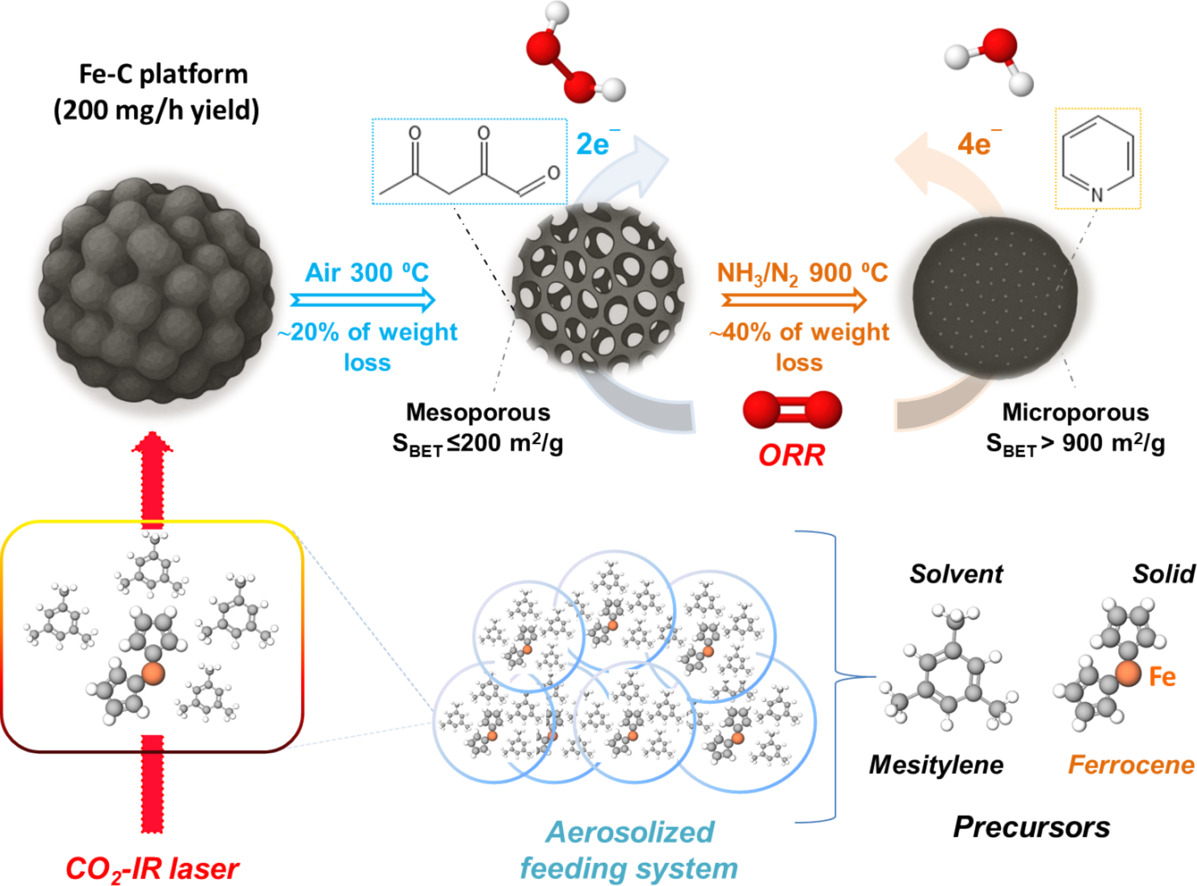
A team of researchers from INMA (CSIC-UNIZAR), together with the Institute of Carbon Science and Technology (ICB-CSIC), has developed iron-carbon (Fe-C) nanostructures using laser technology that are capable of promoting two different pathways of the same reaction: oxygen reduction.

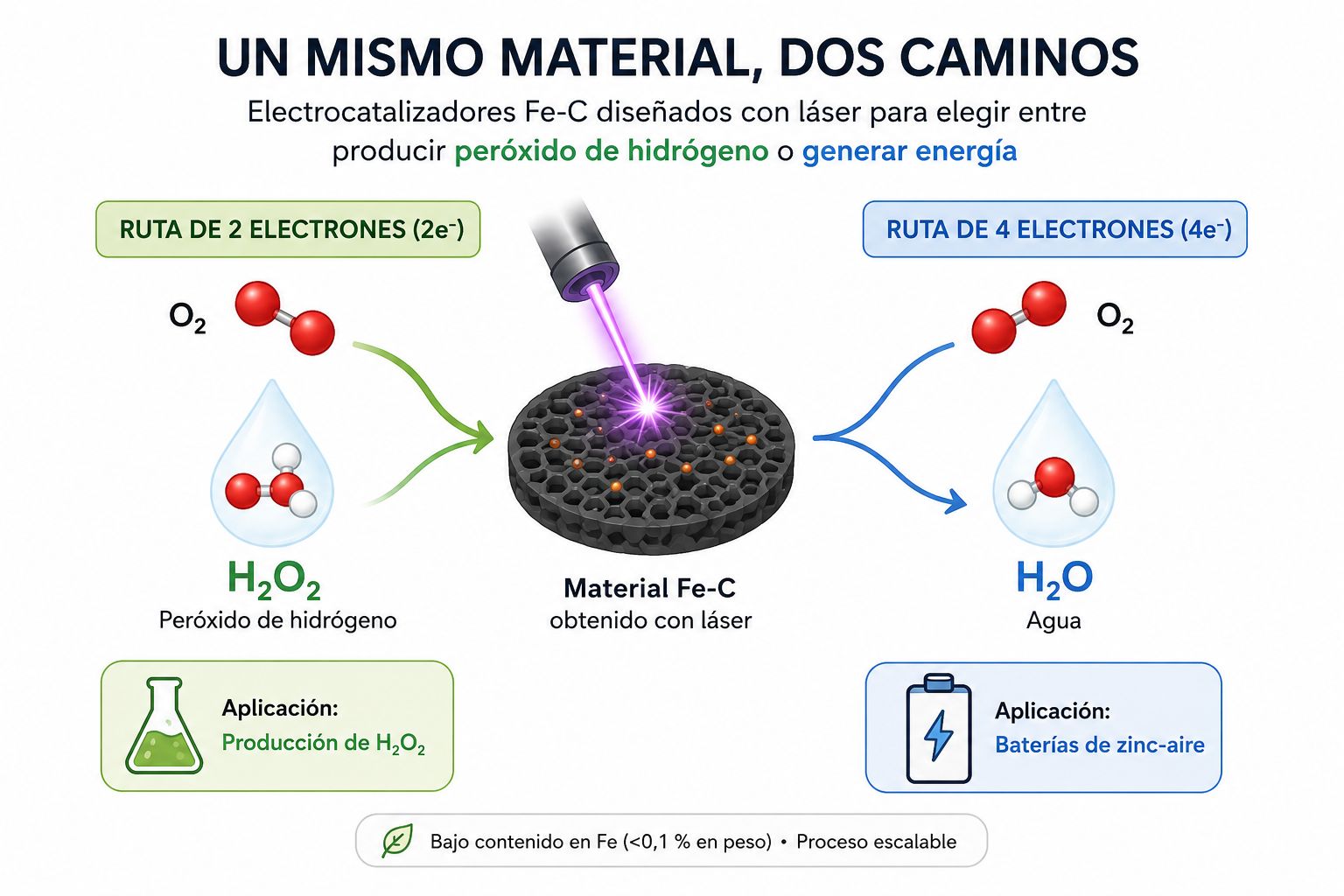
Why is this important? Because, depending on how the material is treated, it can be tailored towards two very different applications:

🧪 The 2-electron (2e⁻) pathway favours the production of hydrogen peroxide (H₂O₂). The optimised catalyst achieved a Faradaic efficiency of 94% after 24 hours of electrolysis.

🔋 The 4-electron (4e⁻) pathway favours the formation of water and enables the material to be used as a catalyst in zinc-air batteries, where it demonstrated power output and stability comparable to those of a benchmark platinum-based catalyst.

The research therefore shows that it is possible to fine-tune a single material to direct a chemical reaction towards the desired outcome, while using extremely small amounts of iron, less than 0.1 wt%, and a process with strong potential for scale-up.

The work has been published in the Chemical Engineering Journal (CEJ) and is authored by Ekaterina Pakrieva, Javier Hernández-Ferrer, Ana Rueda-Flores, Francisco Balas, Enrique García-Bordeje, Alejandro Ansón-Casaos, Oleg Usoltsev, Ana M. Benito, Wolfgang K. Maser and José L. Hueso.

👉 Research that brings together nanomaterials, chemistry and energy to advance more efficient electrochemical processes and technologies.


Tuning 2e− and 4e− oxygen reduction pathways in laser-driven Fe-C electrocatalysts for H2O2 production and Zn–air batteries

DOI: 10.1016/j.cej.2026.180589

Ekaterina Pakrieva, Javier Hernández-Ferrer, Ana Rueda-Flores, Francisco Balas, Enrique García-Bordeje, Alejandro Ansón-Casaos, Oleg Usoltsev, Ana M. Benito, Wolfgang K. Maser and José L. Hueso

Chemical Engineering Journal 546 (2026) 180589, 12th Aug. 2026


Abstract:

Electrocatalytic oxygen reduction plays a central role in electrochemical energy technologies and in the production of hydrogen peroxide. Achieving selective control over the two-electron (2e−) and four-electron (4e−) oxygen reduction reaction (ORR) pathways within a single catalyst platform remains challenging. Here, we report a laser-driven synthesis of Fesingle bondC nanostructures that enables tunable ORR selectivity through controlled post-treatment. Air annealing at 300 °C yields high H2O2 selectivity (~75% at 0.65 V vs RHE), attributed to oxygen-rich groups and well-developed mesoporosity. Notably, with an optimized 2-electron catalyst, 80 ppm of H2O2 with 94% faradaic efficiency was achieved after 24 h of electrolysis. In contrast, an ammonia based (NH3/N2) treatment at 900 °C promotes the formation of a microporous structure and the incorporation of nitrogen species, resulting in selective water production (~86% at 0.65 V vs RHE). The 4-electron catalyst delivers power and stability comparable to Pt/GC in a primary zinc–air battery. These findings demonstrate a practical approach for tuning ORR selectivity within a Fe-containing carbon-based platform, using scalable processing and trace Fe contents (<0.1 wt%) with Fe present as atomically dispersed sites, limiting leaching and Fenton-type reactions.
Previous Post

High-efficiency magnetic nanomaterials that do not sacrifice biological safety

Next Post

Programming of complex magnetic profiles enforced by 4D printed magnetic LCE actuators

Next Post
Programming of complex magnetic profiles enforced by 4D printed magnetic LCE actuators

Programming of complex magnetic profiles enforced by 4D printed magnetic LCE actuators

Últimas noticias destacadas

  • Jesús Martínez de la Fuente receives the Juan de la Cierva National Research Award for his outstanding career in knowledge transfer in the field of nanobiotechnology
  • María José Martínez, CSIC scientist at INMA, receives the National Research Award
  • Ultrasmall platinum nanoparticles for radiation-enhanced cancer therapy

Últimas publicaciones científicas destacadas

  • A neural network enables the design of how light propagates at the nanometre scale
  • Computational design of a photoactive [4]catenane with cyclo[48]carbon as an electron-accepting hub
  • Programming of complex magnetic profiles enforced by 4D printed magnetic LCE actuators

Últimas novedades

  • INMA and Keysight Connect Science and Industry to Accelerate Quantum Technologies Through the CSIC Converge Programme
  • Heat lost by electronic devices could be reused to store and transmit information in the future
  • Aragon marks forty years as a leading force in the materials science that is transforming the world

Últimas noticias de divulgación

  • Nanocrític@s among the outreach projects highlighted by FECYT
  • INMA participates in the 4th Conference on Advanced Materials in Spain (AMatS 2025)
  • NanoAsalto and Conrado Rillo, awarded by IPFest 2025

Bienvenida

  • Dr Anton Stasyuk
  • Dr Olga Stasyuk
  • Dr Mónica Marro

    Campus San Francisco, Facultad de Ciencias
    C/ Pedro Cerbuna, 12 – 50009 Zaragoza (España)

    Tel.:(+34) 876 55 33 22
    webmasterinma@unizar.es

    INSTITUTO DE NANOCIENCIA Y MATERIALES DE ARAGÓN, Copyright © 2022 INMA, CSIC-UZ | Aviso Legal | Política de cookies  | webmasterinma@unizar.es

    No Result
    View All Result
    • THE INSTITUTE
      • General information
        • Welcome
        • History of the Institute
        • Organizational chart
        • Departments
        • Scientific Committee
        • Annual Reports
        • Welcome Handbook
        • Associations
      • Directory
      • Location and contact
    • RESEARCH
      • Research Areas
        • Area 1: Materials for energy
          and environment (MEM)
        • Area 2: Materials for biomedicine (BIO)
        • Area 3: Materials for information
          technology (MTI)
        • Area 4: New phenomena at the
          nanoscale (NFN)
        • Area 5: Synthesis, processing and scaling
          of advanced functional materials (SPE)
        • Area 6: Singular experimental
          technologies (TES)
      • Research Groups
      • Scientific publications
      • International projects
      • INMA scientific infrastructure
      • Microdevices Engineering Technical Unit (UTIM)
        • Structure UTIM
        • Catalog UTIM
        • Capabilities UTIM
        • Applications UTIM
      • INMA large scientific facilities
      • Scientific-Technical Services available at the institute
    • TRAINING
      • Master NANOMAT
      • Degree studies
      • Master studies
      • PhD studies
      • Internships
      • Scholarships and grants
      • Course of introduction to laboratory safety -SegurINMA
      • Research career path in Spain
    • JOB OFFERS
    • DISSEMINATION
      • Activities
        • General public
        • Schools and institutes
        • Special events
        • Cátedra SAMCA de Nanotecnología (EN)
        • LMA
      • Projects
      • Advising and training
      • Awards and distinctions
      • Multimedia
    • TRANSFER
      • Technological offer
        • Patents
        • Capabilities for industry
      • Transferred technology
      • Spin-offs
    • EQUALITY
      • Protocols and prevention against harassment

    © 2026 JNews - Premium WordPress news & magazine theme by Jegtheme.

    Este sitio web utiliza cookies para que usted tenga la mejor experiencia de usuario. Si continúa navegando está dando su consentimiento para la aceptación de las mencionadas cookies y la aceptación de nuestra política de cookies

    ACEPTAR
    Aviso de cookies