Instituto de Nanociencia y Materiales de Aragón
  • EspañolEspañol
Intranet
  • THE INSTITUTE
    • General information
      • Welcome
      • History of the Institute
      • Organizational chart
      • Departments
        • Department 1: Functional organic materials
        • Department 2: Materials for energy and environment
        • Department 3: Physics of materials and nanosystems
        • Department 4: Bio-nano-medicine
        • Department 5: Multifunctional magnetic materials
      • Scientific Committee
      • Annual Reports
      • Welcome Handbook
      • Associations
    • Directory
    • Location and contact
  • RESEARCH
    • Research Areas
      • Area 1: Materials for energy
        and environment (MEM)
      • Area 2: Materials for biomedicine (BIO)
      • Area 3: Materials for information
        technology (MTI)
      • Area 4: New phenomena at the
        nanoscale (NFN)
      • Area 5: Synthesis, processing and scaling
        of advanced functional materials (SPE)
      • Area 6: Singular experimental
        technologies (TES)
    • Research Groups
    • Scientific publications
    • International projects
    • INMA scientific infrastructure
    • Microdevices Engineering Technical Unit (UTIM)
      • Structure UTIM
      • Catalog UTIM
      • Capabilities UTIM
      • Applications UTIM
    • INMA large scientific facilities
    • CEQMA Scientific-Technical Services
  • TRAINING
    • Master NANOMAT
    • Degree studies
    • Master studies
    • PhD studies
    • Internships
    • Scholarships and grants
    • Course of introduction to laboratory safety -SegurINMA
    • Research career path in Spain
  • JOB OFFERS
  • DISSEMINATION
    • Activities
      • General public
      • Schools and institutes
      • Special events
        • Researchers’ Night
        • Woman and science
        • Semana de la Ciencia
          Valle de Benasque
      • Cátedra SAMCA de Nanotecnología (EN)
      • LMA
    • Projects
    • Advising and training
    • Awards and distinctions
    • Multimedia
  • TRANSFER
    • Technological offer
      • Patents
      • Capabilities for industry
    • Transferred technology
    • Spin-offs
  • EQUALITY
    • Protocols and prevention against harassment
Instituto de Nanociencia y Materiales de Aragón
  • THE INSTITUTE
    • General information
      • Welcome
      • History of the Institute
      • Organizational chart
      • Departments
        • Department 1: Functional organic materials
        • Department 2: Materials for energy and environment
        • Department 3: Physics of materials and nanosystems
        • Department 4: Bio-nano-medicine
        • Department 5: Multifunctional magnetic materials
      • Scientific Committee
      • Annual Reports
      • Welcome Handbook
      • Associations
    • Directory
    • Location and contact
  • RESEARCH
    • Research Areas
      • Area 1: Materials for energy
        and environment (MEM)
      • Area 2: Materials for biomedicine (BIO)
      • Area 3: Materials for information
        technology (MTI)
      • Area 4: New phenomena at the
        nanoscale (NFN)
      • Area 5: Synthesis, processing and scaling
        of advanced functional materials (SPE)
      • Area 6: Singular experimental
        technologies (TES)
    • Research Groups
    • Scientific publications
    • International projects
    • INMA scientific infrastructure
    • Microdevices Engineering Technical Unit (UTIM)
      • Structure UTIM
      • Catalog UTIM
      • Capabilities UTIM
      • Applications UTIM
    • INMA large scientific facilities
    • CEQMA Scientific-Technical Services
  • TRAINING
    • Master NANOMAT
    • Degree studies
    • Master studies
    • PhD studies
    • Internships
    • Scholarships and grants
    • Course of introduction to laboratory safety -SegurINMA
    • Research career path in Spain
  • JOB OFFERS
  • DISSEMINATION
    • Activities
      • General public
      • Schools and institutes
      • Special events
        • Researchers’ Night
        • Woman and science
        • Semana de la Ciencia
          Valle de Benasque
      • Cátedra SAMCA de Nanotecnología (EN)
      • LMA
    • Projects
    • Advising and training
    • Awards and distinctions
    • Multimedia
  • TRANSFER
    • Technological offer
      • Patents
      • Capabilities for industry
    • Transferred technology
    • Spin-offs
  • EQUALITY
    • Protocols and prevention against harassment
Instituto de Nanociencia y Materiales de Aragón
No Result
View All Result

Home » A new strategy against cancer combines magnetic nanoparticles and natural plant‑derived ‘nanomessengers’

A new strategy against cancer combines magnetic nanoparticles and natural plant‑derived ‘nanomessengers’

by INMAweb
17/06/2026
in News
0
Una nueva estrategia contra el cáncer combina nanopartículas magnéticas y ‘nanomensajeros’ naturales extraídos de plantas 

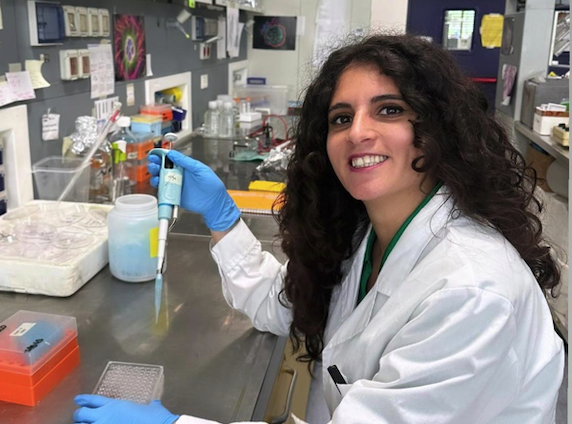
The EMERGE project, developed at INMA (CSIC–University of Zaragoza), uses plant‑derived extracellular vesicles and magnetic nanoparticles to design more selective and biocompatible therapies against tumours. This research has been led for the past year by Marisa Conte (CSIC), who obtained a Marie Curie fellowship to carry it out


Zaragoza, 16 June 2026. Can nanoparticles obtained from plants join forces with magnetic ones to develop new cancer therapies? This is the question addressed by the European project EMERGE (Engineered plant‑derived extracellular vesicles tagged with magnetic nanoparticles as novel antitumoural agents), a pioneering investigation aimed at designing new nanomedicine strategies for cancer treatment. The work is being conducted at the Institute of Nanoscience and Materials of Aragón (INMA), a joint institute of the Spanish National Research Council (CSIC) and the University of Zaragoza.

The principal investigator is Marisa Conte (CSIC), who has been leading this line of research for a year thanks to a prestigious Marie Skłodowska‑Curie Postdoctoral Fellowship. The grant, awarded under the European Union’s Horizon Europe 2024 call, officially began on 1 July 2025 and will run for two years.

The distinctive value of EMERGE lies in its exploration of new therapeutic tools based on the combination of plant‑derived extracellular vesicles and magnetic nanoparticles. Extracellular vesicles are natural nanoparticles used by cells as ‘messengers’ to communicate with one another. In recent years, they have attracted great interest due to their potential as safe and efficient vehicles for delivering therapeutic agents.

Marisa Conte’s research focuses on harnessing the natural properties of these vesicles and combining them with magnetic nanoparticles to develop more selective and biocompatible systems capable of acting against tumour cells. One of the main advantages of this approach is the possibility of using magnetic hyperthermia, a technique that employs external magnetic fields to generate localised heat and destroy cancer cells in a controlled manner, minimising damage to healthy tissues.

Three‑dimensional tumour models

EMERGE also incorporates a strong collaborative dimension. During a six‑month stay at the Santobono‑Pausilipon Hospital in Naples (Italy), the researcher will work with three‑dimensional tumour models obtained directly from oncology patients. These models make it possible to reproduce the complexity of human tumours more realistically and facilitate the evaluation of new therapeutic strategies under conditions closer to clinical practice.

The use of these advanced models will allow the team to analyse the effectiveness of the nanocomplexes developed in EMERGE and to study tumour responses to the proposed treatments, helping accelerate the transfer of knowledge from the laboratory to future biomedical applications.

Working with patient‑derived organoids (miniature reproductions of the tumour from which they originate) represents a new frontier in the development of personalised therapies. As each organoid is obtained from the tumour of a specific patient, it can reproduce many of that tumour’s biological and molecular characteristics, which may differ significantly from those of other patients. This enables more precise and tailored evaluation of therapeutic strategies for each individual case.

With this project, INMA strengthens its position in the field of nanomedicine and advanced biomedical research, while consolidating its capacity to attract international talent and competitive European funding aimed at addressing some of the major health challenges facing our society.

Severo Ochoa Centre of Excellence

The Aragon Nanoscience and Materials Institute (INMA) is the first in our Autonomous Community to obtain the Severo Ochoa excellence accreditation, awarded by the Spanish State Research Agency. This recognition entails funding of 4.5 million euros and five predoctoral contracts for the 2024–2028 period. These are in addition to the ten contracts granted in the previous call, when INMA narrowly missed achieving the accreditation.

INMA is a joint institute created three years ago through the merger of two CSIC and University of Zaragoza research centres, precisely with the aim of aspiring to this excellence distinction. With around 300 members, it currently manages more than 40 European projects and produces an annual average of 300 publications and 7 million euros in competitive public funding. It also collaborates with industry, securing around one million euros per year through contracts and royalties.


17-06-2026
Previous Post

An “Escapatón” puts the finishing touch to the sixth edition of the critical thinking promotion project “Agency of Nano‑Critics: Session Zero”

Últimas noticias destacadas

  • María José Martínez, CSIC scientist at INMA, receives the National Research Award
  • Ultrasmall platinum nanoparticles for radiation-enhanced cancer therapy
  • Paula Novella’s research (INMA) has been recognised as one of the best in the country at the CSIC-AEAC Awards for antimicrobial resistance

Últimas publicaciones científicas destacadas

  • A new family of chemical products effective against antibiotic‑resistant pathogens identified
  • Researchers are developing a new technology to capture CO₂ directly from the air
  • Platinum nanoparticles increase the effectiveness of radiotherapy treatments in cancer

Últimas novedades

  • A new strategy against cancer combines magnetic nanoparticles and natural plant‑derived ‘nanomessengers’
  • An “Escapatón” puts the finishing touch to the sixth edition of the critical thinking promotion project “Agency of Nano‑Critics: Session Zero”
  • The 7th Nanotechnology Gala in Zaragoza recognises outstanding projects and research with an impact on health, industry and future technologies

Últimas noticias de divulgación

  • INMA participates in the 4th Conference on Advanced Materials in Spain (AMatS 2025)
  • NanoAsalto and Conrado Rillo, awarded by IPFest 2025
  • Quantum film series at the Zaragoza Film Library

Bienvenida

  • Dr Anton Stasyuk
  • Dr Olga Stasyuk
  • Dr Mónica Marro

    Campus San Francisco, Facultad de Ciencias
    C/ Pedro Cerbuna, 12 – 50009 Zaragoza (España)

    Tel.:(+34) 876 55 33 22
    webmasterinma@unizar.es

    INSTITUTO DE NANOCIENCIA Y MATERIALES DE ARAGÓN, Copyright © 2022 INMA, CSIC-UZ | Aviso Legal | Política de cookies  | webmasterinma@unizar.es

    No Result
    View All Result
    • THE INSTITUTE
      • General information
        • Welcome
        • History of the Institute
        • Organizational chart
        • Departments
        • Scientific Committee
        • Annual Reports
        • Welcome Handbook
        • Associations
      • Directory
      • Location and contact
    • RESEARCH
      • Research Areas
        • Area 1: Materials for energy
          and environment (MEM)
        • Area 2: Materials for biomedicine (BIO)
        • Area 3: Materials for information
          technology (MTI)
        • Area 4: New phenomena at the
          nanoscale (NFN)
        • Area 5: Synthesis, processing and scaling
          of advanced functional materials (SPE)
        • Area 6: Singular experimental
          technologies (TES)
      • Research Groups
      • Scientific publications
      • International projects
      • INMA scientific infrastructure
      • Microdevices Engineering Technical Unit (UTIM)
        • Structure UTIM
        • Catalog UTIM
        • Capabilities UTIM
        • Applications UTIM
      • INMA large scientific facilities
      • CEQMA Scientific-Technical Services
    • TRAINING
      • Master NANOMAT
      • Degree studies
      • Master studies
      • PhD studies
      • Internships
      • Scholarships and grants
      • Course of introduction to laboratory safety -SegurINMA
      • Research career path in Spain
    • JOB OFFERS
    • DISSEMINATION
      • Activities
        • General public
        • Schools and institutes
        • Special events
        • Cátedra SAMCA de Nanotecnología (EN)
        • LMA
      • Projects
      • Advising and training
      • Awards and distinctions
      • Multimedia
    • TRANSFER
      • Technological offer
        • Patents
        • Capabilities for industry
      • Transferred technology
      • Spin-offs
    • EQUALITY
      • Protocols and prevention against harassment

    © 2026 JNews - Premium WordPress news & magazine theme by Jegtheme.

    Este sitio web utiliza cookies para que usted tenga la mejor experiencia de usuario. Si continúa navegando está dando su consentimiento para la aceptación de las mencionadas cookies y la aceptación de nuestra política de cookies

    ACEPTAR
    Aviso de cookies