Instituto de Nanociencia y Materiales de Aragón
  • EspañolEspañol
Intranet
  • THE INSTITUTE
    • General information
      • Welcome
      • History of the Institute
      • Organizational chart
      • Departments
        • Department 1: Functional organic materials
        • Department 2: Materials for energy and environment
        • Department 3: Physics of materials and nanosystems
        • Department 4: Bio-nano-medicine
        • Department 5: Multifunctional magnetic materials
      • Scientific Committee
      • Annual Reports
      • Welcome Handbook
      • Associations
    • Directory
    • Location and contact
  • RESEARCH
    • Research Areas
      • Area 1: Materials for energy
        and environment (MEM)
      • Area 2: Materials for biomedicine (BIO)
      • Area 3: Materials for information
        technology (MTI)
      • Area 4: New phenomena at the
        nanoscale (NFN)
      • Area 5: Synthesis, processing and scaling
        of advanced functional materials (SPE)
      • Area 6: Singular experimental
        technologies (TES)
    • Research Groups
    • Scientific publications
    • International projects
    • INMA scientific infrastructure
    • Microdevices Engineering Technical Unit (UTIM)
      • Structure UTIM
      • Catalog UTIM
      • Capabilities UTIM
      • Applications UTIM
    • INMA large scientific facilities
    • Scientific-Technical Services available at the institute
  • TRAINING
    • Master NANOMAT
    • Degree studies
    • Master studies
    • PhD studies
    • Internships
    • Scholarships and grants
    • Course of introduction to laboratory safety -SegurINMA
    • Research career path in Spain
  • JOB OFFERS
  • DISSEMINATION
    • Activities
      • General public
      • Schools and institutes
      • Special events
        • Researchers’ Night
        • Woman and science
        • Semana de la Ciencia
          Valle de Benasque
      • Cátedra SAMCA de Nanotecnología (EN)
      • LMA
    • Projects
    • Advising and training
    • Awards and distinctions
    • Multimedia
  • TRANSFER
    • Technological offer
      • Patents
      • Capabilities for industry
    • Transferred technology
    • Spin-offs
  • EQUALITY
    • Protocols and prevention against harassment
Instituto de Nanociencia y Materiales de Aragón
  • THE INSTITUTE
    • General information
      • Welcome
      • History of the Institute
      • Organizational chart
      • Departments
        • Department 1: Functional organic materials
        • Department 2: Materials for energy and environment
        • Department 3: Physics of materials and nanosystems
        • Department 4: Bio-nano-medicine
        • Department 5: Multifunctional magnetic materials
      • Scientific Committee
      • Annual Reports
      • Welcome Handbook
      • Associations
    • Directory
    • Location and contact
  • RESEARCH
    • Research Areas
      • Area 1: Materials for energy
        and environment (MEM)
      • Area 2: Materials for biomedicine (BIO)
      • Area 3: Materials for information
        technology (MTI)
      • Area 4: New phenomena at the
        nanoscale (NFN)
      • Area 5: Synthesis, processing and scaling
        of advanced functional materials (SPE)
      • Area 6: Singular experimental
        technologies (TES)
    • Research Groups
    • Scientific publications
    • International projects
    • INMA scientific infrastructure
    • Microdevices Engineering Technical Unit (UTIM)
      • Structure UTIM
      • Catalog UTIM
      • Capabilities UTIM
      • Applications UTIM
    • INMA large scientific facilities
    • Scientific-Technical Services available at the institute
  • TRAINING
    • Master NANOMAT
    • Degree studies
    • Master studies
    • PhD studies
    • Internships
    • Scholarships and grants
    • Course of introduction to laboratory safety -SegurINMA
    • Research career path in Spain
  • JOB OFFERS
  • DISSEMINATION
    • Activities
      • General public
      • Schools and institutes
      • Special events
        • Researchers’ Night
        • Woman and science
        • Semana de la Ciencia
          Valle de Benasque
      • Cátedra SAMCA de Nanotecnología (EN)
      • LMA
    • Projects
    • Advising and training
    • Awards and distinctions
    • Multimedia
  • TRANSFER
    • Technological offer
      • Patents
      • Capabilities for industry
    • Transferred technology
    • Spin-offs
  • EQUALITY
    • Protocols and prevention against harassment
Instituto de Nanociencia y Materiales de Aragón
No Result
View All Result

Home » Heat lost by electronic devices could be reused to store and transmit information in the future

Heat lost by electronic devices could be reused to store and transmit information in the future

by INMAweb
08/09/2026
in News
0
El calor que pierden los dispositivos electrónicos podría reutilizarse para almacenar y transmitir información en el futuro

The European project 3D-Sky has investigated how to harness heat, including the waste heat generated by electronic devices, a major challenge as the digitalisation of society and the growing demand for data processing and storage continue to increase energy consumption.

The work of Alberto Anadón, who carried out the project as a researcher employed by the Spanish National Research Council (CSIC) at the Aragon Nanoscience and Materials Institute (INMA, CSIC-University of Zaragoza) and has recently joined the University of Zaragoza under a Ramón y Cajal contract, was conducted within the framework of the Marie Skłodowska-Curie programme.


Zaragoza, 8 September. Computers, mobile phones and data centres consume increasing amounts of energy, and part of that energy is ultimately lost as heat. But what if, instead of wasting that heat, we could use it to help store and transfer information? This is one of the ideas explored by 3D-Sky (Thermo-spin 3D Platform for Skyrmion Motion), a Marie Skłodowska-Curie project funded by the European Union and carried out at the Aragon Nanoscience and Materials Institute (INMA), a joint research centre of the Spanish National Research Council (CSIC) and the University of Zaragoza, between July 2024 and June 2026.

The project was carried out by Alberto Anadón, a CSIC researcher at INMA, under the supervision of researcher Cristina Bran (CSIC) and in close collaboration with the group led by Amalio Fernández-Pacheco at TU Wien (Vienna). Its aim was to explore new strategies for using heat, including the waste heat generated by electronic devices themselves, as a tool capable of controlling and moving magnetic information at the nanoscale.

The challenge addressed by this research is becoming increasingly relevant. The ongoing digitalisation of society and the growing demand for data processing and storage are driving up the energy consumption associated with information technologies. A significant proportion of this energy is dissipated and ultimately lost as heat.

3D-Sky seeks to turn this problem on its head. Rather than treating heat solely as an energy loss that must be removed, the research explores how it can be harnessed to control magnetic structures that could play a role in future information storage and processing technologies.

Tiny magnetic whirlpools for information storage

The key protagonists of the project are magnetic skyrmions, extremely small and stable configurations of a material’s magnetisation that can be visualised as tiny magnetic “whirlpools”.

Their nanometre-scale size, thousands of times smaller than the thickness of a human hair, combined with their stability and the possibility of moving them within certain materials, makes them highly promising candidates for future generations of information storage and processing devices.

The potential use of these structures as carriers of information could contribute to the development of memory technologies with higher storage densities, faster operation and lower energy consumption.

Within this context, 3D-Sky has investigated how temperature changes and thermal gradients can generate forces capable of influencing skyrmion motion. The goal is to understand how heat itself can become a practical tool for manipulating magnetic information at extremely small scales.

Among the project’s most significant achievements is the demonstration that a heat pulse can create individual skyrmions “on demand” in devices containing integrated micro-heaters, developed in collaboration with the Autonomous University of Madrid. A thermal pulse breaks magnetic domains into isolated and stable skyrmions.

Taking nanomagnetism into the third dimension

The project’s second major objective was to move beyond the conventional flat geometry of devices and explore magnetism in three dimensions.

During 3D-Sky, three-dimensional nanostructures with geometries such as ramps, horseshoes and helices were fabricated using Focused Electron Beam Induced Deposition (FEBID), a technique that can be regarded as a form of nanoscale “3D printing”. The process uses the electron beam of an electron microscope to fabricate structures with extremely complex shapes and nanometre-scale dimensions.

Working in three dimensions opens up new possibilities because the geometry of the nanostructures themselves allows both heat distribution and magnetic behaviour to be modified and controlled in ways that are not possible in conventional planar circuits.

This combination of 3D nanomagnetism and thermospintronics therefore opens new research avenues for studying how temperature, geometry and magnetism interact, and how these interactions could be exploited in future information technologies.

A collaborative network to advance new magnetic technologies

The 3D-Sky project was carried out in close collaboration with the group of Amalio Fernández-Pacheco at TU Wien (Vienna) and has enabled the establishment and strengthening of scientific collaborations with a range of national and international institutions, including the Autonomous University of Madrid (UAM), the Madrid Institute of Materials Science (ICMM-CSIC), CUNEF University, the ALBA Synchrotron and the Institut Jean Lamour (CNRS-University of Lorraine, France).

This network brings together complementary expertise in the fabrication of three-dimensional nanostructures, advanced magnetic characterisation, and the study of materials and physical phenomena at the nanoscale.

The completion of 3D-Sky does not mark the end of this line of research. Since 1 July, Alberto Anadón has held a Ramón y Cajal contract at the University of Zaragoza, where he will continue developing his research at INMA.

This new stage will allow further advances in the study of three-dimensional nanomagnetism and thermospintronics, building on the knowledge, capabilities and collaborations generated during the European project.

The next step will be to transfer thermal experiments to fully three-dimensional structures, such as the horseshoe-shaped nanostructures that have already been fabricated, and to gain a more precise understanding of the physical mechanisms that allow temperature to drive skyrmion motion.

Alberto Anadón’s incorporation through the Ramón y Cajal programme will help consolidate a research line at the interface of materials physics, nanomagnetism and future information technologies. It will ensure continuity for a scientific trajectory fostered by an excellence programme such as the Marie Skłodowska-Curie Actions, while strengthening the institute’s ability to attract and retain outstanding research talent.

The 3D-Sky project has received funding from the European Union through the Marie Skłodowska-Curie Actions under the Horizon Europe programme (Grant Agreement No. 101108063).

Severo Ochoa Centre of Excellence

The Aragon Nanoscience and Materials Institute (INMA) was the first institution in the Autonomous Community of Aragon to obtain the Severo Ochoa Centre of Excellence accreditation, awarded by the Spanish State Research Agency. The recognition includes €4.5 million in funding and five doctoral contracts for the 2024-2028 period.

INMA is a joint research institute of the Spanish National Research Council (CSIC) and the University of Zaragoza. With around 300 members, it currently manages more than 40 European projects and produces an average of 300 scientific publications per year, while securing approximately €7 million annually through competitive public funding programmes. The institute also works closely with industry.


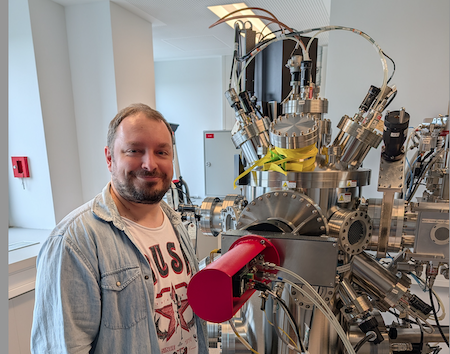
Alberto Anadón’s photos


08-09-2026

Previous Post

A neural network enables the design of how light propagates at the nanometre scale

Últimas noticias destacadas

  • Jesús Martínez de la Fuente receives the Juan de la Cierva National Research Award for his outstanding career in knowledge transfer in the field of nanobiotechnology
  • María José Martínez, CSIC scientist at INMA, receives the National Research Award
  • Ultrasmall platinum nanoparticles for radiation-enhanced cancer therapy

Últimas publicaciones científicas destacadas

  • A neural network enables the design of how light propagates at the nanometre scale
  • Computational design of a photoactive [4]catenane with cyclo[48]carbon as an electron-accepting hub
  • Programming of complex magnetic profiles enforced by 4D printed magnetic LCE actuators

Últimas novedades

  • Heat lost by electronic devices could be reused to store and transmit information in the future
  • Aragon marks forty years as a leading force in the materials science that is transforming the world
  • Boost your future in nanotechnology! Applications are now open for Cátedra SAMCA de Nanotecnología scholarships for the NanoMat Master’s programme (2026–2027 academic year)

Últimas noticias de divulgación

  • INMA participates in the 4th Conference on Advanced Materials in Spain (AMatS 2025)
  • NanoAsalto and Conrado Rillo, awarded by IPFest 2025
  • Quantum film series at the Zaragoza Film Library

Bienvenida

  • Dr Anton Stasyuk
  • Dr Olga Stasyuk
  • Dr Mónica Marro

    Campus San Francisco, Facultad de Ciencias
    C/ Pedro Cerbuna, 12 – 50009 Zaragoza (España)

    Tel.:(+34) 876 55 33 22
    webmasterinma@unizar.es

    INSTITUTO DE NANOCIENCIA Y MATERIALES DE ARAGÓN, Copyright © 2022 INMA, CSIC-UZ | Aviso Legal | Política de cookies  | webmasterinma@unizar.es

    No Result
    View All Result
    • THE INSTITUTE
      • General information
        • Welcome
        • History of the Institute
        • Organizational chart
        • Departments
        • Scientific Committee
        • Annual Reports
        • Welcome Handbook
        • Associations
      • Directory
      • Location and contact
    • RESEARCH
      • Research Areas
        • Area 1: Materials for energy
          and environment (MEM)
        • Area 2: Materials for biomedicine (BIO)
        • Area 3: Materials for information
          technology (MTI)
        • Area 4: New phenomena at the
          nanoscale (NFN)
        • Area 5: Synthesis, processing and scaling
          of advanced functional materials (SPE)
        • Area 6: Singular experimental
          technologies (TES)
      • Research Groups
      • Scientific publications
      • International projects
      • INMA scientific infrastructure
      • Microdevices Engineering Technical Unit (UTIM)
        • Structure UTIM
        • Catalog UTIM
        • Capabilities UTIM
        • Applications UTIM
      • INMA large scientific facilities
      • Scientific-Technical Services available at the institute
    • TRAINING
      • Master NANOMAT
      • Degree studies
      • Master studies
      • PhD studies
      • Internships
      • Scholarships and grants
      • Course of introduction to laboratory safety -SegurINMA
      • Research career path in Spain
    • JOB OFFERS
    • DISSEMINATION
      • Activities
        • General public
        • Schools and institutes
        • Special events
        • Cátedra SAMCA de Nanotecnología (EN)
        • LMA
      • Projects
      • Advising and training
      • Awards and distinctions
      • Multimedia
    • TRANSFER
      • Technological offer
        • Patents
        • Capabilities for industry
      • Transferred technology
      • Spin-offs
    • EQUALITY
      • Protocols and prevention against harassment

    © 2026 JNews - Premium WordPress news & magazine theme by Jegtheme.

    Este sitio web utiliza cookies para que usted tenga la mejor experiencia de usuario. Si continúa navegando está dando su consentimiento para la aceptación de las mencionadas cookies y la aceptación de nuestra política de cookies

    ACEPTAR
    Aviso de cookies