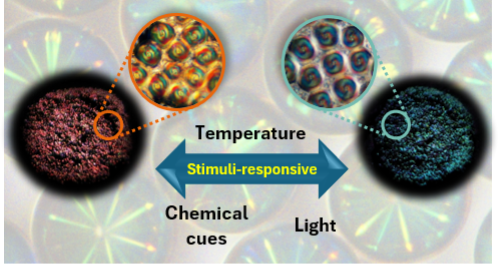
Researchers Mauricio Vera Arévalo and Alberto Concellón Allueva, from the Liquid Crystals and Polymers Group (CLIP) at the Aragon Nanoscience and Materials Institute (INMA), a joint CSIC–University of Zaragoza institute, have developed a new class of photonic materials based on cholesteric liquid crystals that display structural colour entirely independent of the viewing angle and whose colour can be reversibly modulated by different external stimuli. The results have been published in Journal of the American Chemical Society, one of the highest‑impact international journals in Chemistry.
Cholesteric liquid crystals are materials capable of selectively reflecting specific wavelengths of light, generating intense colours without the need for pigments or dyes. However, these colours usually depend on the viewing angle, a limitation that hinders their use in sensors and photonic devices. To overcome this issue, the researchers have developed a strategy based on microdroplets of cholesteric liquid crystal embedded within a printable polymer matrix. This architecture preserves structural colour visible from any direction while maintaining the ability to reversibly modulate the colour in response to various stimuli such as temperature, light, pH, or different chemical substances.
In addition, the materials developed can be processed as printable photonic inks that can be moulded, painted, or deposited onto surfaces of different shapes to produce functional coatings and three‑dimensional structures. The resulting materials reversibly change colour in response to variations in temperature, exposure to light, or the presence of certain chemical substances, converting these environmental changes into easily detectable optical signals. This discovery opens the door to the development of a new generation of intelligent photonic materials for optical sensors, functional coatings, and other advanced devices with applications in chemical detection, photonics, and smart technologies.
“Multiresponsive isotropic structural color in cholesteric liquid crystals”
DOI: https://doi.org/10.1021/jacs.6c07395
Mauricio Vera-Arévalo, Alberto Concellón
J. Am. Chem. Soc. 2026, 25th July 2026