Instituto de Nanociencia y Materiales de Aragón
  • EspañolEspañol
Intranet
  • THE INSTITUTE
    • General information
      • Welcome
      • History of the Institute
      • Organizational chart
      • Departments
        • Department 1: Functional organic materials
        • Department 2: Materials for energy and environment
        • Department 3: Physics of materials and nanosystems
        • Department 4: Bio-nano-medicine
        • Department 5: Multifunctional magnetic materials
      • Scientific Committee
      • Annual Reports
      • Welcome Handbook
      • Associations
    • Directory
    • Location and contact
  • RESEARCH
    • Research Areas
      • Area 1: Materials for energy
        and environment (MEM)
      • Area 2: Materials for biomedicine (BIO)
      • Area 3: Materials for information
        technology (MTI)
      • Area 4: New phenomena at the
        nanoscale (NFN)
      • Area 5: Synthesis, processing and scaling
        of advanced functional materials (SPE)
      • Area 6: Singular experimental
        technologies (TES)
    • Research Groups
    • Scientific publications
    • International projects
    • INMA scientific infrastructure
    • Microdevices Engineering Technical Unit (UTIM)
      • Structure UTIM
      • Catalog UTIM
      • Capabilities UTIM
      • Applications UTIM
    • INMA large scientific facilities
    • Scientific-Technical Services available at the institute
  • TRAINING
    • Master NANOMAT
    • Degree studies
    • Master studies
    • PhD studies
    • Internships
    • Scholarships and grants
    • Course of introduction to laboratory safety -SegurINMA
    • Research career path in Spain
  • JOB OFFERS
  • DISSEMINATION
    • Activities
      • General public
      • Schools and institutes
      • Special events
        • Researchers’ Night
        • Woman and science
        • Semana de la Ciencia
          Valle de Benasque
      • Cátedra SAMCA de Nanotecnología (EN)
      • LMA
    • Projects
    • Advising and training
    • Awards and distinctions
    • Multimedia
  • TRANSFER
    • Technological offer
      • Patents
      • Capabilities for industry
    • Transferred technology
    • Spin-offs
  • EQUALITY
    • Protocols and prevention against harassment
Instituto de Nanociencia y Materiales de Aragón
  • THE INSTITUTE
    • General information
      • Welcome
      • History of the Institute
      • Organizational chart
      • Departments
        • Department 1: Functional organic materials
        • Department 2: Materials for energy and environment
        • Department 3: Physics of materials and nanosystems
        • Department 4: Bio-nano-medicine
        • Department 5: Multifunctional magnetic materials
      • Scientific Committee
      • Annual Reports
      • Welcome Handbook
      • Associations
    • Directory
    • Location and contact
  • RESEARCH
    • Research Areas
      • Area 1: Materials for energy
        and environment (MEM)
      • Area 2: Materials for biomedicine (BIO)
      • Area 3: Materials for information
        technology (MTI)
      • Area 4: New phenomena at the
        nanoscale (NFN)
      • Area 5: Synthesis, processing and scaling
        of advanced functional materials (SPE)
      • Area 6: Singular experimental
        technologies (TES)
    • Research Groups
    • Scientific publications
    • International projects
    • INMA scientific infrastructure
    • Microdevices Engineering Technical Unit (UTIM)
      • Structure UTIM
      • Catalog UTIM
      • Capabilities UTIM
      • Applications UTIM
    • INMA large scientific facilities
    • Scientific-Technical Services available at the institute
  • TRAINING
    • Master NANOMAT
    • Degree studies
    • Master studies
    • PhD studies
    • Internships
    • Scholarships and grants
    • Course of introduction to laboratory safety -SegurINMA
    • Research career path in Spain
  • JOB OFFERS
  • DISSEMINATION
    • Activities
      • General public
      • Schools and institutes
      • Special events
        • Researchers’ Night
        • Woman and science
        • Semana de la Ciencia
          Valle de Benasque
      • Cátedra SAMCA de Nanotecnología (EN)
      • LMA
    • Projects
    • Advising and training
    • Awards and distinctions
    • Multimedia
  • TRANSFER
    • Technological offer
      • Patents
      • Capabilities for industry
    • Transferred technology
    • Spin-offs
  • EQUALITY
    • Protocols and prevention against harassment
Instituto de Nanociencia y Materiales de Aragón
No Result
View All Result

Home » Diverse ancestral myosin motors generate and segregate distinct types of nanocluster-rich domains at the plasma membrane

Diverse ancestral myosin motors generate and segregate distinct types of nanocluster-rich domains at the plasma membrane

by INMAweb
15/09/2026
in Highlight
0
Diverse ancestral myosin motors generate and segregate distinct types of nanocluster-rich domains at the plasma membrane

DOI: 10.1126/sciadv.aeb8889

SCIENCE ADVANCES, 11 Sep 2026, Vol 12, Issue 37

PARIJAT SIL, THOMAS S. VAN ZANTEN, SOWMYA JAHNAVI, AJAY BANSAL, HAFEZ RAZMAZMA, SUVRAJIT SAHA, BHAGYASHRI MAHAJAN, MUKESH KUMAR, PHILLIP J. STANSFELD, PARVINDER PAL SINGH, MADAN RAO, AND SATYAJIT MAYOR

Abstract:

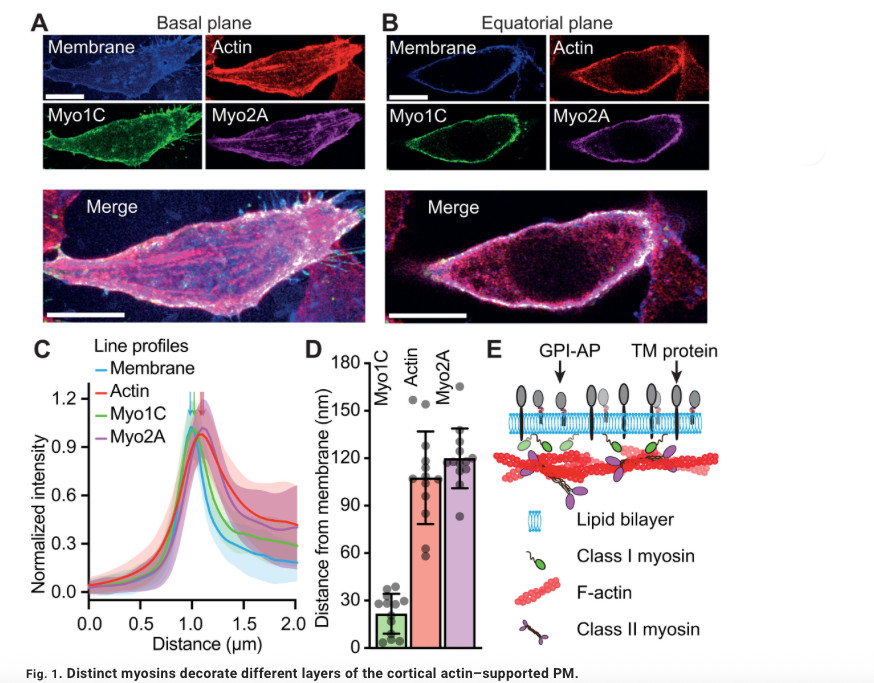
Molecular organization of the plasma membrane at nano- and micrometer scales is critical for its function in all living cells. This emerges not only from the self-assembly of lipids and proteins but also from active forces originating in the underlying cytoskeletal cortex. These forces drive membrane molecules into nonequilibrium steady-state patterns such as nanoclusters. However, the molecular agents connecting membrane organization with cytoskeletal dynamics and stresses have remained unknown. Here, we show that two classes of ubiquitous ancestral nonmuscle myosins are deployed for the organization of different types of membrane components. Inner leaflet–localized class I myosins link outerleaflet glycosylphosphatidylinositol-anchored molecules to juxta-membrane actin filaments, whereas the more cortically localized Class II myosins operate on transmembrane proteins endowed with actin-binding capacity. Consistent with an active Flory-Huggins theory for phase separation, these observations show that the distinct motor-driven membrane molecules generate spatially segregated mesoscale domains, enriched in nanoclusters derived from different myosin classes. Moreover, chemically reversible posttranslational modifications such as palmitoylation enable concatenation of these domains by enhancing the affinity of the membrane domain constituents for each other. We anticipate that the segregation potential of the adenosine 5′-triphosphate (ATP)–fueled cell membrane is made available for the crucial purpose of modulating information transduction because it can be regulated in space and time during the construction of signaling cascades, underpinning functional plasma membrane organization.

Previous Post

Nanocrític@s among the outreach projects highlighted by FECYT

Últimas noticias destacadas

  • Jesús Martínez de la Fuente receives the Juan de la Cierva National Research Award for his outstanding career in knowledge transfer in the field of nanobiotechnology
  • María José Martínez, CSIC scientist at INMA, receives the National Research Award
  • Ultrasmall platinum nanoparticles for radiation-enhanced cancer therapy

Últimas publicaciones científicas destacadas

  • Diverse ancestral myosin motors generate and segregate distinct types of nanocluster-rich domains at the plasma membrane
  • A neural network enables the design of how light propagates at the nanometre scale
  • Computational design of a photoactive [4]catenane with cyclo[48]carbon as an electron-accepting hub

Últimas novedades

  • INMA and Keysight Connect Science and Industry to Accelerate Quantum Technologies Through the CSIC Converge Programme
  • Heat lost by electronic devices could be reused to store and transmit information in the future
  • Aragon marks forty years as a leading force in the materials science that is transforming the world

Últimas noticias de divulgación

  • Nanocrític@s among the outreach projects highlighted by FECYT
  • INMA participates in the 4th Conference on Advanced Materials in Spain (AMatS 2025)
  • NanoAsalto and Conrado Rillo, awarded by IPFest 2025

Bienvenida

  • Dr Anton Stasyuk
  • Dr Olga Stasyuk
  • Dr Mónica Marro

    Campus San Francisco, Facultad de Ciencias
    C/ Pedro Cerbuna, 12 – 50009 Zaragoza (España)

    Tel.:(+34) 876 55 33 22
    webmasterinma@unizar.es

    INSTITUTO DE NANOCIENCIA Y MATERIALES DE ARAGÓN, Copyright © 2022 INMA, CSIC-UZ | Aviso Legal | Política de cookies  | webmasterinma@unizar.es

    No Result
    View All Result
    • THE INSTITUTE
      • General information
        • Welcome
        • History of the Institute
        • Organizational chart
        • Departments
        • Scientific Committee
        • Annual Reports
        • Welcome Handbook
        • Associations
      • Directory
      • Location and contact
    • RESEARCH
      • Research Areas
        • Area 1: Materials for energy
          and environment (MEM)
        • Area 2: Materials for biomedicine (BIO)
        • Area 3: Materials for information
          technology (MTI)
        • Area 4: New phenomena at the
          nanoscale (NFN)
        • Area 5: Synthesis, processing and scaling
          of advanced functional materials (SPE)
        • Area 6: Singular experimental
          technologies (TES)
      • Research Groups
      • Scientific publications
      • International projects
      • INMA scientific infrastructure
      • Microdevices Engineering Technical Unit (UTIM)
        • Structure UTIM
        • Catalog UTIM
        • Capabilities UTIM
        • Applications UTIM
      • INMA large scientific facilities
      • Scientific-Technical Services available at the institute
    • TRAINING
      • Master NANOMAT
      • Degree studies
      • Master studies
      • PhD studies
      • Internships
      • Scholarships and grants
      • Course of introduction to laboratory safety -SegurINMA
      • Research career path in Spain
    • JOB OFFERS
    • DISSEMINATION
      • Activities
        • General public
        • Schools and institutes
        • Special events
        • Cátedra SAMCA de Nanotecnología (EN)
        • LMA
      • Projects
      • Advising and training
      • Awards and distinctions
      • Multimedia
    • TRANSFER
      • Technological offer
        • Patents
        • Capabilities for industry
      • Transferred technology
      • Spin-offs
    • EQUALITY
      • Protocols and prevention against harassment

    © 2026 JNews - Premium WordPress news & magazine theme by Jegtheme.

    Este sitio web utiliza cookies para que usted tenga la mejor experiencia de usuario. Si continúa navegando está dando su consentimiento para la aceptación de las mencionadas cookies y la aceptación de nuestra política de cookies

    ACEPTAR
    Aviso de cookies