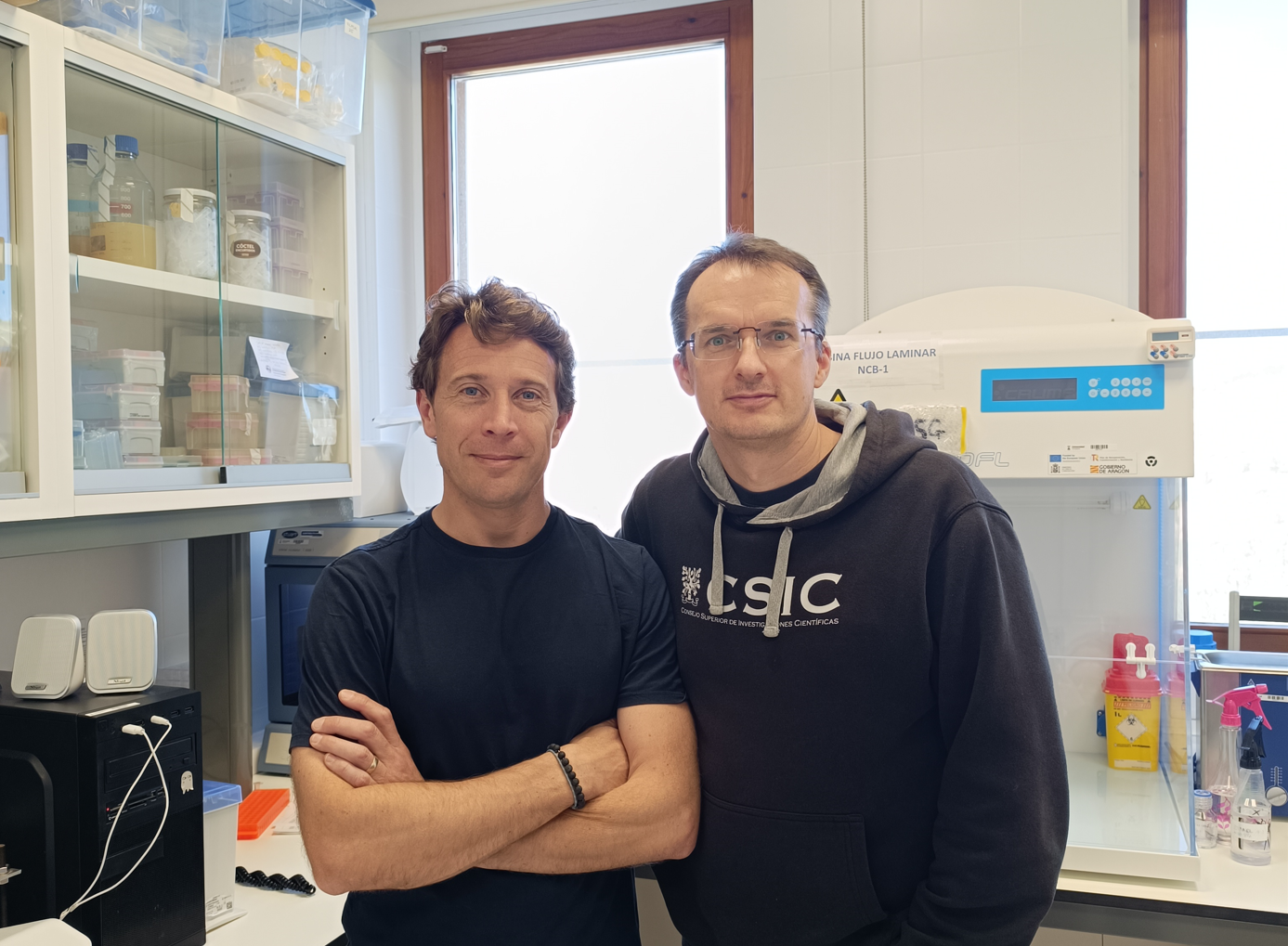
The international “BMRex” project is coordinated by Jonas Gurauskis (a scientist at the CSIC’s ARAID at INMA) who, together with Scott Mitchell (CSIC at INMA), is working on two patents to retain and degrade microplastics in wastewater treatment plants before they reach rivers and seas
These advances and many others related to water pollution and water resource management will be discussed in May at an international symposium at the Pedro Pascual Science Centre in Benasque (Water Safety Symposium – WSS2026)
Zaragoza, 21 April 2026. Microplastics and nanoplastics have become a major environmental problem of our time, with trillions of fragments entering our food chain and our bodies through bioaccumulation. Due to their size and colloidal behaviour, these particles behave more like smoke in the air than like sand in water. In other words, they cannot be easily captured using conventional filters.
The Aragon Nanoscience and Materials Institute (INMA), a joint institute of the Spanish National Research Council (CSIC) and the University of Zaragoza, is already working on two promising patents to capture and degrade these microplastics in a single process. Furthermore, the solution would be applied within the water treatment systems, preventing the pollution from reaching rivers and seas.
This breakthrough stems from the European project “BMRex”, coordinated by Jonas Gurauskis, an ARAID researcher at the CSIC’s INMA. The project, which began three years ago, is driven by an international consortium comprising teams from Spain, Germany, Portugal, Denmark and the United Kingdom, and is led by the CSIC. It has received a Pathfinder Open grant of €3,213,793.75 from the European Innovation Council (EIC) and £267,683.00 from the UK Research and Innovation (UKRI). Furthermore, the work of another CSIC scientist at INMA, Scott Mitchell, is proving decisive in the design of the membranes.
The BMRex proposal is based on biocatalytic membrane reactors specifically designed to operate within wastewater treatment plants. These reactors enable the ‘capture’ of microplastics circulating in the water, retaining and degrading them in a single step, thereby preventing them from continuing to circulate through the water cycle. This is a particularly significant breakthrough because it tackles the problem at its source, before the pollutants disperse and become much more difficult to remove.
A feasible and non-polluting solution
The reactors are made from ceramic materials, which are strong and durable, and do not introduce new plastics into the system.
On the one hand, ceramics offer excellent durability and stability in water treatment projects; furthermore, they do not pollute, meaning the solution is consistent with the project’s own environmental objective.
On the other hand, BMRex not only ‘captures’ microplastics and breaks them down, but also devotes a substantial part of its efforts to ensuring that the compounds resulting from this breakdown are not persistent, toxic or harmful to ecosystems. It is not just a matter of ‘making the plastic disappear’, but of closing the cycle without creating new, invisible risks.
Is it possible to measure microplastics reliably?
The consortium encountered an unforeseen but fundamental obstacle right at the start of the project: microplastics are not only difficult to remove, but also to measure. For this reason, the team could not fully rely on existing protocols in the field of microplastic characterisation and measurement—a controversy underpinning recent publications in prestigious journals such as Nature, which suggest that figures on pollution from these tiny materials may be skewed.
This study is particularly reliable because the consortium’s first challenge was to establish its own procedures for measuring and processing samples to avoid quantification errors.
International experts will analyse the global impact of water pollution in Benasque in May
INMA is fully committed to finding solutions to these problems and strengthening the role of research as a key tool for tackling today’s major environmental challenges.
The Water Safety Symposium – WSS2026 – forms part of this effort; it will be held in a few weeks’ time at the Pedro Pascual Science Centre in Benasque to examine emerging pollutants and new technologies for water purification. The event will take place from 6 to 9 May 2026 and will bring together scientists, engineers, industry representatives and policy-makers to discuss solutions to the global water crisis and improve water safety and quality.
The scientific sessions will revolve around five main themes: water resource management in the face of global scarcity; the challenges posed by emerging pollutants, such as PFAS, microplastics and pharmaceutical residues; and the development of advanced materials for purification, including multifunctional membranes and nanomaterials. In addition, innovations in smart devices and AI-powered sensors for real-time water quality monitoring will be presented, as well as sustainable and energy-efficient approaches, ranging from low-energy desalination and bioremediation to solar purification and circular water use systems.
The symposium is organised primarily by researchers from the Aragón Institute of Nanoscience and Materials and the Aragón Institute for Engineering Research (I3A) (Unizar).
Severo Ochoa Centre of Excellence
The Aragon Nanoscience and Materials Institute (INMA) is the first in our Autonomous Community to obtain Severo Ochoa accreditation for excellence, awarded by the State Research Agency. This recognition entails funding of €4.5 million and the provision of five pre-doctoral contracts for the period 2024–2028.
INMA is a joint institute of the CSIC and the University of Zaragoza. With around 300 members, it has more than 40 ongoing European projects and an annual average of 300 publications, as well as securing €7 million from competitive public funding schemes. Furthermore, it works in collaboration with industry, generating around €1 million annually through contracts and royalties.
21-04-2026