

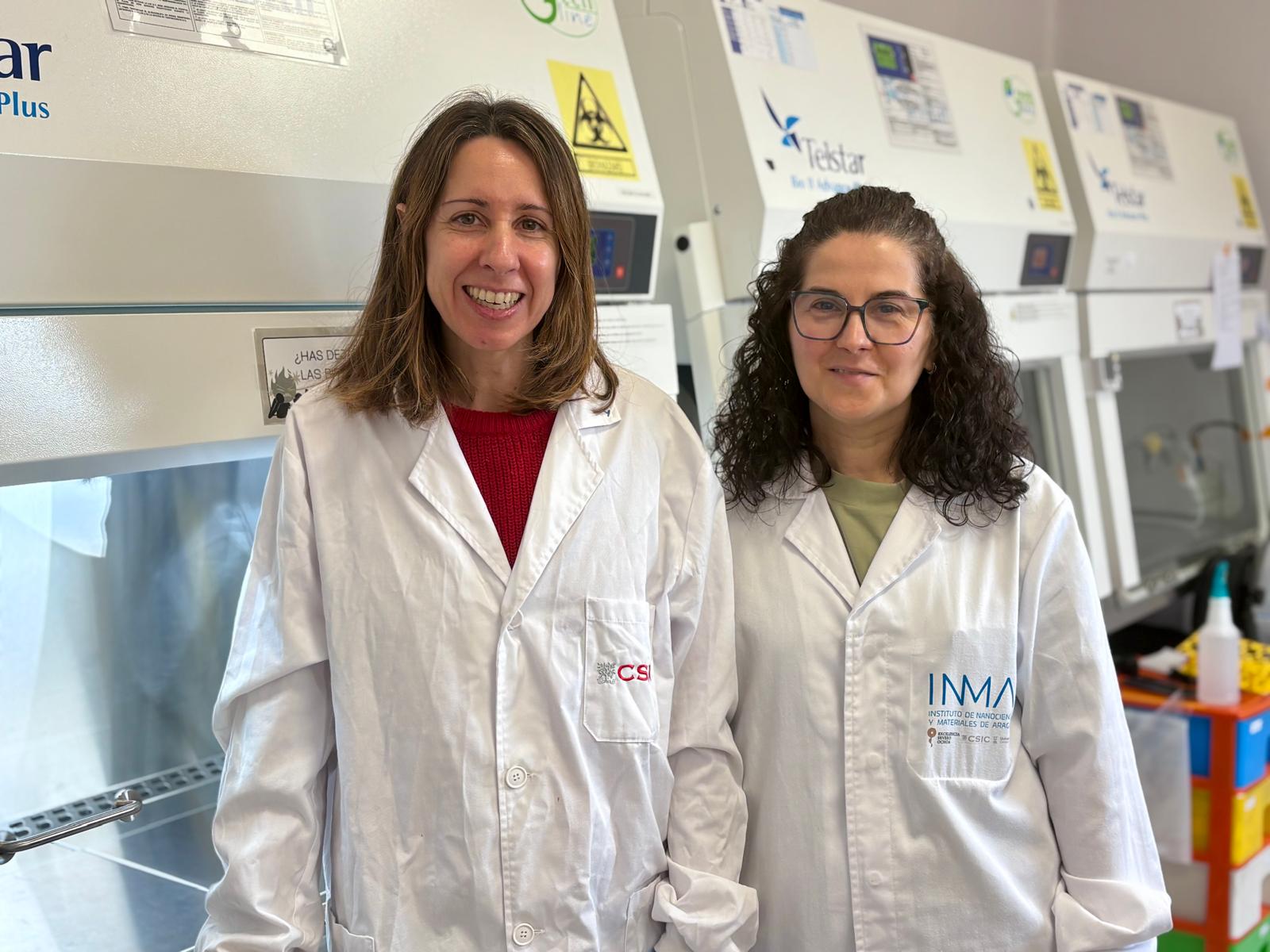
The study, led by the CSIC at the INMA (CSIC-UNIZAR), demonstrates that it is possible to stimulate cell growth and accelerate wound closure in cell cultures using nanoparticles and low-intensity magnetic fields
The breakthrough has been published in the scientific journal Advanced Functional Materials
Zaragoza, 17 November 2026. Using magnets to stimulate the repair of damaged tissues could become a new strategy in regenerative medicine. A team from the Aragon Nanoscience and Materials Institute (INMA), a joint centre of the Spanish National Research Council (CSIC) and the University of Zaragoza (UNIZAR), has developed a technology based on magnetic nanoparticles that makes it possible to activate cellular mechanisms involved in tissue growth and repair from outside the body, opening up new possibilities in regenerative medicine.
The research, whose lead author is Christian Castro Hinojosa, was led by María Moros and Raluca Fratila, both CSIC researchers, and represents one of the main achievements of the ERC Starting Grant project SIROCCO, led by María Moros. Specifically, the results show that the application of low-intensity magnetic fields together with magnetic nanoparticles can stimulate cell proliferation and accelerate wound closure. So far, the findings have been validated in vitro using cellular models, meaning that further research will be required to assess their potential clinical translation.
The results, published in the prestigious scientific journal Advanced Functional Materials, open up new possibilities for the future development of treatments capable of promoting tissue regeneration non-invasively through external stimuli.
A new way to stimulate tissue repair
The body’s ability to repair damaged tissues depends on complex cellular mechanisms that regulate, among other processes, cell growth and division.
Until now, many strategies aimed at stimulating these mechanisms have relied on the administration of drugs. However, these approaches can present limitations, particularly when it comes to controlling precisely where and when stimulation occurs, which may lead to side effects elsewhere in the body. Stimulating cell proliferation only at the desired site would represent a major advance in tissue engineering.
The technology developed at INMA offers an innovative alternative: activating cellular growth mechanisms using externally applied forces. To achieve this, the researchers use magnetic nanoparticles designed to bind selectively to a protein on the cell surface known as E-cadherin, which acts as a type of adhesive between cells.
When a gentle magnetic field is applied, the nanoparticles exert a small mechanical force on this protein, triggering a series of processes within the cell that promote the activation of genes involved in cell growth and division. In this way, the researchers have succeeded in transforming a harmless external magnetic stimulus into a biological response capable of promoting cell proliferation and accelerating wound closure without toxic side effects.
Why is this important?
Unlike previous designs, this platform provides a safe, selective, non-invasive and highly versatile strategy for developing targeted regenerative therapies without the use of conventional drugs. In the future, technologies of this kind could contribute to the development of new tools to support tissue repair, although their clinical application will require further research to demonstrate their safety and efficacy in more complex models.
The study also involved CSIC researchers Lucía G. Recaredo, Susel del Sol Fernández, Pilar Gomollón-Zueco and Yilián Fernández-Afonso, as well as Pablo Martínez-Vicente from the University of Zaragoza.
About the images provided
We are attaching photographs and audiovisual material from the experiment, showing how the system works and how the magnetic nanoparticles respond to stimulation.
More specifically, if you open the PowerPoint presentation, you will find:
Page 1. A device with magnets
A system incorporating very small magnets (10 × 10 × 3 mm), developed using 3D printing, which enables controlled magnetic fields to be applied to cell cultures. These magnets generate a local magnetic field without heating the sample, without requiring cooling, and at a very low cost.
Page 1. Animation of nanoparticles stimulated by the magnetic field
Movement of magnetic nanoparticles in response to the application of an external magnetic field.
Page 2. Images of fluorescent cells
Microscopy images showing nanoparticles (in red) bound to the cell surface before stimulation with the magnet.
Page 2. Comparison of wound closure
An experiment showing a faster wound-closure rate in model cultures when cells are treated with nanoparticles and magnets.
Images in PowerPoint: https://saco.csic.es/s/AR6bixY3Fr94WWq (password: 2bf0684fe3e34918; available up to 17 dic. 2026).
More information about the scientific publication:
Switching cells on with magnets: a drug-free way to speed up tissue repair
17-11-2026


