Instituto de Nanociencia y Materiales de Aragón
  • EspañolEspañol
Intranet
  • THE INSTITUTE
    • General information
      • Welcome
      • History of the Institute
      • Organizational chart
      • Departments
        • Department 1: Functional organic materials
        • Department 2: Materials for energy and environment
        • Department 3: Physics of materials and nanosystems
        • Department 4: Bio-nano-medicine
        • Department 5: Multifunctional magnetic materials
      • Scientific Committee
      • Annual Reports
      • Welcome Handbook
      • Associations
    • Directory
    • Location and contact
  • RESEARCH
    • Research Areas
      • Area 1: Materials for energy
        and environment (MEM)
      • Area 2: Materials for biomedicine (BIO)
      • Area 3: Materials for information
        technology (MTI)
      • Area 4: New phenomena at the
        nanoscale (NFN)
      • Area 5: Synthesis, processing and scaling
        of advanced functional materials (SPE)
      • Area 6: Singular experimental
        technologies (TES)
    • Research Groups
    • Scientific publications
    • International projects
    • INMA scientific infrastructure
    • Microdevices Engineering Technical Unit (UTIM)
      • Structure UTIM
      • Catalog UTIM
      • Capabilities UTIM
      • Applications UTIM
    • INMA large scientific facilities
    • Scientific-Technical Services available at the institute
  • TRAINING
    • Master NANOMAT
    • Degree studies
    • Master studies
    • PhD studies
    • Internships
    • Scholarships and grants
    • Course of introduction to laboratory safety -SegurINMA
    • Research career path in Spain
  • JOB OFFERS
  • DISSEMINATION
    • Activities
      • General public
      • Schools and institutes
      • Special events
        • Researchers’ Night
        • Woman and science
        • Semana de la Ciencia
          Valle de Benasque
      • Cátedra SAMCA de Nanotecnología (EN)
      • LMA
    • Projects
    • Advising and training
    • Awards and distinctions
    • Multimedia
  • TRANSFER
    • Technological offer
      • Patents
      • Capabilities for industry
    • Transferred technology
    • Spin-offs
  • EQUALITY
    • Protocols and prevention against harassment
Instituto de Nanociencia y Materiales de Aragón
No Result
View All Result

Home » The INMA is participating in international research on catalyst design using advanced electron microscopy techniques

The INMA is participating in international research on catalyst design using advanced electron microscopy techniques

by INMAweb
21/10/2026
in Highlight
0
El INMA participa en una investigación internacional sobre el diseño de catalizadores mediante técnicas avanzadas de microscopía electrónica

Our researchers Raúl Arenal and Abhijit Roy, from the Aragon Nanoscience and Materials Institute (INMA, CSIC–University of Zaragoza) and the Laboratory of Advanced Microscopy (LMA) at the University of Zaragoza, are participating in an international study led by Gianvito Vilé’s group at the Polytechnic University of Milan (Italy) and published in the scientific journal Angewandte Chemie, providing new insights into the design of more efficient catalysts.

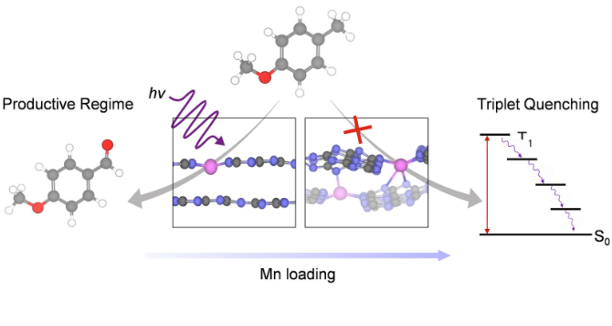
The study reveals that increasing the number of manganese atoms in certain photocatalysts does not always improve their performance, as the incorporation of Mn triggers a dynamic restructuring of these systems. Beyond a certain concentration, changes occur in the material’s structure that can reduce its effectiveness.

INMA’s contribution has been crucial to the characterisation of these materials. Raúl Arenal (an ARAID researcher at the University of Zaragoza) and Abhijit Roy, a postdoctoral researcher in Arenal’s team (the “Nanoscopy in Low-Dimensional Materials” (NLDM) research group at INMA, CSIC–UNIZAR), contributed through advanced scanning transmission electron microscopy (STEM) techniques. The analyses were carried out at the Laboratory of Advanced Microscopy (LMA) of the University of Zaragoza.

This collaboration highlights the value of advanced scientific infrastructures and their role in international research efforts that enable a deeper understanding of materials at the atomic scale.


📖 Scientific publication: Site density governs switching reactivity regimes during aerobic C–H oxidation in Mn single-atom photocatalysts

DOI: 10.1002/ange.3256491

Angew. Chem. Int. Ed. 2026, e3256491

Accepted: 3rd Sep. 2026

Viktoria Velichko, Agustín de Arriba, Areti Moutsiou, Elisabetta Inico, Andrea Olivati, Berta Pérez-Román, Jesús López-Sánchez, Ik Seon Kwon, Andrea Tonelli, Abhijit Roy, Valentina De Renzi, Raul Arenal, Annamaria Petrozza, Carlo Cavallotti, Gianvito Vilé

Abstract:
Understanding how the density of isolated metal sites affects the structure and function of single-atom catalysts remains a central challenge, particularly for photocatalysts based on polymeric semiconductors. In this study, we show that Mn incorporation in carbon nitride-supported single-atom photocatalysts (Mn1@CNx) triggers a regime transition without detectable Mn aggregation. At low-to-intermediate loadings, isolated Mn–Nx sites are accommodated within a partially delaminated CNx framework, promoting productive carrier trapping, oxygen activation, and selective aerobic benzylic C–H oxidation. Above a critical loading, however, Mn incorporation reorganizes the support into a distorted and densified architecture, modifies the Mn coordination environment, and shifts carrier dynamics toward unproductive recombination. Structural, spectroscopic, and computational analyses connect this transition to framework stacking, electronic disorder, and Mn-support coupling. During selective aerobic benzylic C–H oxidation, we show that this regime transition translates into a nonmonotonic activity response, in which additional isolated Mn sites become detrimental once support reorganization overrides the benefit of increased site density. Mechanistic experiments and theory support a photoinduced oxygen activation, with the productive regime enabled by the balance between isolated Mn sites and a favorable CNx trap-state landscape. These findings establish single-atom site density as a structural and photophysical design parameter for polymer-supported photocatalysts.

Previous Post

A Marie Curie fellow advances research into new intelligent materials capable of self-organisation at the nanoscale

Últimas noticias destacadas

  • Lucía Gutiérrez, selected as an IEEE Magnetics Society Distinguished Lecturer for 2027-2028.
  • Jesús Martínez de la Fuente receives the Juan de la Cierva National Research Award for his outstanding career in knowledge transfer in the field of nanobiotechnology
  • María José Martínez, CSIC scientist at INMA, receives the National Research Award

Últimas publicaciones científicas destacadas

  • The INMA is participating in international research on catalyst design using advanced electron microscopy techniques
  • A 3D magnetic nanotube enables the observation of new magnetic structures at the nanoscale
  • (no title)

Últimas novedades

  • A Marie Curie fellow advances research into new intelligent materials capable of self-organisation at the nanoscale
  • INMA Data Management Unit, recognised by the CSIC Management Awards
  • A portable device will enable soil analysis to optimise nutrient applications

Últimas noticias de divulgación

  • Nanocrític@s among the outreach projects highlighted by FECYT
  • INMA participates in the 4th Conference on Advanced Materials in Spain (AMatS 2025)
  • NanoAsalto and Conrado Rillo, awarded by IPFest 2025

Bienvenida

  • Dr Anton Stasyuk
  • Dr Olga Stasyuk
  • Dr Mónica Marro

    Campus San Francisco, Facultad de Ciencias
    C/ Pedro Cerbuna, 12 – 50009 Zaragoza (España)

    Tel.:(+34) 876 55 33 22
    webmasterinma@unizar.es

    INSTITUTO DE NANOCIENCIA Y MATERIALES DE ARAGÓN, Copyright © 2022 INMA, CSIC-UZ | Aviso Legal | Política de cookies  | webmasterinma@unizar.es

    No Result
    View All Result
    • THE INSTITUTE
      • General information
        • Welcome
        • History of the Institute
        • Organizational chart
        • Departments
        • Scientific Committee
        • Annual Reports
        • Welcome Handbook
        • Associations
      • Directory
      • Location and contact
    • RESEARCH
      • Research Areas
        • Area 1: Materials for energy
          and environment (MEM)
        • Area 2: Materials for biomedicine (BIO)
        • Area 3: Materials for information
          technology (MTI)
        • Area 4: New phenomena at the
          nanoscale (NFN)
        • Area 5: Synthesis, processing and scaling
          of advanced functional materials (SPE)
        • Area 6: Singular experimental
          technologies (TES)
      • Research Groups
      • Scientific publications
      • International projects
      • INMA scientific infrastructure
      • Microdevices Engineering Technical Unit (UTIM)
        • Structure UTIM
        • Catalog UTIM
        • Capabilities UTIM
        • Applications UTIM
      • INMA large scientific facilities
      • Scientific-Technical Services available at the institute
    • TRAINING
      • Master NANOMAT
      • Degree studies
      • Master studies
      • PhD studies
      • Internships
      • Scholarships and grants
      • Course of introduction to laboratory safety -SegurINMA
      • Research career path in Spain
    • JOB OFFERS
    • DISSEMINATION
      • Activities
        • General public
        • Schools and institutes
        • Special events
        • Cátedra SAMCA de Nanotecnología (EN)
        • LMA
      • Projects
      • Advising and training
      • Awards and distinctions
      • Multimedia
    • TRANSFER
      • Technological offer
        • Patents
        • Capabilities for industry
      • Transferred technology
      • Spin-offs
    • EQUALITY
      • Protocols and prevention against harassment

    © 2026 JNews - Premium WordPress news & magazine theme by Jegtheme.

    Este sitio web utiliza cookies para que usted tenga la mejor experiencia de usuario. Si continúa navegando está dando su consentimiento para la aceptación de las mencionadas cookies y la aceptación de nuestra política de cookies

    ACEPTAR
    Aviso de cookies