

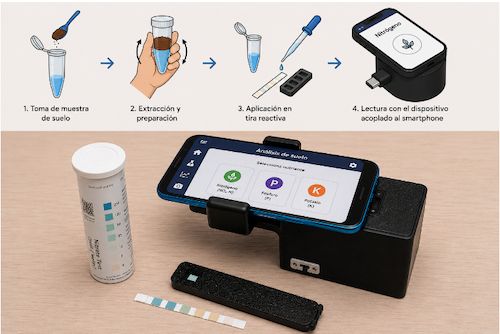
An operational group comprising three cooperatives from Aragon is developing a project to improve crop fertilisation, in collaboration with the N&SB group at INMA (CSIC-UNIZAR)
Three Aragonese cooperatives, with the support of several public institutions, are working on the development of the NPK-SCAN project, whose objective is to build a portable device that will make it possible to determine mineral nitrogen, phosphorus and potassium directly in the field by means of reactive test strips. Measurements, with results available immediately, will be taken prior to fertiliser application in order to match nutrient inputs to the actual requirements of each plot. This approach will not only improve productivity and environmental sustainability but will also promote knowledge transfer in the field of sustainable fertilisation.
The use of the system proposed by NPK-SCAN will generate substantial savings for farmers by reducing fertiliser use by between 10% and 20%, thereby lowering input costs by between €30 and €80 per hectare in arable crops. Furthermore, the application of optimised nutrient doses will contribute directly to improved environmental sustainability and increased productivity in agricultural plots.
The project represents a significant advance over current solutions, as chemical analyses will be carried out directly in the field and fertilisation can then be applied in a targeted and efficient manner. The portable device will deliver rapid results through the controlled reading of colour changes developed on reactive test strips. The device will be attached to a smartphone, whose camera will capture images under controlled lighting conditions in order to obtain quantitative information on the concentration of the nutrients analysed. In this way, measurements can be performed quickly and repeatedly throughout the crop cycle as part of a precision agriculture approach.
The project introduces innovations in three key areas. First, measurements will be performed in situ using colourimetric test strips capable of determining nitrates, phosphates and potassium through colour changes that can be quantified using a smartphone. Colourimetric test strips for these determinations will be developed and optimised, taking existing commercial kit systems as a starting point and adapting them for use with the device. Secondly, the system will incorporate a miniaturised integrating sphere that will collect the light reflected by the test strip in a uniform manner and reduce the influence of factors such as measurement angle and external lighting, thereby improving the sensitivity and reproducibility of the measurements compared with conventional systems. Finally, rather than relying on the empirical models commonly used to directly correlate camera-recorded colour with analyte concentration, a quantification model based on physicochemical principles will be developed with the aim of providing more robust and reproducible measurements.
The operational group
The operational group is made up of the agricultural cooperatives Agraria San Lamberto Cooperative Society (Zaragoza), Aragonesa Gallicum Cooperative Society (San Mateo de Gállego and Zuera) and CADEBRO (Cooperativa Agrícola Aragonesa del Ebro), which operates across the Zaragoza and Ribera Alta del Ebro regions. Together, these organisations represent around 1,300 member farmers and have a strong presence throughout the territory, enabling the project activities to be conducted on active farms located in different municipalities across the Province of Zaragoza. They will be responsible for selecting representative agricultural plots and soils in which to calibrate the optoelectronic device.
The University of Zaragoza, through the Nanosensors and Bioanalytical Systems (N&SB) Research Group of the Aragon Nanoscience and Materials Institute (INMA), will be responsible for the development, calibration and validation of the optoelectronic device for soil nutrient analysis. Meanwhile, the Aragon Agri-food Innovation and Transfer Foundation (FITA) will assume the technical, administrative and financial coordination of the project while acting as a bridge between the research community and the productive sector.
An important component of NPK-SCAN is knowledge transfer through technical workshops, demonstration activities and training initiatives aimed at disseminating project results and improving soil-related knowledge within the agricultural sector. These actions will be implemented by the Aragon Agri-food Research and Technology Centre (CITA) through the Rural Bioeconomy Innovation Centre in Teruel (CITAte), with sessions organised in various municipalities across Aragon to promote the project.
Running until September 2029
The NPK-SCAN project is now commencing and will run until September 2029. Its area of operation covers the Autonomous Community of Aragon, with a particular focus on the Province of Zaragoza, where both the scientific and technical infrastructures and the agricultural holdings involved are located. The objectives for this period are clear: firstly, to develop and validate the device and, secondly, to transfer knowledge on efficient soil fertilisation practices to the agricultural sector through technical workshops. These activities will lead to nutrient applications that are better aligned with the actual needs of the soil, reducing the risk of nitrate pollution.
The project encompasses all three links of the agri-food value chain. The first is primary production, represented by the three cooperatives. The processing sector is covered through the alfalfa dehydration plants operated by SCA San Lamberto and SCA Gallicum, as well as feed manufacturing activities carried out by SCA Gallicum and CADEBRO. Finally, marketing and commercialisation activities are undertaken by the Agroveco Group, of which CADEBRO and Servicampo are members.
Contact
For any enquiries related to this project, please contact María Martín at FITA.
Email: info@fita-aragon.es
Tel.: +34 976 716 976
Photo: Concept of the NPK-SCAN system for the rapid determination of nitrogen, phosphorus and potassium in soils using reactive test strips and a portable device coupled to a smartphone.


