

Researchers from the University of Zaragoza at INMA have published an article in the journal Advanced Materials that could prove decisive in the fight against climate change
Their work is based on the application of MOF materials (the focus of the 2025 Nobel Prize in Chemistry) to capture CO₂
Zaragoza, 18 May 2026. A team from INMA, a joint institute of the Spanish National Research Council (CSIC) and the University of Zaragoza, has achieved a breakthrough that could be decisive in the fight against climate change. Their research reports, for the first time, the application of membranes based on MOF materials (porous metal–organic frameworks that received the 2025 Nobel Prize in Chemistry, awarded to researchers Yaghi, Kitagawa and Robson) to capture carbon dioxide (CO₂) directly from the air.
The study has been published in the prestigious scientific journal Advanced Materials and represents an important step towards the implementation of more efficient and sustainable technologies to reduce atmospheric CO₂ concentrations. The team is made up of scientists from the Department of Chemical Engineering & Environmental Technologies at the University of Zaragoza, who are also members of the Membranes and Catalysis with Nanostructured Materials Group (MECANOS) at INMA.
The work advances one of the emerging strategies to combat climate change by applying ultrathin membranes incorporating MOF materials to the direct air capture of CO₂ (DAC). Unlike other methods, this approach does not require acting on a specific emission source, as it enables CO₂ to be removed directly from the atmosphere.
The membranes, formed by extremely thin layers of materials combined at the nanometric scale, incorporate a MOF adapted from a structure known as ZIF‑8. This adaptation has been achieved through a sequential ligand‑exchange process, an innovative technique developed specifically at INMA, which enhances the material’s ability to capture CO₂ molecules and optimises the membrane’s properties. This membrane can separate CO₂ with great precision while allowing a high airflow, even under conditions similar to real air, where the gas is present at very low concentrations (around 400 parts per million, that is, 0.04%).
DAC is a technology that is beginning to be developed in various countries because it does not need to be located near a specific emission source, as CO₂ is present throughout the atmosphere. This makes it possible to install these plants in places where energy is cheaper and cleaner, such as areas with abundant renewable energy (wind, solar or geothermal).
The researchers leading the project are Professors Carlos Téllez and Joaquín Coronas, principal investigators of the project Direct air capture of CO₂ with thin‑film nanocomposite membranes based on MOFs, PID2022‑138582OB‑I00, funded by the Spanish Ministry of Science, Innovation and Universities through the State Research Agency and co‑funded by the European Regional Development Fund.
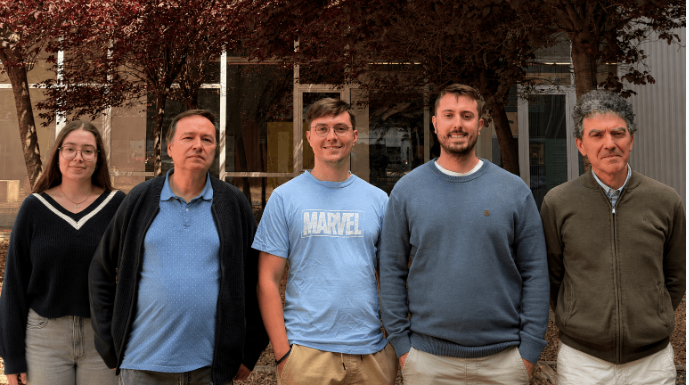
The research team also includes Íñigo Martínez (who will soon defend his doctoral thesis on the subject), José Miguel Luque (a postdoctoral fellow funded by the La Caixa Foundation and recently awarded a Ramón y Cajal postdoctoral contract), and Lucía Carrillo (doctoral student). In addition, researchers from the University of Manchester (United Kingdom), Dr Andrew Foster and Prof Peter Budd, contributed to the work by providing the polymer (PIM‑1) used to produce the membranes.
The article has been published at the following link:
Synergy of block and microporous polymers with tailored zeolitic imidazole frameworks for membrane‑based direct air capture
DOI: https://doi.org/10.1002/adma.202510740 Advanced Materials (impact factor 26.8), 6 Oct. 2025
Íñigo Martínez‑Visus, Lucía Carrillo‑Sánchez, José Miguel Luque‑Alled, Andrew B. Foster, Peter M. Budd, Carlos Téllez, Joaquín Coronas
The names of the people in the attached photograph, from left to right, are: Lucía Carrillo, Carlos Téllez, Íñigo Martínez, José Miguel Luque and Joaquín Coronas.


