Scientists from the University of Zaragoza at INMA (CSIC–UNIZAR), together with researchers from the Antimicrobials Team of the Mycobacterial Genetics Group at the University of Zaragoza, have just published their work in the journal Antibiotics. Five years of collaborative research were devoted to a disruptive methodology: analysing molecules initially designed for photovoltaic applications.
Zaragoza, 25 May 2026. A team of scientists has achieved a promising breakthrough from Aragón by identifying a new family of compounds active against bacteria including methicillin‑resistant Staphylococcus aureus (MRSA), one of the most dangerous pathogens according to the WHO due to its resistance to conventional antibiotics. The team consists of researchers from the University of Zaragoza at the Aragon Nanoscience and Materials Institute (INMA), a joint institute of the Spanish National Research Council (CSIC) and UNIZAR, and the Antimicrobials Team of the Mycobacterial Genetics Group at UNIZAR.
The study, published in the journal Antibiotics (Q1, Journal Citation Reports), addresses the growing problem of antibiotic resistance, responsible for millions of deaths worldwide each year. The work is the result of a research line developed over approximately five years.
The study adopts an approach that differs from conventional strategies in antibiotic discovery. Instead of using compounds designed as drugs, the researchers analysed photoactive molecules originally developed for photovoltaic applications in materials science.
This approach enabled the identification of antibacterial activity in a specific chemical family, the 4H‑pyran‑4‑ylidenes. Several compounds in this series showed bactericidal activity against Gram‑positive bacteria, even at very low concentrations.
The authors of the study are Santiago Franco and Raquel Andreu, researchers from UNIZAR at INMA; José Manuel Ezquerra‑Aznárez and Raquel Alonso, from UNIZAR; Ainhoa Lucía and José A. Aínsa from the Department of Microbiology and the BIFI at UNIZAR and the Biomedical Research Networking Centre (CIBERES), as well as Santiago Ramón‑García, also an ARAID researcher.
Activity against MRSA
The breakthrough is significant because some of the identified compounds showed activity against different bacterial species, including strains of Staphylococcus aureus. This bacterium is common in the human microbiome and is normally sensitive to antibiotics, but when it becomes resistant—particularly to methicillin (known as MRSA, methicillin‑resistant Staphylococcus aureus)—it can cause infections that are difficult to treat. Under laboratory conditions, one of the identified compounds proved effective against MRSA, which is classified by the World Health Organization (WHO) as one of the most dangerous bacteria due to its resistance.
Moreover, tests carried out on experimental models of human cell lines (HepG2 line) showed that the compounds do not produce toxic effects at the doses required to kill the bacteria.
The results indicate that these compounds have a chemical structure different from that of currently available antibiotic families, which could be relevant in avoiding cross‑resistance.
The work is at an early stage, but it provides initial evidence regarding the bacterial response to these compounds and opens new avenues beyond conventional antibiotics.
The next steps in the research include further investigation into the mechanisms of action of these compounds and optimisation of their chemical properties, with the aim of assessing their potential as a basis for the development of new antimicrobial agents.
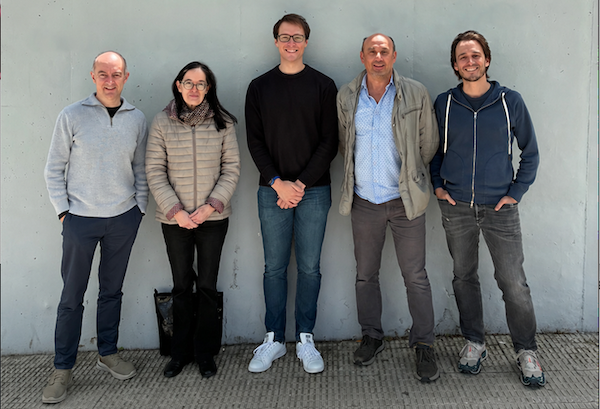
Photo (from left to right: Aínsa, Andreu, Ezquerra, Franco & Ramón).
Scientific publication
“New chemical scaffold with antimicrobial activity identified in a screening of industrial photoactive compounds”
DOI: https://doi.org/10.3390/antibiotics15030321
Antibiotics 2026, 15, 321
20 March 2026
José Manuel Ezquerra-Aznárez, Raquel Alonso-Román, Ainhoa Lucía, Raquel Andreu, Santiago Franco, José A. Aínsa and Santiago Ramón-García
27-05-2026