

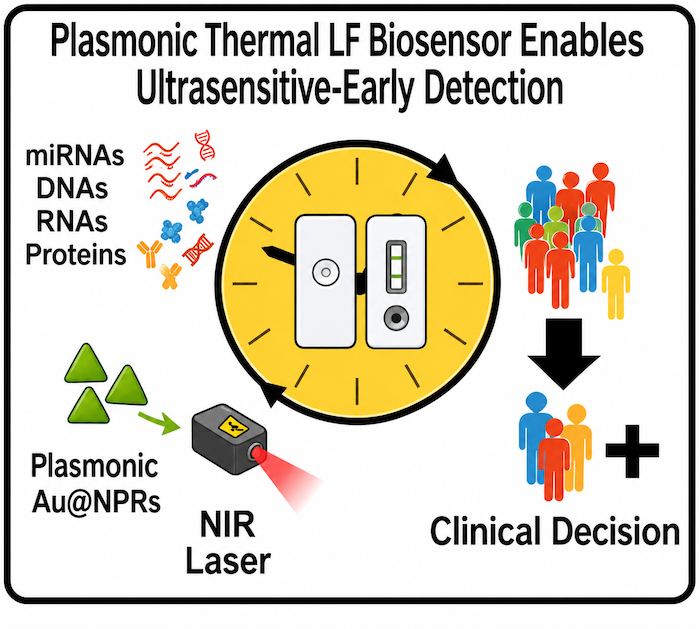
🔬🧪 Building the foundations for next-generation ultrasensitive lateral flow assays!
Prior to the Bionanonsurf group‘s latter publication, they introduced in Small a portable and versatile thermoplasmonic platform based on gold nanoprisms, designed to approach gold-standard detection sensitivity while preserving the simplicity and accessibility of conventional lateral flow assays.
By exploiting the unique photothermal properties of plasmonic nanoparticles, their Calorimetric Lateral Flow Assay (CLFA) technology transforms conventional passive labels into active signal amplifiers, opening new possibilities for ultrasensitive biomolecular detection.
This earlier work laid the scientific and technological foundations for their latter publication and the development of new diagnostic applications.
One technological platform, multiple diagnostic applications, and a common goal: pushing the sensitivity boundaries of conventional lateral flow assays.
🔬 From fundamental nanoscience to next-generation diagnostic technologies.
Approaching gold‐standard sensitivity in a portable and versatile gold nanoprisms thermoplasmonic platform for lateral flow detection of biomolecules
Small, 2026; 22:e14946, accepted 21 May 2026
Carlos Cuestas Ayllón, Alba Martín Barreiro, África García Barrientos, María Moros, Valeria Grazú Bonavía, Jesús Martínez de la Fuente
Abstract:
Plasmonic nanoparticles exhibit unique optical and thermal properties that make them ideal for next‐generation diagnostic technologies. Among them, gold nanoprisms (AuNPrs) are especially powerful due to their anisotropic geometry, tunable surface plasmon resonance in the near‐infrared (NIR) region, and high photothermal conversion efficiency. These features transform them from passive labels into active nanotransducers capable of amplifying diagnostic signals. Building on these advantages, we developed two AuNPr‐based sensing platforms: Thermo Lateral Flow Immunoassay (ThermoLFIA) and Thermo Oligonucleotide‐based Lateral Flow Assay (ThermoOLFA). By coupling AuNPrs with thermoresponsive substrates, both systems use localized heat generation to boost analytical sensitivity, enabling visual enhancement far beyond that of conventional gold spheres. ThermoLFIA demonstrated clinically relevant detection of gastrointestinal cancer biomarkers (CEA, CA19‐9, VEGF), outperforming standard ELISA tests. In parallel, functionalization of AuNPrs with DNA probes enabled ThermoOLFA to detect SARS‐CoV‐2 RNA with sensitivity comparable to RT‐qPCR, but without amplification steps and within 25 min. This proof‐of‐concept confirms that plasmonic nanoprisms can drive rapid, portable, and ultrasensitive diagnostics, opening a path toward point‐of‐care platforms with strong clinical and translational potential.
Keywords: cancer detection, infectious diseases biomarkers, plasmonic nanoparticles, point‐of‐care devices, thermal biosensors.


