

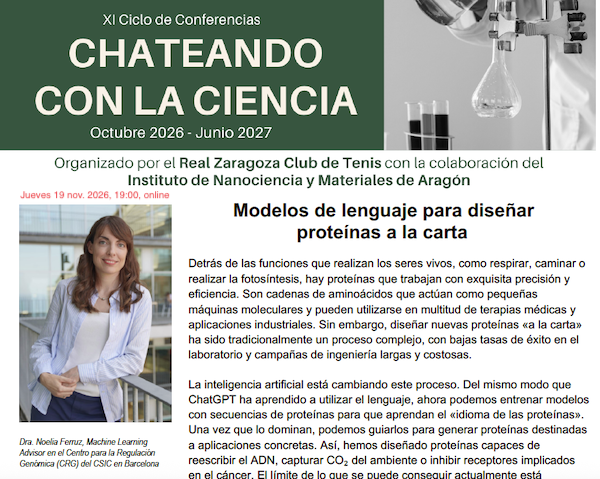
Chateando con la Ciencia: Noelia Ferruz, from the Centro de Regulación Genómica (CRG), CSIC, Barcelona
Language models for designing bespoke proteins
Breathing, walking and photosynthesis are all made possible by proteins: chains of amino acids that act as tiny molecular machines. Their potential in medical therapies and industrial applications is enormous, but designing new proteins “to order” has traditionally been a complex process, with low success rates in the laboratory and long, costly engineering campaigns.
Artificial intelligence is changing this picture. Just as ChatGPT learned to use language, it is now possible to train models on protein sequences so that they learn the “language of proteins”, and then steer them towards specific applications. Using this approach, proteins have been designed that can rewrite DNA, capture CO₂ from the atmosphere or inhibit receptors involved in cancer.
Dr Noelia Ferruz, Machine Learning Advisor at the Centre for Genomic Regulation (CRG) of the Spanish National Research Council (CSIC) in Barcelona, will speak on this topic in the lecture opening the 11th “Chateando con la Ciencia” (Chatting with Science) lecture series. The series is organised by the Real Zaragoza Club de Tenis in collaboration with the Aragon Nanoscience and Materials Institute (INMA). A chemist, bioinformatician and doctor of biomedicine, trained at the Universities of Zaragoza, Cambridge and Pompeu Fabra, she is one of the Spanish researchers leading the application of AI to the life sciences. She has worked with companies such as Pfizer, Janssen and Boehringer Ingelheim, and now leads the Artificial Intelligence for Protein Design group at the CRG. Her team works on enzymes for CO₂ capture, gene-editing tools and new strategies against cancer. She has been awarded an ERC Starting Grant and other prestigious European projects.
The talk will be held by videoconference, with access limited to 100 participants. To attend, please request the access code from palacio@unizar.es.
📅 Thursday, 19 November 2026
🕒 19:00
📍 Videoconference (access limited to 100 participants; access code: palacio@unizar.es)


