Aragon will manage almost two million euros from the European Union to produce renewable synthetic fuels with maximum energy savings
- The Aragón Hydrogen Foundation, as coordinator, and the Aragon Nanoscience and Materials Institute are participating as partners in the European project +C2Fue-LS, alongside five other entities from Spain, France, Belgium and Germany
- The initiative represents an innovative technology for converting CO2 into alcohols and other key compounds such as fuels and value-added chemicals
Zaragoza, 13 November 2025. On 1 October, the European project +C2Fue-LS was launched, which aims to contribute to the production of renewable synthetic fuels for maritime transport and aviation, among other sectors, at a temperature below 100 degrees Celsius, i.e. through highly efficient processes in terms of energy savings and making the most of resources. The initiative, which will last four years, involves seven partners, including the Aragón Hydrogen Foundation (FHA) as coordinator and the Aragon Nanoscience and Materials Institute (INMA), a joint centre of the Spanish National Research Council (CSIC) and the University of Zaragoza. Of the total budget, which amounts to four million euros, the Aragonese entities will manage just over 1.8 million.
+C2Fue-LS represents an innovative technology in the conversion of CO2 into alcohols and other key compounds such as fuels and value-added chemicals. To achieve its goal, the project will design advanced materials and validate new reactor concepts that will enable (thanks to hydrogen) the transformation of emissions such as CO2 into clean fuels and chemicals at the lowest possible temperature, which are key in industry for various applications and with an overall improvement in energy efficiency of between 10% and 15%. Thanks to the use of a combination of plasma technologies – a pioneer in room-temperature catalysis – enzymes and organic metal ion networks, +C2Fue-LS will significantly reduce energy barriers and increase process efficiency.
The project results are expected to have an impact on several sectors such as maritime and air transport, mobility, the energy sector, the chemical industry and the pharmaceutical industry, among others, ‘as the new reactor concept to be developed can be customised according to the product to be obtained,’ explains Vanesa Gil, a researcher at the Aragonese Agency for Research and Development (ARAID) at the FHA and project leader. Using hydrogen as a raw material, this disruptive modular technological reactor will be able to selectively produce, under mild conditions (less than 100 degrees), aldehydes and light alcohols for fuel cells, for direct use in maritime transport, and other essential components for the chemical industry, as well as alcohols ready for use in the production of aviation fuels, using renewable electricity.
The principal investigator on behalf of the CSIC is Jonas Gurauskis, ARAID researcher at INMA-CSIC-UNIZAR, who is leading the advanced design and manufacture of materials such as catalytic supports using additive (3D) technology.
In addition, Elena Gálvez, CSIC research professor at INMA-CSIC-Unizar, is leading the design and characterisation of advanced catalysts for use in cold plasma-based catalytic processes with the aim of recycling CO₂ and transforming it together with H₂ into molecules of interest as precursors for fuels and other chemical products.
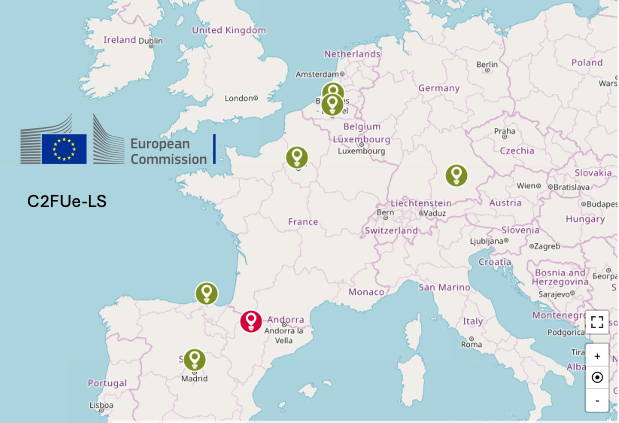
The other participating partners are BC Materials (Basque Country), CNRS (France), the University of Antwerp (Belgium), the University of Munich (Germany) and Aliénor (Belgium).
This project has received funding from the European Union’s Framework Programme for Research and Innovation, Horizon Europe, under grant agreement No. 101236115.
13-11-2025