Nanomaterials
In Philadelphia in 1946, the world’s first computer was built. It was called the ENIAC, was over three metres long and consumed 174,000 watts of power: every time it was plugged in, the lights of Philadelphia flickered for a few moments. Today we have computers that fit in the palm of your hand and run on batteries.
Miniaturisation is reaching unimaginable extremes, to the point where we are making objects 100 times smaller than a virus: we are in the age of nanotechnology. Using nanoscience, NASA has been able to detect ONE water molecule on Mars.
What are we doing at INMA on this topic?
We build magnetic nanowires -for sensors with a reaction time of millionths of a second-, we study materials containing magnetic nanoparticles -applicable in the read heads of hard disks-, nanoporous materials -used in the fractionation of oil-, and even the metabolism of iron in humans, where nanoscience has a lot to say…
We are investigating the use of magnetic nanomaterials in medicine: they can guide the drug to the site of application by finding the most suitable molecular pathways. We are also researching nanomaterials with a magnetocaloric effect, which can be used to clear tumours in areas where surgery is risky or impractical.
We are also working in one of the most promising fields, that of carbon nanotubes. They are 6 times less dense than steel, 5 times more rigid and 100 times more resistant. The INMA is working to incorporate them into a nanocomposite of very high mechanical performance.
Magnetism as a tool in the study of new alloys
Why are we still fascinated by metals? Dozens of centuries after their discovery, metallic materials continue to play an important role in our economic and technological development. Despite the remoteness of our coexistence with them, there are still many basic aspects yet to be fully understood, such as the emergence of new manufacturing methods, which require innovative approaches to the characterisation and understanding of these materials.
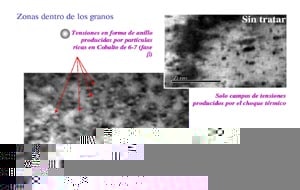
Magnetic tracking of the growth of cobalt particles in a CuCo matrix illustrates this new approach, which is being worked on at INMA. Surprising details of how the cobalt particles cannibalise their environment until they become magnetically isolated from the rest will allow us to perceive why the use of magnetism can be a refined tool in the characterisation of alloys of industrial interest.