Instituto de Nanociencia y Materiales de Aragón
  • EspañolEspañol
Intranet
  • THE INSTITUTE
    • General information
      • Welcome
      • History of the Institute
      • Organizational chart
      • Departments
        • Department 1: Functional organic materials
        • Department 2: Materials for energy and environment
        • Department 3: Physics of materials and nanosystems
        • Department 4: Bio-nano-medicine
        • Department 5: Multifunctional magnetic materials
      • Scientific Committee
      • Annual Reports
      • Welcome Handbook
      • Associations
    • Directory
    • Location and contact
  • RESEARCH
    • Research Areas
      • Area 1: Materials for energy
        and environment (MEM)
      • Area 2: Materials for biomedicine (BIO)
      • Area 3: Materials for information
        technology (MTI)
      • Area 4: New phenomena at the
        nanoscale (NFN)
      • Area 5: Synthesis, processing and scaling
        of advanced functional materials (SPE)
      • Area 6: Singular experimental
        technologies (TES)
    • Research Groups
    • Scientific publications
    • International projects
    • INMA scientific infrastructure
    • Microdevices Engineering Technical Unit (UTIM)
      • Structure UTIM
      • Catalog UTIM
      • Capabilities UTIM
      • Applications UTIM
    • INMA large scientific facilities
  • TRAINING
    • Master NANOMAT
    • Degree studies
    • Master studies
    • PhD studies
    • Internships
    • Scholarships and grants
    • Course of introduction to laboratory safety -SegurINMA
    • Research career path in Spain
  • JOB OFFERS
  • DISSEMINATION
    • Activities
      • General public
      • Schools and institutes
      • Special events
        • Researchers’ Night
        • Woman and science
        • Semana de la Ciencia
          Valle de Benasque
      • Cátedra SAMCA de Nanotecnología (EN)
      • LMA
    • Projects
    • Advising and training
    • Awards and distinctions
    • Multimedia
  • TRANSFER
    • Technological offer
      • Patents
      • Capabilities for industry
    • Transferred technology
    • Spin-offs
  • EQUALITY
    • Protocols and prevention against harassment
Instituto de Nanociencia y Materiales de Aragón
  • THE INSTITUTE
    • General information
      • Welcome
      • History of the Institute
      • Organizational chart
      • Departments
        • Department 1: Functional organic materials
        • Department 2: Materials for energy and environment
        • Department 3: Physics of materials and nanosystems
        • Department 4: Bio-nano-medicine
        • Department 5: Multifunctional magnetic materials
      • Scientific Committee
      • Annual Reports
      • Welcome Handbook
      • Associations
    • Directory
    • Location and contact
  • RESEARCH
    • Research Areas
      • Area 1: Materials for energy
        and environment (MEM)
      • Area 2: Materials for biomedicine (BIO)
      • Area 3: Materials for information
        technology (MTI)
      • Area 4: New phenomena at the
        nanoscale (NFN)
      • Area 5: Synthesis, processing and scaling
        of advanced functional materials (SPE)
      • Area 6: Singular experimental
        technologies (TES)
    • Research Groups
    • Scientific publications
    • International projects
    • INMA scientific infrastructure
    • Microdevices Engineering Technical Unit (UTIM)
      • Structure UTIM
      • Catalog UTIM
      • Capabilities UTIM
      • Applications UTIM
    • INMA large scientific facilities
  • TRAINING
    • Master NANOMAT
    • Degree studies
    • Master studies
    • PhD studies
    • Internships
    • Scholarships and grants
    • Course of introduction to laboratory safety -SegurINMA
    • Research career path in Spain
  • JOB OFFERS
  • DISSEMINATION
    • Activities
      • General public
      • Schools and institutes
      • Special events
        • Researchers’ Night
        • Woman and science
        • Semana de la Ciencia
          Valle de Benasque
      • Cátedra SAMCA de Nanotecnología (EN)
      • LMA
    • Projects
    • Advising and training
    • Awards and distinctions
    • Multimedia
  • TRANSFER
    • Technological offer
      • Patents
      • Capabilities for industry
    • Transferred technology
    • Spin-offs
  • EQUALITY
    • Protocols and prevention against harassment
Instituto de Nanociencia y Materiales de Aragón
No Result
View All Result

Home » Optimizing electron injection in D-A’-π-a dye sensitized solar cells: The role of electrolyte modificati

Optimizing electron injection in D-A’-π-a dye sensitized solar cells: The role of electrolyte modificati

by INMAweb
12/12/2025
in Highlight
0
Optimizing electron injection in D-A’-π-a dye sensitized solar cells: The role of electrolyte modification

Isolda Duerto, Jesús Orduna, Belén Villacampa and María-Jesús Blesa have published Optimizing electron injection in D-A’-π-a dye sensitized solar cells: The role of electrolyte modification.

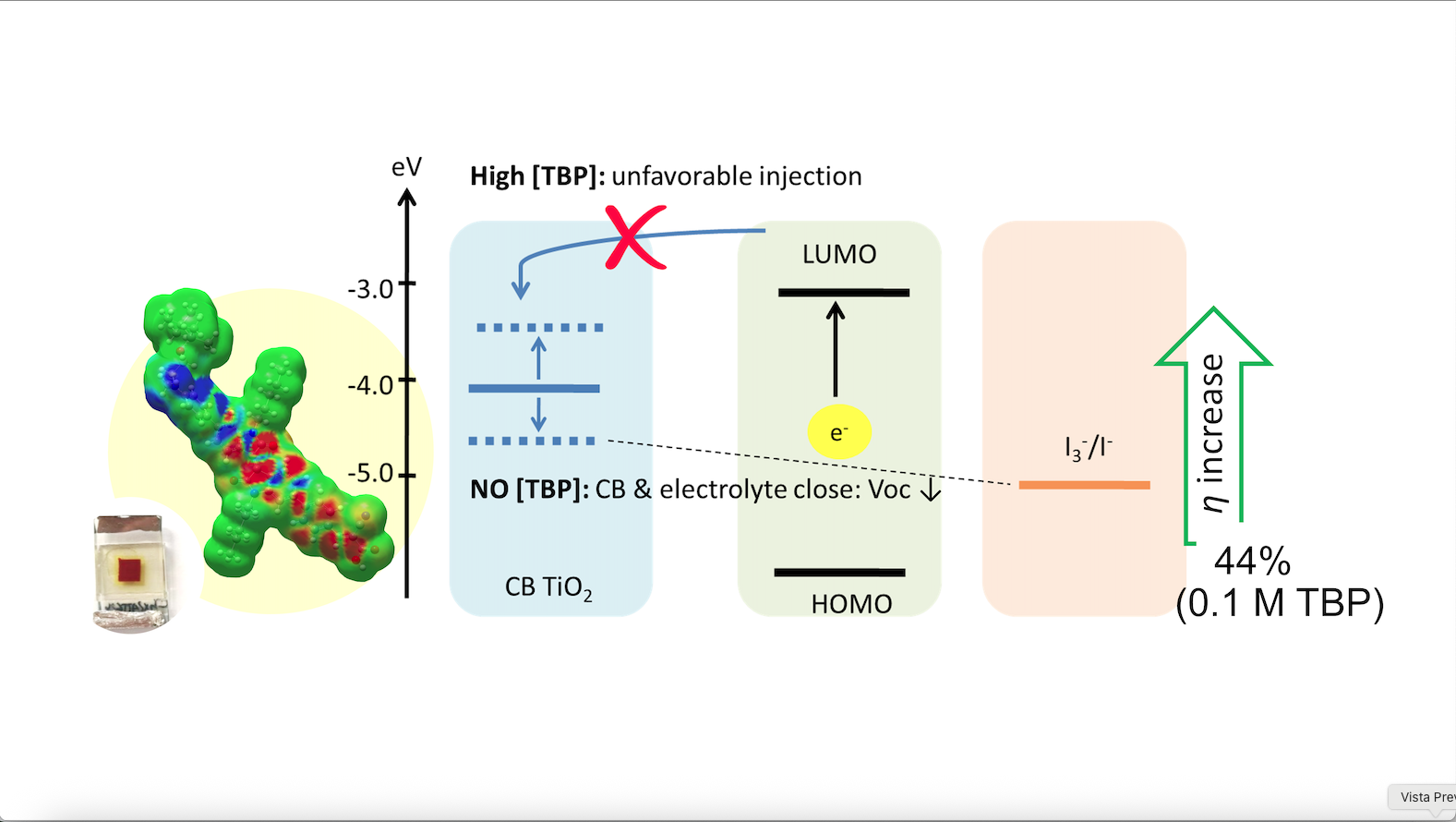
This study establishes a theoretical and technical pathway, based on electroanalytical methods, for an optimized design of DSSCs with balanced short-circuit current density (Jsc) and open-circuit voltage (Voc) parameters. To overcome this, the effect of the iodide/triiodide electrolyte composition on the electrochemical properties is explored.

This work can be found in Journal of Electroanalytical Chemistry 1001 (2026) 119686, a journal with a 22% acceptance rate.

Optimizing electron injection in D-A’-π-a dye sensitized solar cells: The role of electrolyte modification

Isolda Duerto, Jesús Orduna, Belén Villacampa, María-Jesús Blesa

DOI: 10.1016/j.jelechem.2025.119686

Journal of Electroanalytical Chemistry, Volume 1001, 15 January 2026, 119686

Abstract
This study establishes a theoretical and technical pathway, based on electroanalytical methods, for an optimized design of DSSCs with balanced short-circuit current density (Jsc) and open-circuit voltage parameters (Voc). In this paper, isoindigo (iI) and benzothiadiazole (BTZ) are included as auxiliary acceptors in A-iI-Ph-SIL and A-BTZ-Ph-SIL dyes, respectively. The strength of auxiliary acceptors greatly influences the thermodynamic parameters governing the electron transfer process, as well as the proper distribution of electron density in orbitals. Theoretical calculations reveal that the isoindigo unit, in A-iI-Ph-SIL, exhibits a strong acceptor character that hinders charge transfer from the donor to the primary acceptor. However, in the A-BTZ-Ph-SIL, the moderate acceptor character of the benzothiadiazole unit allows charge movement across the molecule. Voltammetric analyses indicate that, in A-iI-Ph-SIL, the electron injection into the semiconductor is compromised because its excited state energy level is too close to the TiO2 conduction band edge. This fact limits the necessary driving force for efficient injection process. To overcome this, the influence of the iodide/triiodide electrolyte composition on the electrochemical properties is explored. A concentration of 0.1 M tert-butylpyridine yields the optimal efficiency in these devices. This particular concentration strikes the right balance between Jsc and Voc. Notably, this optimized concentration led to a significant 44 % improvement in DSSC efficiency compared to the conventional 0.5 M tert-butylpyridine concentration, achieving a maximum efficiency of 4.79 %. Electrochemical Impedance Spectroscopy indicates that better conversion efficiencies of the devices are linked to a high charge transfer resistance at the TiO₂/solvent interface.

Imagen

Previous Post

On-chip EPR spectrometry of metalloproteins using superconducting lumped element resonators

Next Post

CSIC researchers open the door to revolutionising quantum technologies thanks to artificial intelligence and cold atoms

Next Post
Investigadores del CSIC abren la puerta a revolucionar las tecnologías cuánticas gracias a la inteligencia artificial y a los átomos fríos

CSIC researchers open the door to revolutionising quantum technologies thanks to artificial intelligence and cold atoms

Últimas noticias destacadas

  • INMA participates in a fundamental breakthrough in the design of new multifunctional materials for biomedical and high-tech applications
  • INMA is recognised for developing its globally impactful helium technology
  • INMA researcher Jesús Carrete receives award from the Royal Academy of Exact, Physical, Chemical, and Natural Sciences of Zaragoza

Últimas publicaciones científicas destacadas

  • Optimizing electron injection in D-A’-π-a dye sensitized solar cells: The role of electrolyte modificati
  • On-chip EPR spectrometry of metalloproteins using superconducting lumped element resonators
  • Galvanic intercalation of molecular cations into Van der Waals materials and heterostructures

Últimas novedades

  • CSIC researchers open the door to revolutionising quantum technologies thanks to artificial intelligence and cold atoms
  • Aragon leads a European project to develop natural treatments that protect cultural heritage from biodeterioration
  • Call for entries for the REAL competition, organised by the Cátedra SAMCA de Nanotecnología

Últimas noticias de divulgación

  • INMA participates in the 4th Conference on Advanced Materials in Spain (AMatS 2025)
  • NanoAsalto and Conrado Rillo, awarded by IPFest 2025
  • Quantum film series at the Zaragoza Film Library

Bienvenida

  • Dr Cristina Momblona
  • Dr. Thomas S. van Zanten
  • Dr Cristina Bran

    Campus San Francisco, Facultad de Ciencias
    C/ Pedro Cerbuna, 12 – 50009 Zaragoza (España)

    Tel.:(+34) 876 55 33 22
    webmasterinma@unizar.es

    INSTITUTO DE NANOCIENCIA Y MATERIALES DE ARAGÓN, Copyright © 2022 INMA, CSIC-UZ | Aviso Legal | Política de cookies  | webmasterinma@unizar.es

    No Result
    View All Result
    • THE INSTITUTE
      • General information
        • Welcome
        • History of the Institute
        • Organizational chart
        • Departments
        • Scientific Committee
        • Annual Reports
        • Welcome Handbook
        • Associations
      • Directory
      • Location and contact
    • RESEARCH
      • Research Areas
        • Area 1: Materials for energy
          and environment (MEM)
        • Area 2: Materials for biomedicine (BIO)
        • Area 3: Materials for information
          technology (MTI)
        • Area 4: New phenomena at the
          nanoscale (NFN)
        • Area 5: Synthesis, processing and scaling
          of advanced functional materials (SPE)
        • Area 6: Singular experimental
          technologies (TES)
      • Research Groups
      • Scientific publications
      • International projects
      • INMA scientific infrastructure
      • Microdevices Engineering Technical Unit (UTIM)
        • Structure UTIM
        • Catalog UTIM
        • Capabilities UTIM
        • Applications UTIM
      • INMA large scientific facilities
    • TRAINING
      • Master NANOMAT
      • Degree studies
      • Master studies
      • PhD studies
      • Internships
      • Scholarships and grants
      • Course of introduction to laboratory safety -SegurINMA
      • Research career path in Spain
    • JOB OFFERS
    • DISSEMINATION
      • Activities
        • General public
        • Schools and institutes
        • Special events
        • Cátedra SAMCA de Nanotecnología (EN)
        • LMA
      • Projects
      • Advising and training
      • Awards and distinctions
      • Multimedia
    • TRANSFER
      • Technological offer
        • Patents
        • Capabilities for industry
      • Transferred technology
      • Spin-offs
    • EQUALITY
      • Protocols and prevention against harassment

    © 2026 JNews - Premium WordPress news & magazine theme by Jegtheme.

    Este sitio web utiliza cookies para que usted tenga la mejor experiencia de usuario. Si continúa navegando está dando su consentimiento para la aceptación de las mencionadas cookies y la aceptación de nuestra política de cookies

    ACEPTAR
    Aviso de cookies