INMA researchers develop a new rapid sensor for foodborne bacteria such as Salmonella or Listeria
The study, which uses liquid crystals that “light up” upon pathogen detection, has just been published in the prestigious Journal of the American Chemical Society, opening new avenues for fast and effective solutions to prevent outbreaks.
Led by the CLIP (Liquid Crystals and Polymers) group at the Aragon Nanoscience and Materials Institute (INMA, CSIC-Unizar)
Zaragoza, 20 January 2026. A team of researchers from INMA, a joint institute of the Spanish National Research Council (CSIC) and the University of Zaragoza, has developed a new type of biosensor capable of rapidly and easily detecting pathogens using liquid crystals, materials well known for their use in display technologies, but with remarkable properties beyond electronics.
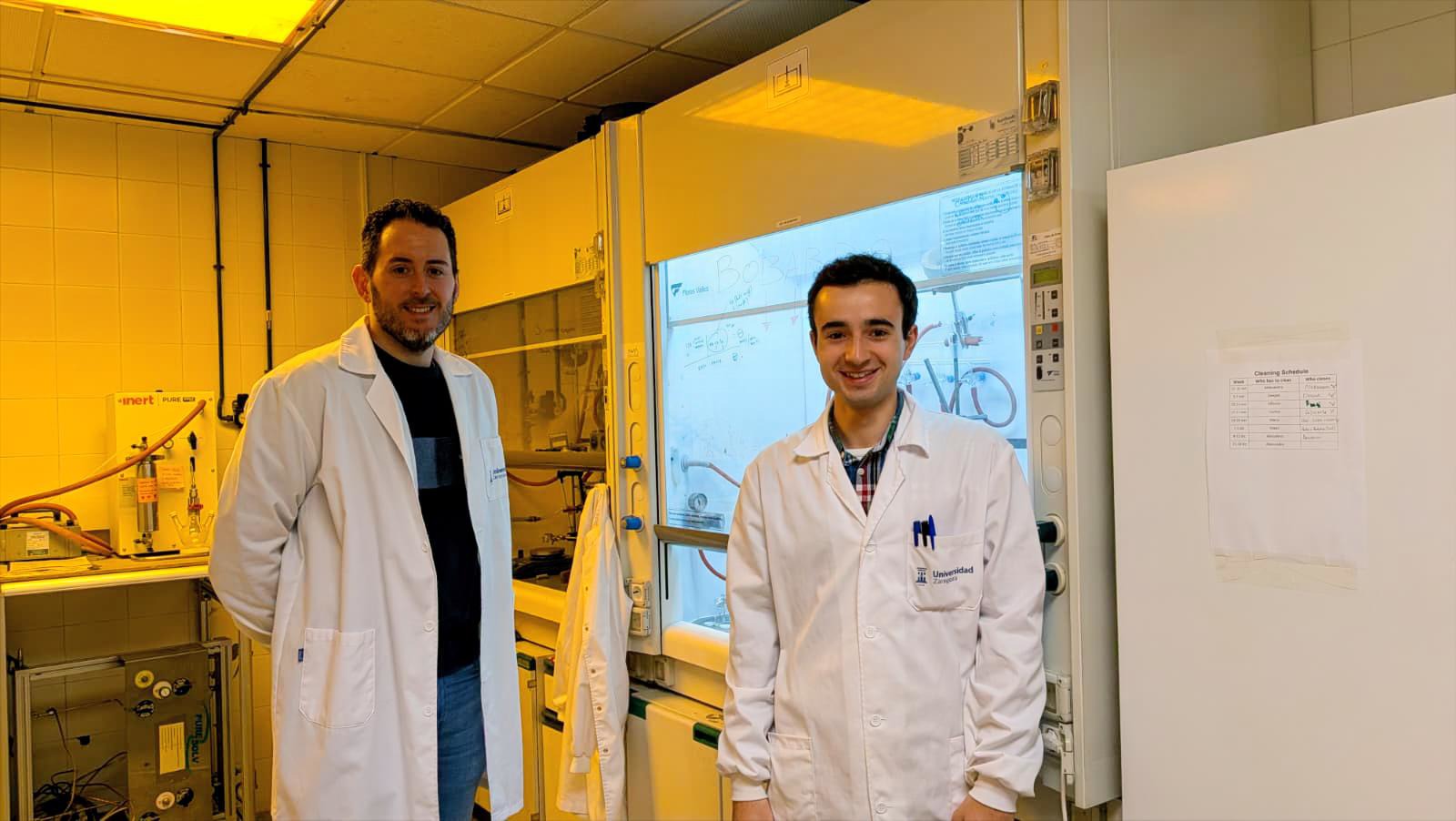
The study has been published in the prestigious Journal of the American Chemical Society, one of the highest-impact scientific journals in chemistry. The research was led by the ‘Ramón y Cajal’ researcher Alberto Concellón Allueva, with the participation of the pre-doctoral researcher Mauricio Vera Arévalo, both from the University of Zaragoza and members of the CLIP (Liquid Crystals and Polymers) group at INMA.
Foodborne diseases remain a major public health concern worldwide. Bacteria such as Salmonella and Listeria, commonly found in meat, poultry, fruit and vegetables, cause thousands of infections every year. Early detection is essential to prevent outbreaks, yet current methods are often slow, complex, and require several days of laboratory incubation.
The key to this new breakthrough lies in the detection system developed by the researchers, which is based on liquid crystals, materials that are extremely sensitive to changes at their interface with water. When liquid crystals come into contact with certain molecules or microorganisms, their internal organization changes. Until now, detecting these changes typically required specialized microscopes and expert operators, limiting practical use outside the laboratory.
However, the work published in the Journal of the American Chemical Society proposes an alternative: converting the changes in liquid crystal molecular order into fluorescent light signals that are directly quantifiable and therefore easy to measure. To achieve this, researchers from the CLIP group created microscopic liquid crystal droplets designed to specifically recognize a pathogen. When the bacterium is present, it alters the internal structure of the liquid crystal, causing the droplet to “switch on” or “switch off” its fluorescence, an effect that can be measured using compact, portable devices such as handheld spectrophotometers. Using this system, it is possible to detect bacteria such as Salmonella in approximately one hour with very high sensitivity, even when only a small number of cells are present.
This advance paves the way for rapid, portable, and user-friendly tests that could be deployed in food-processing plants, quality-control laboratories, and potentially even in domestic settings in the future. Furthermore, the technology is highly adaptable: by modifying the recognition element, it could be extended to detect other pathogens of health interest.
Severo Ochoa Centre of Excellence
The Aragon Nanoscience and Materials Institute (INMA) has been the first in our Autonomous Community to obtain Severo Ochoa accreditation of excellence, awarded by the State Research Agency. This recognition entails funding of 4.5 million euros and the awarding of five pre-doctoral contracts for the period 2024-2028.
The INMA is a joint institute of the CSIC and the University of Zaragoza. With around 300 members, it has more than 40 European projects underway and an annual average of 300 publications and €7 million obtained in competitive public programmes. It also works in collaboration with industry, earning around €1 million per year from contracts and royalties.
Scientific publication: “Fluorescence transduction of liquid crystal ordering transitions for biosensing”
DOI: doi.org/10.1021/jacs.5c16679
Mauricio Vera-Arévalo and Alberto Concellón
Journal of the American Chemical Society
12th Jan. 2026
Abstract:
Liquid crystal (LC) ordering transitions are exquisitely sensitive to molecular interactions at aqueous interfaces and have long served as the basis for optical biosensors. However, the readout of these transitions has almost exclusively relied on polarized-light optical microscopy, which limits quantification and hinders practical deployment. Here, we report a fluorescence-based transduction scheme that converts LC ordering transitions to quantitative optical outputs. Our strategy employs amphiphilic block copolymers bearing aggregation-induced emission (AIE) motifs that undergo dynamic covalent conjugation with IgG antibodies through reversible imine chemistry. In complex LC emulsions, polymer surfactants localize differently depending on droplet LC configuration: accumulation at monopolar defects concentrates AIE units to generate a bright ON state, whereas redistribution along the LC/water interface in the radial configuration suppresses emission to yield an OFF state. Recognition of Salmonella enterica serovar Typhimurium─one of the most prevalent foodborne pathogens─reversibly perturbs this equilibrium, producing rapid (∼1 h) ON/OFF fluorescence responses with detection limits down to 102 cells/mL. Incorporation of a ratiometric reference dye further enhances robustness against experimental variability. This work establishes the fluorescence transduction of LC ordering transitions as a generalizable and portable sensing paradigm, bridging soft matter design with real-world diagnostics.
20-01-2026