

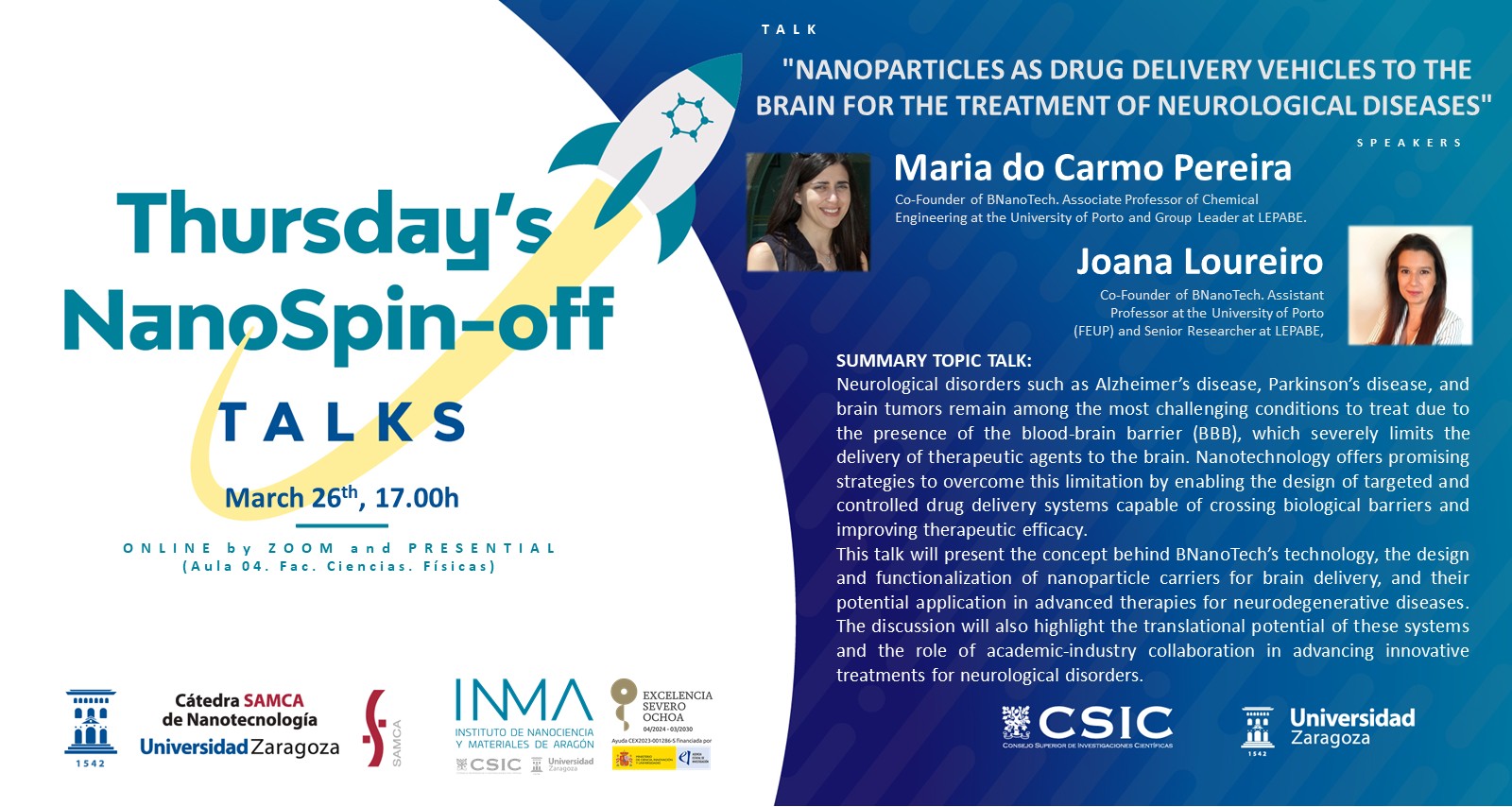
Thursday´s NanoSpin-off Talks: Maria do Carmo Pereira & Joana Loureiro, from BNanoTech
Thursday’s NanoSpin-off Talks
On 26 March at 5.00 pm, as part of the Cátedra SAMCA de Nanotecnología’s lecture series “Thursday’s NanoSpin-off Talks”, a talk entitled “Nanoparticles as drug delivery vehicles to the brain for the treatment of neurological diseases” will take place.
On this occasion, the session will take place in Lecture Theatre 04 of the Physics Building, Faculty of Sciences, San Francisco Campus, University of Zaragoza.
NO PRIOR REGISTRATION IS REQUIRED
It will also be streamed live via TEAMS:
“Thursday’s Nano Spin-off Talks” – BNanoTech | Reunión-Unirse | Microsoft Teams
The talk will be given by Maria do Carmo Pereira and Joana Loureiro, co-founders of the deep-tech start-up BNanoTech. BNanoTech was founded in February 2025 as a spin-off from the Laboratory for Process Engineering, Environment, Biotechnology and Energy (LEPABE), and its main objective is the development of controlled-release systems to deliver drugs to the brain. Its target market includes the pharmaceutical and biomedical industries interested in advanced therapies for neurodegenerative diseases, with potential for strategic partnerships and commercialisation at national and international level.
SUMMARY TOPIC TALK:
Neurological disorders such as Alzheimer’s disease, Parkinson’s disease, and brain tumors remain among the most challenging conditions to treat due to the presence of the blood-brain barrier (BBB), which severely limits the delivery of therapeutic agents to the brain. Nanotechnology offers promising strategies to overcome this limitation by enabling the design of targeted and controlled drug delivery systems capable of crossing biological barriers and improving therapeutic efficacy.
This talk will present the concept behind BNanoTech’s technology, the design and functionalization of nanoparticle carriers for brain delivery, and their potential application in advanced therapies for neurodegenerative diseases. The discussion will also highlight the translational potential of these systems and the role of academic-industry collaboration in advancing innovative treatments for neurological disorders.


