

INMA seminar: José F. Marco
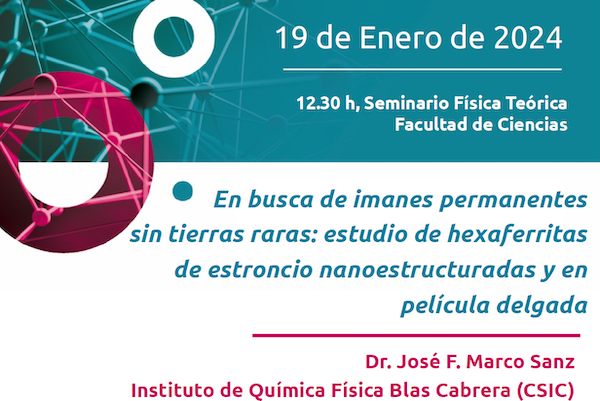
INMA Seminar: In search of permanent magnets without rare earths: study of strontium hexaferrites nanostructured and thin film
On Friday 19 January will be held a new INMA seminar, this time by Dr. José F. Marco Sanz, from the Institute of Physical Chemistry Blas Cabrera (CSIC), who will give the lecture entitled: In search of permanent magnets without rare earths: study of nanostructured strontium hexaferrites and thin film.
Summary of the talk:
Over the last hundred years, permanent magnets have played a fundamental role in the development of multiple fields of technological innovation. These materials have been used mainly for their application in motors and generators, as they allow the transformation of electrical energy into mechanical energy and vice versa. They are also key components in the manufacture of recording media, microwave, radio frequency and magneto-optical devices. Today, however, the best permanent magnets are composed of a considerable proportion of rare earths. Rare earths present two major problems: their extraction causes high environmental damage, and both extraction and separation are mainly controlled by China. To avoid these drawbacks, efforts are being made to develop new permanent magnets made of magnetically hard oxides that can replace rare earth magnets. In particular, strontium hexaferrite (SrFe12O19, SFO) is a highly attractive candidate for such a substitution. Since its discovery in the mid-20th century, this hexagonal ferrite has become a material of great commercial and technological importance, mainly due to its high magnetocrystalline anisotropy and low cost.
Recently, within the framework of the EU-funded AMPHIBIAN project, the research group of the Blas Cabrera Institute of Physical Chemistry has carried out considerable work on the characterisation of the structural and magnetic properties of nanostructured strontium hexaferrite samples fabricated by hydrothermal methods, as well as on the synthesis and characterisation of thin films of this material synthesised by magnetron sputtering. In order to improve the magnetic properties of hexaferrite for its application as a permanent magnet, particular attention has been paid to the possible coupling of hexaferrite (hard phase) with a metallic cobalt surface layer (soft phase) deposited by molecular beam epitaxy on the hexaferrite surface.
This seminar will discuss the characterisation work, which includes techniques such as Mössbauer spectroscopy, X-ray absorption spectroscopy, photoemission microscopy and vibrating sample magnetometry, among others. The calculations performed to reproduce the X-ray absorption spectra and the micromagnetism simulations carried out to understand the possible coupling between the strontium hexaferrite and the cobalt layer deposited on the surface will also be briefly discussed.
The conference will take place on Friday 19 January at 12:30 pm in the Theoretical Physics Seminar of the Science Faculty of the University of Zaragoza.


