

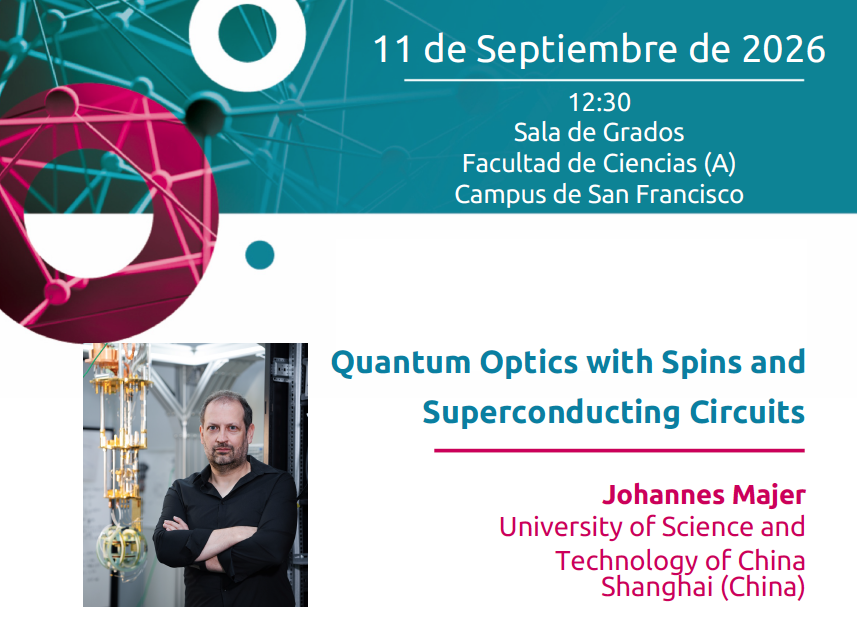
INMA seminar: Johannes Majer, from the University of Science and Technology of China (Shanghai)
The Aragon Nanoscience and Materials Institute (INMA) will host the next session of its seminar series on 11 September, featuring Johannes Majer, professor of quantum physics at the University of Science and Technology of China (Shanghai) and at the CAS Center for Excellence and Synergetic Innovation Center in Quantum Information and Quantum Physics. His talk, entitled “Quantum optics with spins and superconducting circuits”, will present his research on hybrid quantum systems.
Majer has an outstanding track record in the development of quantum technologies: at Yale University, he discovered and developed circuit cQED technology and the transmon qubit, now used by companies such as Google and IBM, as well as numerous start-ups, in their efforts to build superconducting quantum computers. He later pioneered the field of hybrid quantum devices at TU Wien by combining defects in diamond with superconducting circuits. In his current position in Shanghai, he continues to explore these devices, aiming to develop new technologies such as quantum memories, photon detectors and quantum transducers.
In his seminar, Majer will present results on hybrid quantum systems based on spin ensembles coupled to superconducting microwave cavities, a promising approach for both robust experiments in cavity quantum electrodynamics (QED) and future technologies employing quantum mechanical effects. He will explain how, using electron spins hosted by nitrogen-vacancy (NV) centres in diamond, his group has studied phenomena such as the cavity protection effect and hole burning, which extend coherence time and reduce dephasing, as well as superradiance and spin coupling over macroscopic distances.
He will also detail how, using a dispersive detection scheme based on cQED, his team has observed exceptionally long longitudinal relaxation times T1 — of up to 8 hours — in negatively charged NV centres, and how a theoretical model developed ab initio confirms that the low phononic density of states at the NV− transition frequency allows spin polarisation to survive over macroscopic timescales.
The session is open to everyone interested in quantum physics and hybrid systems.
📅 Friday, 11 September 2026 🕒 12:30 📍 Sala de Grados, Facultad de Ciencias (A), Campus de San Francisco


