

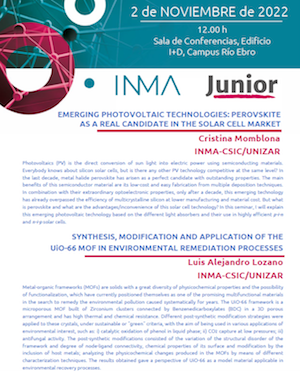
INMA Junior: Cristina Momblona & Luis Alejandro Lozano
On Wednesday 2 November at 12:00h we resume the INMA junior seminar sessions in the Conference Room, R & D Building (Campus Rio Ebro). After the seminar there will be a snack to which all attendees may attend.
INMA JUNIOR SEMINAR:
• Speaker 1: Cristina Momblona
• Title: Emerging photovoltaic technologies: perovskite as a real candidate in the solar cell market
Resumen de la charla: Photovoltaics (PV) is the direct conversion of sun light into electric power using semiconducting materials. Everybody knows about silicon solar cells, but is there any other PV technology competitive at the same level? In the last decade, metal halide perovskite has arisen as a perfect candidate with outstanding properties. The main benefits of this semiconductor material are its low-cost and easy fabrication from multiple deposition techniques. In combination with their extraordinary optoelectronic properties, only after a decade, this emerging technology has already overpassed the efficiency of multicrystalline silicon at lower manufacturing and material cost. But what is perovskite and what are the advantages/inconvenience of this solar cell technology? In this seminar, I will explain this emerging photovoltaic technology based on the different light absorbers and their use in highly efficient p-i-n and n-i-p solar cells.
• Speaker 2: Luis Alejandro Lozano
• Title: Synthesis, modification and application of the UiO-66 MOF in environmental remediation processes
Resumen de la charla: Metal-organic frameworks (MOFs) are solids with a great diversity of physicochemical properties and the possibility of functionalization, which have currently positioned themselves as one of the promising multifunctional materials in the search to remedy the environmental pollution caused systematically for years. The UiO-66 framework is a microporous MOF built of Zirconium clusters connected by Benzenedicarboxylates (BDC) in a 3D porous arrangement and has high thermal and chemical resistance. Different post-synthetic modification strategies were applied to these crystals, under sustainable or “green” criteria, with the aim of being used in various applications of environmental interest, such as: i) catalytic oxidation of phenol in liquid phase; ii) CO2 capture at low pressures; iii) antifungal activity. The post-synthetic modifications consisted of the variation of the structural disorder of the framework and degree of node-ligand connectivity, chemical properties of its surface and modification by the inclusion of host metals; analyzing the physicochemical changes produced in the MOFs by means of different characterization techniques. The results obtained gave a perspective of UiO-66 as a model material applicable in environmental recovery processes.
Date and time: Wednesday 2 November at 12:00h
Place: Sala de Conferencias, Edificio I+D, campus Río Ebro


