

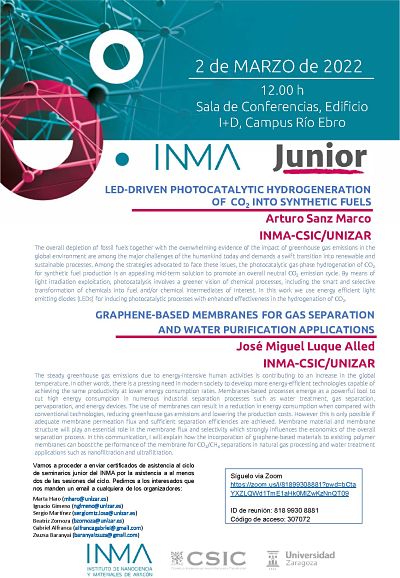
INMA Junior: Arturo Sanz & José M. Luque
INMA Junior: “LED-driven photocatalytic hydrogenation of CO2 into synthetic fuels” and “Graphene-based membranes for gas separation and water purification applications”
On Wednesday 2 March at 12:00 the third INMA junior seminar will take place in the Conference Room of the R & D Building, Campus Rio Ebro and can also be followed through Zoom. After the seminar there will be a snack to which all attendees may attend.
SEMINARIO JUNIOR INMA:
• Speaker 1: Arturo Sanz Marco
• Title: “LED-driven photocatalytic hydrogenation of CO2 into synthetic fuels”
Summary: The overall depletion of fossil fuels together with the overwhelming evidence of the impact of greenhouse gas emissions in the global environment are among the major challenges of the humankind today and demands a swift transition into renewable and sustainable processes. Among the strategies advocated to face these issues, the photocatalytic gas-phase hydrogenation of CO2 for synthetic fuel production is an appealing mid-term solution to promote an overall neutral CO2 emission cycle. By means of light irradiation exploitation, photocatalysis involves a greener vision of chemical processes, including the smart and selective transformation of chemicals into fuel and/or chemical intermediates of interest. In this work we use energy efficient light emitting diodes (LEDs) for inducing photocatalytic processes with enhanced effectiveness in the hydrogenation of CO2.
• Speaker 2: José Miguel Luque Alled
• Title “Graphene-based membranes for gas separation and water purification applications”
Summary: The steady greenhouse gas emissions due to energy-intensive human activities is contributing to an increase in the global temperature. In other words, there is a pressing need in modern society to develop more energy-efficient technologies capable of achieving the same productivity at lower energy consumption rates. Membranes-based processes emerge as a powerful tool to cut high energy consumption in numerous industrial separation processes such as water treatment, gas separation, pervaporation, and energy devices. The use of membranes can result in a reduction in energy consumption when compared with conventional technologies, reducing greenhouse gas emissions and lowering the production costs. However, this is only possible if adequate membrane permeation flux and sufficient separation efficiencies are achieved. Membrane material and membrane structure will play an essential role in the membrane flux and selectivity which strongly influences the economics of the overall separation process. In this communication, I will explain how the incorporation of graphene-based materials to existing polymer membranes can boost the performance of the membrane for CO2/CH4 separations in natural gas processing and water treatment applications such as nanofiltration and ultrafiltration.
Fecha y hora: Miércoles, 2 de marzo, a las 12:00 h.
Lugar: Sala de Conferencias, Edificio I+D, campus Río Ebro
Zoom platform: https://zoom.us/j/81899308881?pwd=bCtaYXZLQWd1TmE1aHk0MlZwKzNnQT09. Meeting ID: 818 9930 8881. Access code: 307072
We will be sending out certificates of attendance to the INMA Junior Seminar Series for attending at least two of the sessions of the series. Interested parties are kindly requested to send an email to any of the organisers: Marta Haro, Ignacio Gimeno, Sergio Martínez, Beatriz Zornoza, Gabriel Alfranca, Zsuzsa Baranyai.


