A historic breakthrough in chemistry has been achieved by combining fluorine with gold to create a two-dimensional material
A CSIC scientist at INMA (CSIC-UNIZAR) has contributed to a major international breakthrough demonstrating, for the first time, that fluorine can indeed form stable networks with metals
This new 2D material paves the way for the next generation of molecular electronics. The findings have been published in the prestigious journal CHEM, one of the leading international publications in the field of chemistry
Zaragoza, 7 April 2026. Fluorine can indeed form stable networks by bonding with metals. This discovery, which challenges basic principles of chemistry that have been established for decades and paves the way for the design of new ‘super’ materials, has just been revealed by an international team of researchers from Spain, Argentina, Japan and Sweden. This group has managed to break a historic barrier in materials chemistry by manufacturing, for the first time, a two-dimensional metal-organic material using fluorine atoms as bonding elements with a metal. The discovery was led in part by Jorge Lobo, a researcher at the Spanish National Research Council (CSIC) at the Aragon Nanoscience and Materials Institute (INMA), a joint institute of the CSIC and the University of Zaragoza, and has been published in the scientific journal CHEM (one of the most prestigious in the field of chemistry).
This breakthrough is crucial because it represents a paradigm shift in the design of advanced materials and opens up new possibilities in the field of molecular electronics and technologies.
This breakthrough is crucial because it represents a paradigm shift in the design of advanced materials and opens up new possibilities in the field of molecular electronics and emerging technologies. Until now, halogen-containing materials – such as fluorine – were ruled out as components in metal-organic frameworks (known as MOFs) given their limited ability to bind to metals. Fluorine had always been considered a poor choice due to its extreme electronegativity, as it could only coordinate within molecular-level structures, making its bonding with metals unfeasible for forming composite materials.
This limitation had held back the development of new materials based on fluorinated molecules for decades, but this new study demonstrates that, under the right conditions and in contact with metal surfaces, fluorine can indeed act as a stable and effective ligand—that is, as a solid connecting element in the material’s architecture.
This breakthrough therefore reveals that a ‘building block’ that nobody was using is not only functional but also opens the door to the discovery of new 2D materials.
The fact is that two-dimensional materials (such as graphene) are strategic because, being made up of a single layer of atoms, they possess unique electronic properties that could revolutionise the electronics of the future. These 2D materials are considered strategic because they have the potential to make a significant impact on energy (batteries and catalysts); electronics; telecommunications; biomedical sensors; and quantum technologies.
Bowl-shaped molecules and a ‘wavy’ lattice
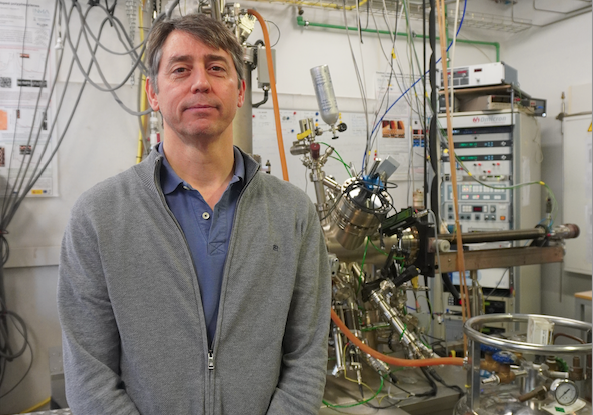
To achieve this, the researchers used special molecules called fluorinated subphthalocyanines, which have a curved shape similar to a bowl or an inverted umbrella with a short handle. These concave molecules were deposited onto a gold surface and gently heated to promote their reorganisation. The result was surprising: the system self-assembled (organised itself spontaneously) to form an ordered two-dimensional network in which six fluorine atoms coordinate with a gold atom. The final structure exhibits a slight undulation due to the natural curvature of the molecules. All this experimental evidence was obtained using the scanning tunnelling microscopy equipment at the Advanced Microscopy Laboratory (LMA) at the University of Zaragoza.
One of the most striking aspects of the discovery is that, despite not being completely flat, the lattice maintains continuous electronic delocalisation. This means that electrons can move through the material with ease, an essential property for applications in nanoscale electronic devices.
Atomic-resolution microscopy techniques and theoretical calculations confirmed both the undulating structure and its electronic properties.
Curvature as a new design tool
Beyond the technical breakthrough, the study introduces an innovative idea: molecular curvature can be used strategically to control chemical reactivity, the final structure of the material and its electronic properties.
Rather than being an obstacle, the three-dimensional shape of the molecules thus becomes a design tool. This approach could in the future enable the creation of new functional materials using chemical elements that have hitherto been little explored.
This discovery not only expands the catalogue of available two-dimensional materials, but also opens the door to exploring chemical elements rarely used in this field, with new possibilities for the creation of functional materials of the future.
Severo Ochoa Centre of Excellence
The Aragon Nanoscience and Materials Institute (INMA)has become the first organisation in our autonomous community to obtain Severo Ochoa accreditation for excellence, awarded by the State Research Agency. This recognition comes with funding of €4.5 million and the provision of five pre-doctoral research fellowships for the period 2024–2028. These are in addition to the ten already awarded in the previous call for applications, when INMA narrowly missed out on achieving accreditation.
INMA is a joint institute, created three years ago through the merger of two research centres from the CSIC and the University of Zaragoza, specifically with the aim of securing this distinction of excellence. With around 300 members, it has more than 40 ongoing European projects and an annual average of 300 publications, as well as €7 million secured from competitive public funding schemes. Furthermore, it works in collaboration with industry, generating around €1 million annually from contracts and royalties.
The publication can be viewed here:
Fabrication of corrugated halogen 2D metal-organic frameworks by means of F···Au coordination
DOI: 10.1016/j.chempr.2026.102967
Jorge Labella, Adriana E. Candia, Jonas Björk, Tomás Torres, Jorge Lobo-Checa
07-04-2026