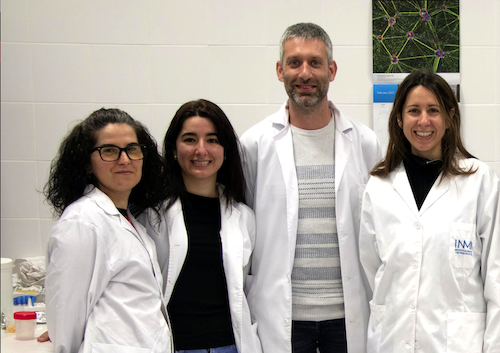
Researchers at the Aragon Nanoscience and Materials Institute (INMA, CSIC–UNIZAR) have just published their findings in the prestigious scientific journal *Advanced Functional Materials*
The discovery, validated so far in in vitro models, represents a significant advance in magnetogenetics and could facilitate less invasive treatments for movement disorders or vascular diseases in the future
Zaragoza, 17 March 2026. A team from the Aragon Nanoscience and Materials Institute (INMA), a joint institute of the Spanish National Research Council (CSIC) and the University of Zaragoza (Unizar), has developed MagPiezo, a new strategy that enables cells to be activated remotely using magnets and magnetic nanoparticles without first modifying their genetic material. Until now, this type of remote activation had only been achieved by genetically modifying cells to express proteins to which magnetic nanoparticles could be selectively attached. This step, which is costly and can hinder the translation of this technology into clinical practice, was considered essential for artificially introducing a receptor and thus ensuring selective activation.
This new study demonstrates that it is possible to achieve the same specificity by anchoring the nanoparticles directly to the cell’s natural receptors, without the need to first modify its DNA in order to introduce them artificially. This approach represents a significant advance in the field of magnetogenetics and opens up new avenues for the controlled modulation of complex biological processes, with potential future applications in movement disorders, vascular diseases and heart attacks, amongst others. For the time being, the finding has been validated in in vitro cell models, so it will be necessary to move on to the next phases of research to assess its potential for clinical translation. The study has been published in the prestigious journal Advanced Functional Materials.
What is magnetogenetics?
Magnetogenetics is a technique that uses magnetic fields and magnetic nanoparticles – particles thousands of times smaller than the thickness of a hair – anchored to specific cellular receptors, known as mechanoreceptors. These receptors, generally proteins present in the cell membrane, are capable of detecting and responding to mechanical forces, such as pressure and tension. Naturally, our cells are able to detect stimuli as diverse as pressure or stretching through these receptors, which is key in processes such as hearing, touch or the regulation of blood pressure.
When an external magnetic field is applied, these nanoparticles act like tiny metal shavings that are drawn to a magnet, generating a small force. This force ‘pulls’ on the receptor to which the nanoparticles are attached within the cell and can activate it, as if the cell had received a natural mechanical signal. Most importantly, these receptors are activated without direct physical contact, and from outside the cell, solely when the magnetic field is applied, allowing for remote and temporally controlled activation.
In previous studies, this technique has been used mainly in the brains of animal models to stimulate neurons involved in movement or behaviour, causing mice to move or, for example, eat at will only when magnetic fields are applied.
The breakthrough: remotely activating natural receptors without altering the cell
To achieve this selective activation, the team has carefully optimised the ‘decoration’ or functionalisation of the magnetic nanoparticles, coating them with antibodies oriented in a controlled manner. In this way, the particles directly recognise the cell’s natural Piezo1 receptor and bind to it with high precision. Another distinctive feature of the work is the development of a magnetic device coupled to a microscope, which allowed the researchers to observe in real time how magnetic stimulation activated the receptor and triggered the expected cellular responses, equivalent to those that occur naturally in response to mechanical stimuli.
What applications might this have?
Although the work has so far been carried out on in vitro cell models, it opens the door to a range of future applications. These include studying with great precision how cells respond to mechanical forces, developing new strategies to promote blood vessel remodelling, and exploring potential applications in cardiovascular diseases, such as heart attacks, where stimulating the formation of new blood vessels could be beneficial.
In short, the study places INMA at the forefront of magnetogenetics and demonstrates how the combination of nanotechnology, biology and physics can generate innovative tools to better understand cellular processes and, in the long term, contribute to the development of more precise and less invasive strategies for treating diseases.
Severo Ochoa Centre of Excellence
The Institute of Nanoscience and Materials of Aragon (INMA) is the first in our Autonomous Community to obtain Severo Ochoa accreditation for excellence, awarded by the State Research Agency. This recognition entails funding of 4.5 million euros and the provision of five pre-doctoral contracts for the period 2024–2028.
NMA is a joint institute of the CSIC and the University of Zaragoza. With around 300 staff members, it has more than 40 ongoing European projects and an annual average of 300 publications, as well as securing €7 million in funding from competitive public programmes. It also works in collaboration with industry, generating around €1 million annually through contracts and royalties.
Scientific publication: “MagPiezo: A magnetogenetic platform for remote activation of endogenous Piezo1 channels in endothelial cells”
Susel del Sol-Fernández, Mariarosaria De Simone, Yilian Fernández-Afonso, Daniel García-González, Pablo Martínez-Vicente, Thomas van Zanten, Raluca M. Fratila, María Moros
First published: 01 January 2026
DOI: https://doi.org/10.1002/adfm.202529076
17-03-2026