

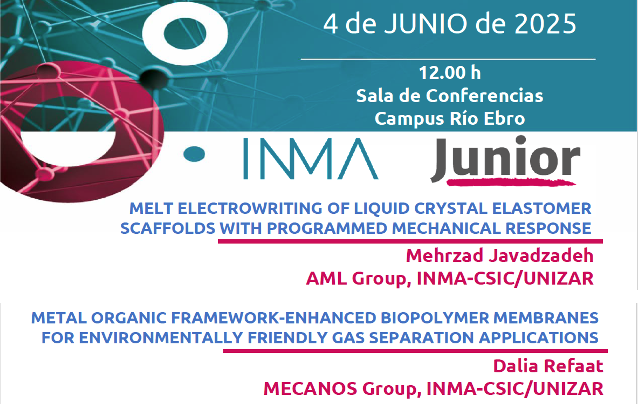
INMA Junior: Mehrzad Javadzadeh & Dalia Refaat
Next Wednesday 4 June, at 12:00, will take place the last INMA Junior Seminar 2025.
Venue: Conference Room – R+D+i Building (Río Ebro Campus).
Speaker 1: Mehrzad Javadzadeh (AML Group, INMA-CSIC/UNIZAR)
Title: Melt electrowriting of liquid crystal elastomer scaffolds with programmed mechanical response
Summary: Recent advances in extrusion-based additive manufacturing have enabled precise control of the mechanical response in Liquid Crystal Elastomers (LCEs). Nevertheless, substantial challenges remain, particularly in producing well-defined scaffolds composed of ultrafine fibers. Melt Electrowriting (MEW) of reactive liquid crystalline inks offers a novel approach, generating digitally positioned, uniform LCE fibers with diameters ranging from hundreds of nanometers to tens of micrometers. This dimension is difficult to achieve using traditional extrusion methods. The MEW process aligns mesogens preferentially along the fiber axis, and this digitally defined alignment directly governs the mechanical response of the crosslinked elastomer upon stimulation. This technique enables the fabrication of precisely structured square-lattice scaffolds with periods as small as 90 µm and ultrafine fiber diameters, achieving exceptional structural accuracy. Additionally, controlled fiber stacking (up to 50 layers) coupled with inter-layer fiber fusion results in unprecedented microstructures characterized by high-aspect-ratio LCE walls. The digital precision of MEW thus enables the fabrication of complex fiber-based scaffolds capable of programmed, reversible shape transformations, opening up promising applications in miniaturized actuators and intelligent structures for soft robotics and biomedical technologies.
Speaker 2: Dalia Refaat
Title: Metal organic framework-enhanced biopolymer membranes for environmentally friendly gas separation applications
Summary: The development of efficient, sustainable gas separation technologies is critical for addressing global energy and environmental challenges. Membrane-based separation has gained significant attention as a cost-effective and energy-efficient alternative to conventional methods such as cryogenic distillation and adsorption. Within this context, biopolymer-based membranes represent a promising class of materials due to their inherent biodegradability, renewability, and low environmental footprint. However, the practical application of pristine biopolymer membranes is often hindered by their limited gas permeability and selectivity. To overcome these limitations, the integration of metal-organic frameworks (MOFs) into biopolymer matrices has emerged as a powerful strategy. MOFs offer high surface areas, tunable pore sizes, and functionalizable frameworks, making them ideal candidates for enhancing the separation performance of polymer membranes. The resulting mixed-matrix membranes (MMMs) exhibit improved gas transport properties, combining the environmental advantages of biopolymers with the molecular sieving and adsorption capabilities of MOFs.
This work highlights recent advances in the design and fabrication of MOF-incorporated biopolymer membranes for gas separation, with particular emphasis on CO2-selective systems such as CO2/CH4 and CO2/N2. Key aspects such as polymer–filler compatibility, interfacial engineering, and the role of functionalized MOFs in promoting selective CO₂ sorption and diffusion are discussed. Special attention is given to sustainable membrane fabrication methods and the use of green solvents. These advancements underscore the potential of biopolymer/MOF hybrid membranes as a viable, environmentally friendly solution for high-performance gas separation applications.


