

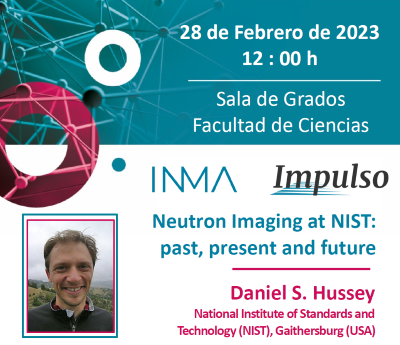
INMA Impulso: David S. Hussey
INMA – Impulse Seminar: Neutron Imaging at NIST: past, present and future
Next Tuesday 28 February will be a new session of the INMA-Impulse lecture series, a series of conferences that seeks to bring the most cutting-edge research to society.
The next session entitled: “Neutron Imaging at NIST: past, present and future” , will be given by Daniel S. Hussey of the National Institute of Standards and Technology (NIST), Gaithersburg (USA).
Summary:
Neutrons provide a unique world-view, since their interaction with matter is very different from most other probes used in materials science. In particular, many common metals (aluminum, steel) are essentially transparent to neutrons while many light elements, like hydrogen, strongly attenuate neutrons. This property led to the establishment of the NIST neutron imaging program in 2001 that initially focused on water transport in proton exchange membrane fuel cells, leading to over 40 patents for General Motors. Since that time, NIST, and the global neutron imaging community, have continued to develop neutron imaging methods. This includes advances in neutron detector spatial resolution, incorporating simultaneous X-ray imaging or NeXT, and novel sources of image contrast including Bragg- edge imaging and dark field imaging. In Bragg-edge imaging, one is able to measure the distribution of certain phases of a given crystalline material, or, with sufficient wavelength resolution the strain in a direction parallel to the beam. In dark field imaging, one obtains three-dimensional multi-scale images, where in each volume element one measures the average pair correlation function over a length scale range of 1 nm to 10 micrometers. Neutron imaging can still find improvements, especially improving the image acquisition time for high spatial resolution images (~1 micrometer). A first step towards this is the Wolter-optics based neutron microscope, which aims to convert X-ray telescopes (like those in CHANDRA) into neutron objective lenses.
The conference will take place on Tuesday 28 February at 12 noon in the Sala de Grados of the Faculty of Science of the University of Zaragoza.


