

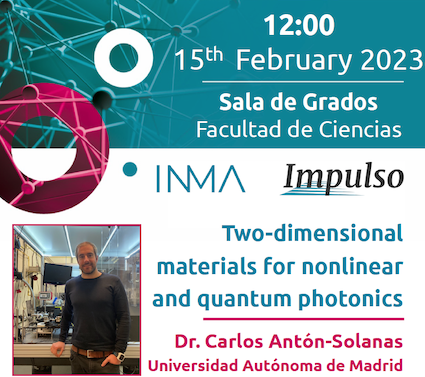
INMA Impulso: Carlos Antón-Solanas
Seminario INMA Impulso: Two-dimensional materials for nonlinear and quantum photonics – Carlos Antón-Solanas
On Wednesday 15 February a new session of the INMA Impulso conference series will take place, a series of conferences that aims to bring cutting-edge research closer to society. “Two-dimensional materials for nonlinear and quantum photonics” will be presented by Carlos Antón-Solanas from the Universidad Autónoma de Madrid.
Summary:
Atomically thin crystals of transition metal dichalcogenides (TMDCs) have emerged as a new platform to study tightly bound excitons and many-body excitations. Their giant dipole coupling to light makes them prime materials for nanophotonic and electronic devices, and for fundamental research on cavity quantum electrodynamics. TMDC excitons can emit at room temperature, and they offer unique, tailorable interactions based on van-der-Waals stacking of monolayers.
In the first part of this talk, I will discuss the formation of exciton-polaritons based on TMDC excitons. Different cavities and two-dimensional materials are explored in various experimental conditions (cold and room temperature) to reach strong coupling between excitons and confined photons. Exciton-polaritons are solid-state quasiparticles with properties linked to matter (Coulomb interactions, magnetic response) and light (extended spatial and temporal coherence). The bosonic character of exciton-polaritons enables their capability to condense into a macroscopic coherent state, like the laser emission, with additional features such as controllable nonlinear interactions.
In the second part, I will discuss another platform to generate single photons based on atomically thin WSe2 monolayers. The local strain in these monolayers produces a potential capable to trap single excitons and so produce single photon emission. These quantum dots can be easily coupled to Fabry-Pérot optical cavities, enhancing their performance towards competitive state-of-the-art single photon sources. First quantum communication testbed-applications with these emitters are being implemented, promising a “bright future” for these quantum photonic devices.
The conference will take place on Wednesday 15 February at 12.00 noon in the Sala de Grados, Facultad de Ciencias, Universidad de Zaragoza.


