

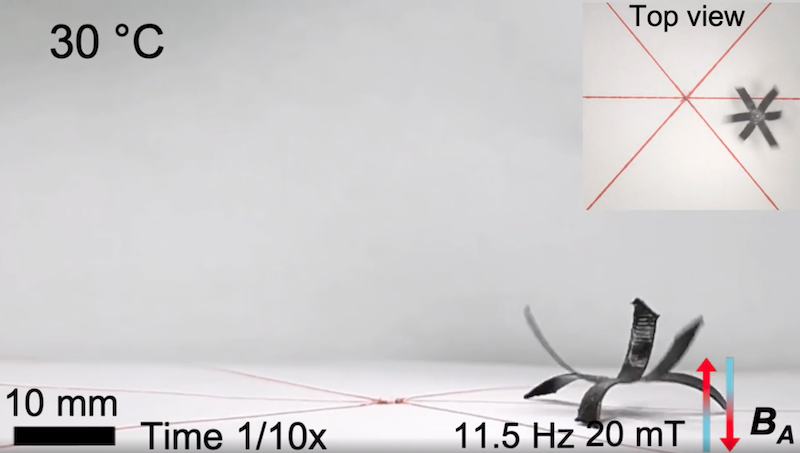
🤔 What if a 4D-printed material could create its own template for magnetic programming?
That is the idea 💡 behind our new work, “Programming of complex magnetic profiles enforced by 4D printed magnetic LCE actuators”, now published in Advanced Materials from Wiley – Advanced Portfolio.
In this work, we use the programmed thermomechanical deformation of 4D-printed magnetic liquid crystal elastomers (MLCEs) to encode complex, 3D magnetic profiles.
Instead of using complex magnetic field patterns, moulds or external mechanical templates, the 4D-printed actuator itself defines the shape in which it is magnetically programmed. Upon cooling, this translates into a spatially varying magnetic profile that allows complex shapes to be recovered at room temperature using for this low magnetic fields 🧲.
The approach enables bidirectional and multistate actuation and is used to create multimaterial soft robots capable of frequency-tunable linear locomotion and chirality-controlled clockwise or anticlockwise rotation. And we put the concept into motion as seen in the movie… 🕷️
Congratulations Erick Espíndola on another great paper! 👏 Great work and a very nice step forward in our research on 4D-printed functional materials and soft robotics. More to come!
This work is the result of a great collaboration between our Advanced Manufacturing Laboratory at INMA (CSIC-UNIZAR) (CSIC–Universidad de Zaragoza) and the group of Prof. Peer Fischer at the Max Planck Institute for Medical Research and Heidelberg University.
The research is part of the STORM-BOTS ITN project 🤖, which has received funding from the European Union’s Horizon 2020 (European Research Executive Agency (REA)) research and innovation programme under Grant Agreement No. 956150.
Programming of complex magnetic profiles enforced by 4D printed magnetic LCE actuators
Advanced Materials, 2026; 0:e00029; 20th Aug. 2026
Erick R. Espíndola-Pérez, Rahul Goyal, Lovish Gulati, María López-Valdeolivas, Peer Fischer, Carlos Sánchez-Somolinos
Abstract:
Magnetic soft actuators enable untethered, contact-free actuation yet they are fundamentally limited by the difficulty of programming complex, three-dimensional (3D), spatially non-uniform magnetic profiles. Here, we introduce a four-dimensional (4D) printing-enabled magnetic programming strategy that overcomes this challenge by magnetizing magnetically active liquid crystal elastomers (MLCEs) in thermally actuated target states. Digitally prescribed director architectures define deterministic 3D deformations at elevated temperature, which serve as intrinsic programming templates during magnetization under a spatially uniform magnetic field. Upon cooling, relaxation of the thermomechanical deformation transforms the initially uniform magnetization into a complex, spatially varying magnetic profile that encodes the target shape as a magnetically favoured configuration. This approach enables the recovery of thermally defined shapes at room temperature under low magnetic fields and allows bidirectional and multistate actuation via simple reversal of field direction. By integrating spatial magnetic programming with controlled geometric asymmetry, we demonstrate frequency-tunable linear locomotion and chirality-encoded clockwise or anticlockwise rotational motion in multimaterial soft robotic architectures. This strategy decouples magnetic profile complexity from magnetization hardware, providing a scalable, template-free route to fully 3D magnetic programming for soft robotics and untethered actuators operating under low-field conditions.
![Computational design of a photoactive [4]catenane with cyclo[48]carbon as an electron-accepting hub](https://inma.unizar-csic.es/wp-content/uploads/1787572709482.jpeg)


