

Isolda Duerto, Jesús Orduna, Belén Villacampa and María-Jesús Blesa have published Optimizing electron injection in D-A’-π-a dye sensitized solar cells: The role of electrolyte modification.
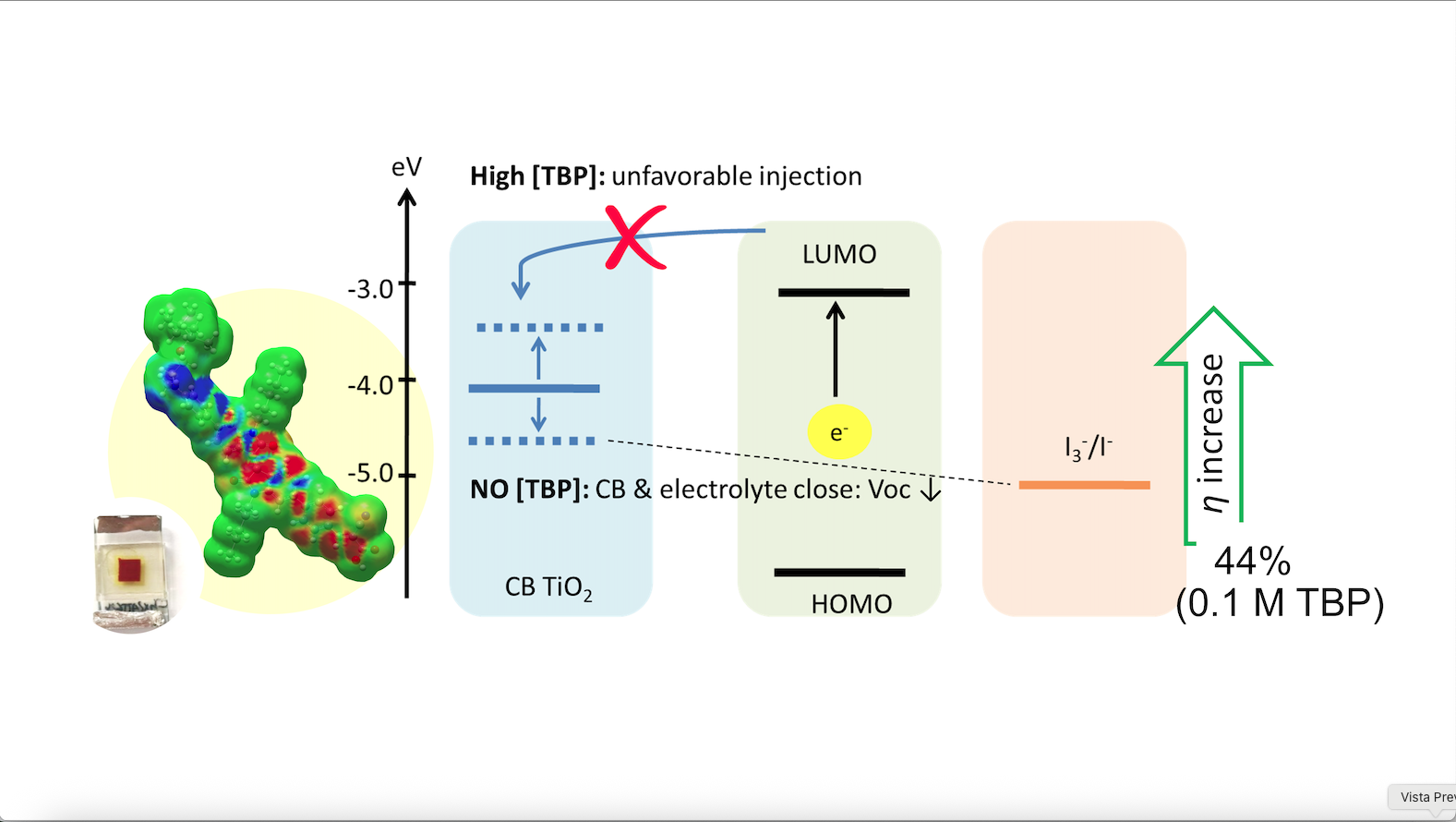
This study establishes a theoretical and technical pathway, based on electroanalytical methods, for an optimized design of DSSCs with balanced short-circuit current density (Jsc) and open-circuit voltage (Voc) parameters. To overcome this, the effect of the iodide/triiodide electrolyte composition on the electrochemical properties is explored.
This work can be found in Journal of Electroanalytical Chemistry 1001 (2026) 119686, a journal with a 22% acceptance rate.
Optimizing electron injection in D-A’-π-a dye sensitized solar cells: The role of electrolyte modification
Isolda Duerto, Jesús Orduna, Belén Villacampa, María-Jesús Blesa
DOI: 10.1016/j.jelechem.2025.119686
Journal of Electroanalytical Chemistry, Volume 1001, 15 January 2026, 119686
Abstract
This study establishes a theoretical and technical pathway, based on electroanalytical methods, for an optimized design of DSSCs with balanced short-circuit current density (Jsc) and open-circuit voltage parameters (Voc). In this paper, isoindigo (iI) and benzothiadiazole (BTZ) are included as auxiliary acceptors in A-iI-Ph-SIL and A-BTZ-Ph-SIL dyes, respectively. The strength of auxiliary acceptors greatly influences the thermodynamic parameters governing the electron transfer process, as well as the proper distribution of electron density in orbitals. Theoretical calculations reveal that the isoindigo unit, in A-iI-Ph-SIL, exhibits a strong acceptor character that hinders charge transfer from the donor to the primary acceptor. However, in the A-BTZ-Ph-SIL, the moderate acceptor character of the benzothiadiazole unit allows charge movement across the molecule. Voltammetric analyses indicate that, in A-iI-Ph-SIL, the electron injection into the semiconductor is compromised because its excited state energy level is too close to the TiO2 conduction band edge. This fact limits the necessary driving force for efficient injection process. To overcome this, the influence of the iodide/triiodide electrolyte composition on the electrochemical properties is explored. A concentration of 0.1 M tert-butylpyridine yields the optimal efficiency in these devices. This particular concentration strikes the right balance between Jsc and Voc. Notably, this optimized concentration led to a significant 44 % improvement in DSSC efficiency compared to the conventional 0.5 M tert-butylpyridine concentration, achieving a maximum efficiency of 4.79 %. Electrochemical Impedance Spectroscopy indicates that better conversion efficiencies of the devices are linked to a high charge transfer resistance at the TiO₂/solvent interface.


