

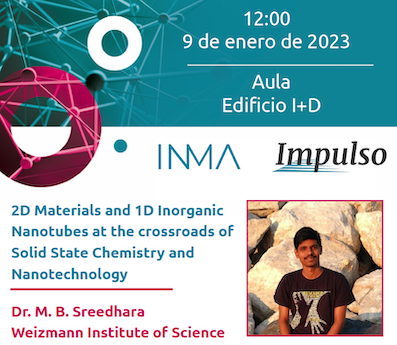
INMA Impulso: M. B. Sreedhara
Para arrancar los seminarios del INMA del 2023, nos acompañará el Dr. M. B. Sreedhara, del Weizmann Institute of Science (Israel), que presentará el seminario: “2D Materials and 1D Inorganic Nanotubes at the Crossroads of Solid State Chemistry and Nanotechnology».
Este seminario tendrá lugar el lunes 9 enero a las 12:00 en la Aula del Edificio I+D+i.
Resumen:
2D Materials and 1D Inorganic Nanotubes at the crossroads of Solid State Chemistry and Nanotechnology
My talk will be focused on inorganic nanotubes especially the nanotubes from misfit layered compounds (MLCs) which are newbies in this emerging field. I will explain what drives 2D layered materials to roll and form 1D nanotubes or fullerenes with a historical perspective. 1D analogues of 2D materials, especially nanotubes exhibit unique properties, which are distinct from the 2D flakes. The reduced dimensionality, strong interactions, and topological effects lead to new emergent degrees of freedom of fundamental interest and promise for future applications in catalysis, lubrication, energy conversion and quantum technologies. The growth of such nanostructures and designing them (shape, size and chirality) for a specific application requires expertise in solid-state chemistry and the use of various growth and characterization techniques. I will discuss in detail the growth of MLC nanotubes particularly LnX-TaX2 (Ln= rare earth, X= S/Se), imaging and mapping them atom by atom, tuning charge transfer (CT) characteristics and the influence of CT on superconductivity and charge density waves (CDW). I will show a family of asymmetric MLC superstructures obtained by serendipity, where chemical affinity outwits the entropy at a high-temperature solid-state reaction. These asymmetric chiral nanotubes with a lack of inversion and time reversal symmetries possess very large local dipole moments and could exhibit various intriguing physical observations. I will also briefly show how we tweaked the reaction conditions to grow WSSe nanotubes and their tunable strong light-matter interaction forming exciton-polariton quasiparticles and explain the significance of this unique optical behavior.
References
1. Sreedhara et. al., Asymmetric misfit nanotubes: Chemical affinity outwits the entropy at high-temperature solid-state reactions”. PNAS-USA, 2021 Vol. 118 No. 35 e2109945118.
2. Sreedhara et. al., Nanotubes from Ternary WS2(1-x)Se2x Alloys: Stoichiometry Modulated Tunable Optical Properties J. Am. Chem. Soc., 2022, 144, 23, 10530–10542.


