

INMA Impulso: Alberto Concellón y Gabriel Alfranca
Seminario INMA Junior: Alberto Concellón y Gabriel Alfranca – 1 de marzo
El próximo miércoles 1 de marzo a las 12:00, en el Aula del Edificio I+D, Campus Rio Ebro, tendrá lugar el próximo Seminario Junior del INMA. Tras el seminario tendrá lugar un picoteo en la Sala de multiusos al que todos los asistentes podrán acudir.
SEMINARIO JUNIOR INMA:
Fecha y hora: Miércoles 1 de marzo a las 12:00 h
Lugar: Aula, Edificio I+D, Campus Río Ebro
Ponente 1: Alberto Concellón
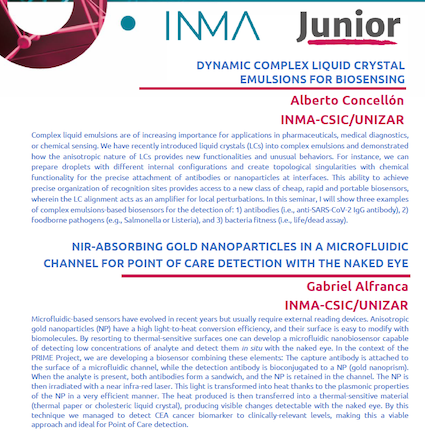
Título: DYNAMIC COMPLEX LIQUID CRYSTAL EMULSIONS FOR BIOSENSING
Resumen de la charla:
Complex liquid emulsions are of increasing importance for applications in pharmaceuticals, medical diagnostics, or chemical sensing. We have recently introduced liquid crystals (LCs) into complex emulsions and demonstrated how the anisotropic nature of LCs provides new functionalities and unusual behaviors. For instance, we can prepare droplets with different internal configurations and create topological singularities with chemical functionality for the precise attachment of antibodies or nanoparticles at interfaces. This ability to achieve precise organization of recognition sites provides access to a new class of cheap, rapid and portable biosensors, wherein the LC alignment acts as an amplifier for local perturbations. In this seminar, I will show three examples of complex emulsions-based biosensors for the detection of: 1) antibodies (i.e., anti-SARS-CoV-2 IgG antibody), 2) foodborne pathogens (e.g., Salmonella or Listeria), and 3) bacteria fitness (i.e., life/dead assay).
Ponente 2: Gabriel Alfranca
Título: NIR-ABSORBING GOLD NANOPARTICLES IN A MICROFLUIDIC CHANNEL FOR POINT OF CARE DETECTION WITH THE NAKED EYE
Resumen de la charla:Microfluidic-based sensors have evolved in recent years but usually require external reading devices. Anisotropic gold nanoparticles (NP) have a high light-to-heat conversion efficiency, and their surface is easy to modify with biomolecules. By resorting to thermal-sensitive surfaces one can develop a microfluidic nanobiosensor capable of detecting low concentrations of analyte and detect them insitu with the naked eye. In the context of the PRIME Project, we are developing a biosensor combining these elements: The capture antibody is attached to the surface of a microfluidic channel, while the detection antibody is bioconjugated to a NP (gold nanoprism). When the analyte is present, both antibodies form a sandwich, and the NP is retained in the channel. The NP is then irradiated with a near infra-red laser. This light is transformed into heat thanks to the plasmonic properties of the NP in a very efficient manner. The heat produced is then transferred into a thermal-sensitive material (thermal paper or cholesteric liquid crystal), producing visible changes detectable with the naked eye. By this technique we managed to detect CEA cancer biomarker to clinically-relevant levels, making this a viable approach and ideal for Point of Care detection.
Vamos a proceder a enviar certificados de asistencia al ciclo de Seminarios Junior del INMA por la asistencia a al menos dos de las sesiones del ciclo. Pedimos a los interesados que nos manden un email a cualquiera de los organizadores:
Beatriz Zornoza (bzornoza@unizar.es)
Gabriel Alfranca (alfrancagabriel@gmail.com)
Zsuzsa Baranyai (zsuzsabaranyai@unizar.es)
Cristina Momblona (cristinamomblona@unizar.es)
Marta Haro (mharo@unizar.es)
Alberto Concellón (aconcellon@unizar.es)
Jorge Pérez (jorgepb@unizar.es)


