3-component (N, Fe, Co) atomically dispersed ORR catalysts prepared by laser-driven decomposition of organic precursors
Ekaterina Pakrieva*, Javier Hernández-Ferrer, Gema Martinez, Francisco Balas, Enrique García-Bordeje, Alejandro Ansón-Casaos, Laura Simonelli, Fernando Bartolomé, Ana M. Benito, Wolfgang K. Maser, José L. Hueso*, Jesús Santamaría*
Chemical Engineering Journal, Volume 526, 2025, 171198,
https://doi.org/10.1016/j.cej.2025.171198.
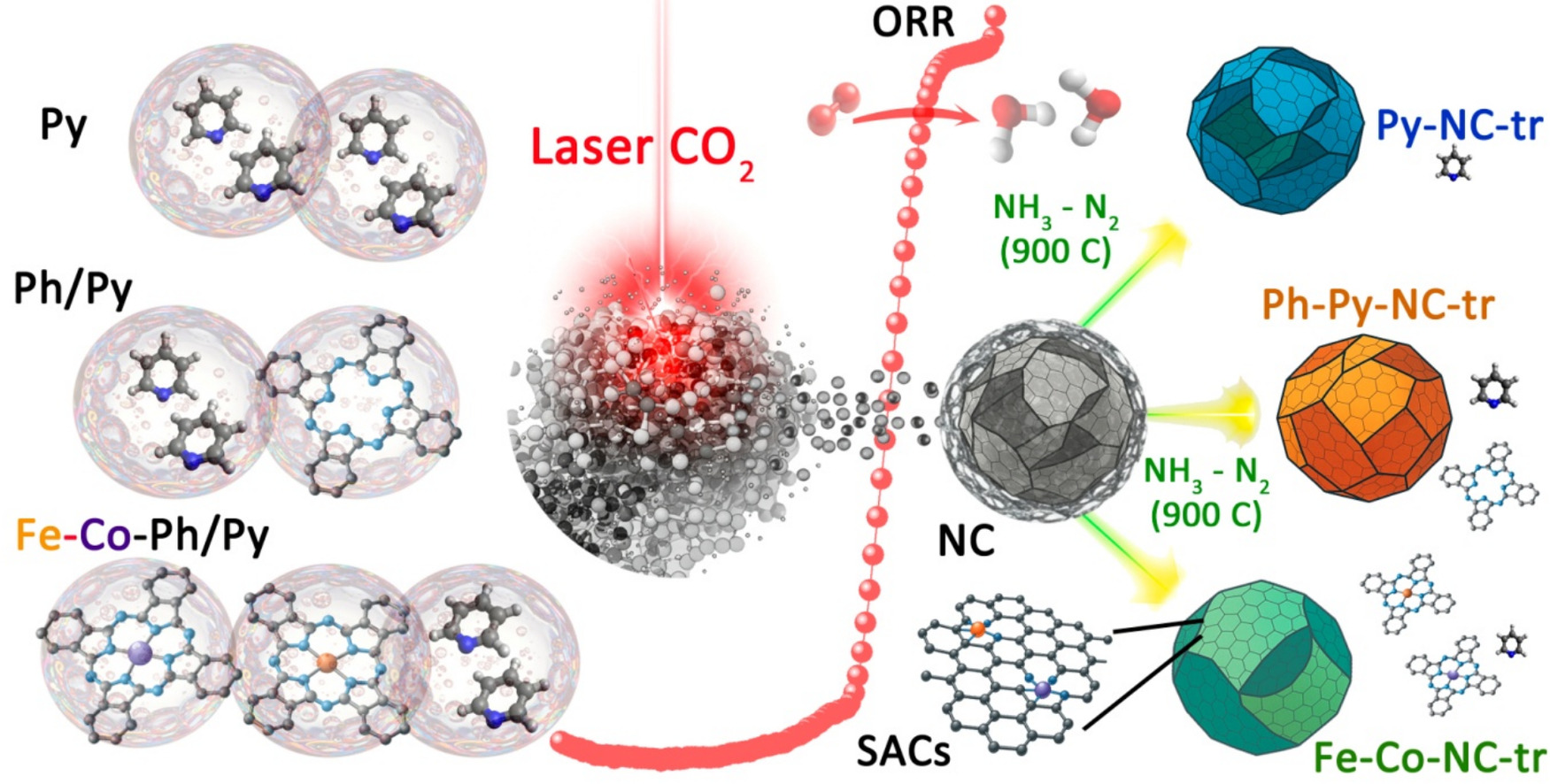
Abstract: The sluggish kinetics of the oxygen reduction reaction (ORR) remain a key bottleneck for the commercialization of proton exchange membrane fuel cells (PEMFCs), driving the search for efficient, non-precious metal catalysts. Herein, we present a laser-assisted pyrolysis strategy for the synthesis of nitrogen-doped carbon (NC) materials, both metal-free and containing atomically dispersed Fe and Co, using aerosolized phthalocyanine precursors and a near-instantaneous rapid decomposition under a high-energy laser beam, while preventing metal aggregation. A single-step post-synthetic thermal activation under an NH₃/N₂ atmosphere further tailors the textural and surface properties, without requiring ammonia co-feeding during laser pyrolysis, acid etching, or multiple treatments, marking a significant improvement over our previously reported single atom (Fe-N/C) protocols. The resulting Fe_Co/NC_tr catalyst exhibits high specific surface area, enhanced microporosity, improved graphitization, and increased abundance of electrochemically beneficial nitrogen sites. Compared to our earlier reported Fe–N/C catalysts, Fe_Co/NC_tr delivers significantly higher limiting current densities and enhanced durability in alkaline media. Overall, the developed Fe_Co/NC catalyst exhibits good ORR catalytic activity and outstanding long-term stability in alkaline media, comparable to the state-of-the-art commercial Pt/C catalysts. Cyanide poisoning tests confirm the essential role of atomically dispersed Fe2+ and Co2+ as active ORR sites.